
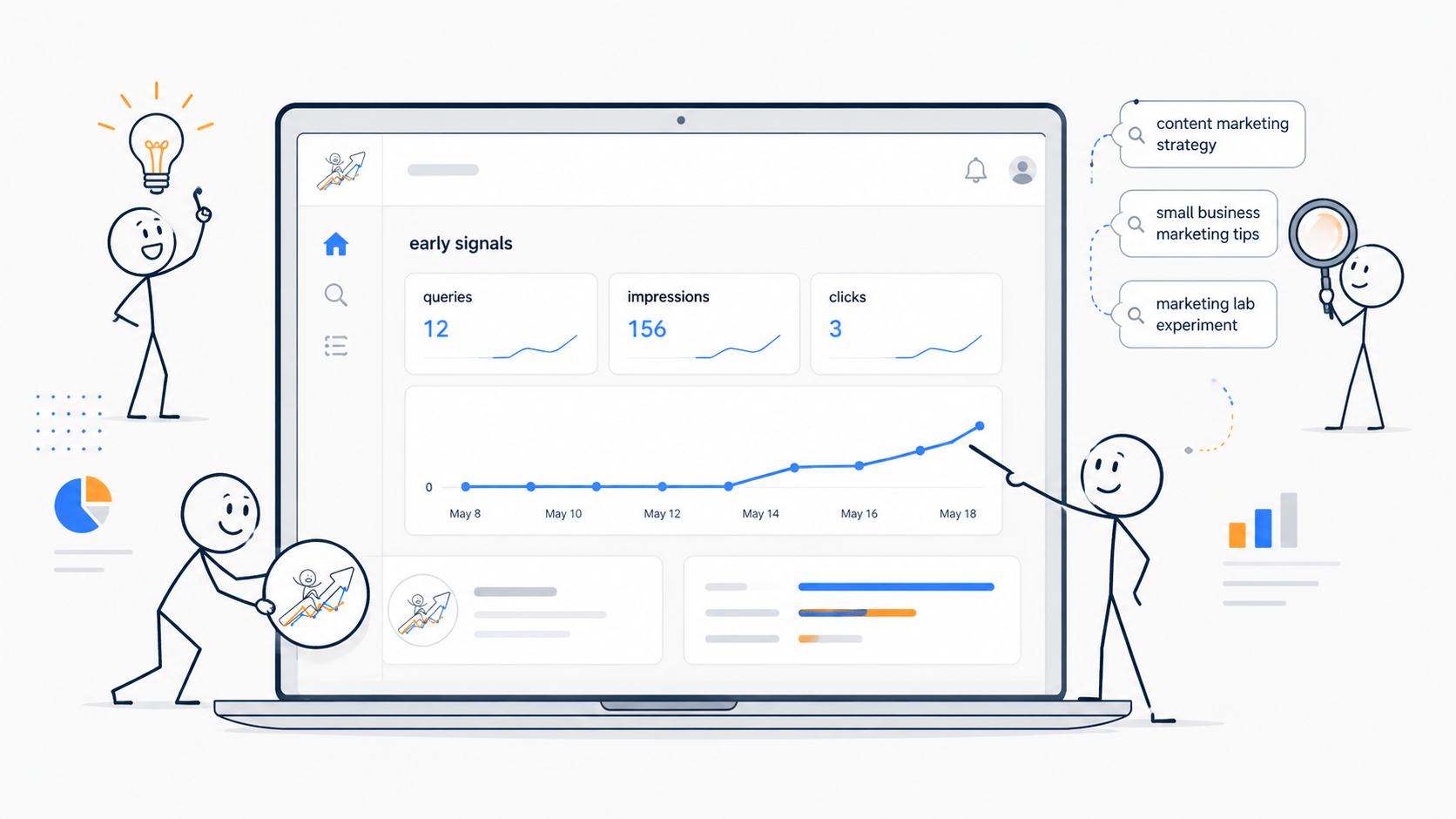
There is a specific moment in every early-stage SEO project that feels small from the outside but important from the inside.
You publish the first articles.
You wait.
You check whether Google indexed them.
Then, at some point, Google Search Console starts showing impressions.
Not traffic.
Not conversions.
Not rankings you can brag about.
Just impressions.
A few queries. A few positions. Maybe one or two clicks. Some pages appearing in places you did not fully expect yet.
For many business owners, this stage feels confusing. For marketers, it can feel tempting. You finally have data, so the instinct is to start changing things immediately.
But this is exactly where I try to slow down.
When the first articles start getting impressions, the website is not “winning” yet. But it is no longer invisible either. That difference matters.
This article is a live-style observation from the early stage of Web Idea US – Marketing Lab. The site is still building its first content base, but the first articles are already entering search visibility. That means Google is not only indexing the content. It is starting to test where the content might belong.
And that is where the real learning begins.
What I Wanted to Observe
The main question behind this experiment is simple:
What happens when the first articles on a new or rebuilt content project start getting impressions in Google Search Console?
More specifically, I wanted to understand:
- whether Google would index the first articles quickly
- whether impressions would appear before a larger content base existed
- what types of queries would trigger visibility
- whether early impressions would match the intended article topics
- whether clicks would appear before deeper SEO polishing
- what this early data could tell me about content direction
This is not a mature SEO analysis yet. The sample is still small. The site is still early. The content structure is still developing.
But early impressions are useful because they show the first layer of communication between the website and Google.
A new website can say, “This is what I’m about.”
Google can respond, “Here are the searches where I may test you.”
That response is not final. But it is valuable.
Why First Impressions Matter
In Google Search Console, an impression means that a page from your site appeared in search results for a query. The user may not have clicked. They may not have even noticed the result. But the page was eligible enough to be shown.
For an established website, impressions are normal.
For a new or rebuilt site, they are more interesting.
They suggest that Google has started to process the content, understand some topical relationships, and test pages against real user searches.
That does not mean the page is ranking well. A page can get impressions at position 70, position 40, or position 18. Those impressions may not drive meaningful traffic yet.
But from a strategist’s perspective, they still answer one important question:
Is the site entering the search system at all?
When the answer becomes yes, the next job is not a celebration. It is an interpretation.
The Early Context: A Small Content Base, Not a Finished SEO Machine
At this stage, I do not treat Web Idea US – Marketing Lab as a fully optimized content asset.
That would be premature.
The site has a clear structure, a defined brand idea, Google Tag Manager and GA4 installed, categories in place, and the first core articles published. But the content system is still young.
The current priority is not to polish every sentence and title endlessly. The priority is to build a meaningful base of 10–15 articles that helps Google, users, and future AI discovery systems understand the site’s topical direction.
That matters because early SEO often fails when people overreact too soon.
They publish two articles.
They check Search Console daily.
They see low positions.
They rewrite everything.
Then they change titles.
Then they change structure.
Then they start chasing random keywords.
The result is not strategy. It is nervous editing.
For this project, I want the early stage to work differently.
First, create enough content for the site to have a shape.
Then observe the signals.
Then improve with context.
What Actually Happens When Impressions Start Appearing
When first Google Search Console impressions appear, several things usually begin at the same time.
Google Starts Testing Topic Associations
The first important signal is query matching.
Google may begin showing your article for searches that are close to your intended topic. Sometimes the match is very clear. Sometimes it is surprising.
For example, if you write about digital marketing analysis before website launch, you may expect impressions around:
- digital marketing analysis
- website launch strategy
- marketing analysis before launch
- website traffic before launch
But you may also start seeing adjacent queries around planning, traffic sources, tools, SEO preparation, or business website mistakes.
This is useful because it shows how Google is interpreting the article beyond the exact title.
Sometimes the query data confirms your strategy.
Sometimes it shows you that your article is broader than you thought.
Sometimes it reveals a future supporting article.
That is why I do not look only at clicks in the early stage. Clicks are important, but query impressions often reveal the shape of future content.
Some Pages May Get Impressions Before They Deserve Clicks
This can be frustrating if you look at the data emotionally.
A page appears for many searches but gets no clicks. The average position is low. The click-through rate is weak.
At first glance, that can look like failure.
But early-stage impressions often happen before the page has enough authority, internal support, or ranking strength to attract clicks.
A page might be relevant enough to be tested, but not strong enough to compete yet.
That is a normal stage.
The question is not, “Why did this article not bring traffic immediately?”
The better question is:
Is this article being tested for the right kinds of searches?
If yes, the page may need time, internal links, supporting articles, clearer headings, stronger examples, or improved title positioning later.
If no, the article may need reframing.
Both answers are useful.
The First Queries Can Reveal How Google Understands the Site
This is one of the most valuable parts of early impressions.
Before a site has a large content library, every published article carries more weight. Google does not have hundreds of pages to understand the brand. It has only a few signals.
That means the first articles help define the initial topical identity of the site.
If the site is about SEO, website traffic, digital visibility, analytics, and growth strategy, then early queries should ideally begin appearing around those themes.
They may not be perfect. They may be broad. They may be low-volume. But they should not be completely unrelated.
If a site about marketing strategy starts getting impressions only for unrelated design templates, random image searches, or off-topic phrases, that would be a different kind of signal.
It might mean the content is unclear, the titles are too broad, the page structure is weak, or Google is still trying to classify the site.
But when early impressions align with the intended topical direction, that is a small positive sign.
Not a final result.
A signal.
What I Do Not Want to Overreact To Yet
Early impressions are useful, but they are also dangerous if you treat them as final truth.
At this stage, I would not overreact to several things.
I Would Not Panic About Low Average Position
A new article showing at position 40, 60, or 80 is not automatically a problem.
It may simply mean Google is testing relevance without giving the page strong visibility yet.
Average position can also be messy when a page appears for many different queries. One query may show the page at position 12. Another may show it at position 76. The average can look weak even if there are small pockets of promise.
So I look for patterns, not just one number.
Which queries are improving?
Which pages are appearing repeatedly?
Which topics are being tested?
Which impressions are completely irrelevant?
Where are positions close enough to eventually become click opportunities?
That is more useful than staring at a single average position number.
I Would Not Rewrite Every Title Immediately
This is a common mistake.
The first impressions appear, the click-through rate is low, and the immediate reaction is to rewrite the title.
Sometimes title improvement is necessary. But doing it too early can create noise.
If the article has only a small number of impressions, the click-through rate may not mean much yet. A page with 20 impressions and zero clicks is not the same as a page with 2,000 impressions and zero clicks.
Before changing titles, I want to know:
- what queries are triggering the page
- whether the title matches those queries
- whether the article is appearing too low for the title to matter
- whether the search intent is informational, commercial, local, or mixed
- whether a better supporting article should be created instead
Early data should inform title work. It should not automatically trigger it.
I Would Not Judge the Whole Content Strategy From One Article
One article can give a clue. It cannot define the entire strategy.
A first article may get impressions quickly because the topic is easier. Another may take longer because the query space is more competitive. A case study may attract different signals than a tools article. A broad pillar article may need more internal support before it performs.
This is why I want a 10–15 article base before making strong conclusions.
With only one or two articles, you are mostly reading isolated signals.
With 10–15 connected articles, you can start seeing patterns:
- which themes Google understands fastest
- which categories get impressions first
- which article types create query visibility
- which pages support each other
- where internal linking should be strengthened
- where future content clusters should go
That is when optimization becomes more strategic.
The Difference Between Indexing and Impressions
A page can be indexed and still receive no meaningful impressions.
That distinction matters.
Indexing means Google has discovered and stored the page in its index. But impressions mean the page has actually appeared for a search query.
A page can be indexed because Google knows it exists.
A page gets impressions because Google is testing or showing it in response to demand.
That second layer is more interesting from a marketing perspective.
Indexing answers:
Can Google access and include this page?
Impressions answer:
Where might this page fit in real search behavior?
That is why I see early impressions as a stronger signal than indexing alone.
Indexing is a technical entry.
Impressions are market exposure.
Still early. Still limited. But more connected to actual demand.
What I Look at First in Google Search Console
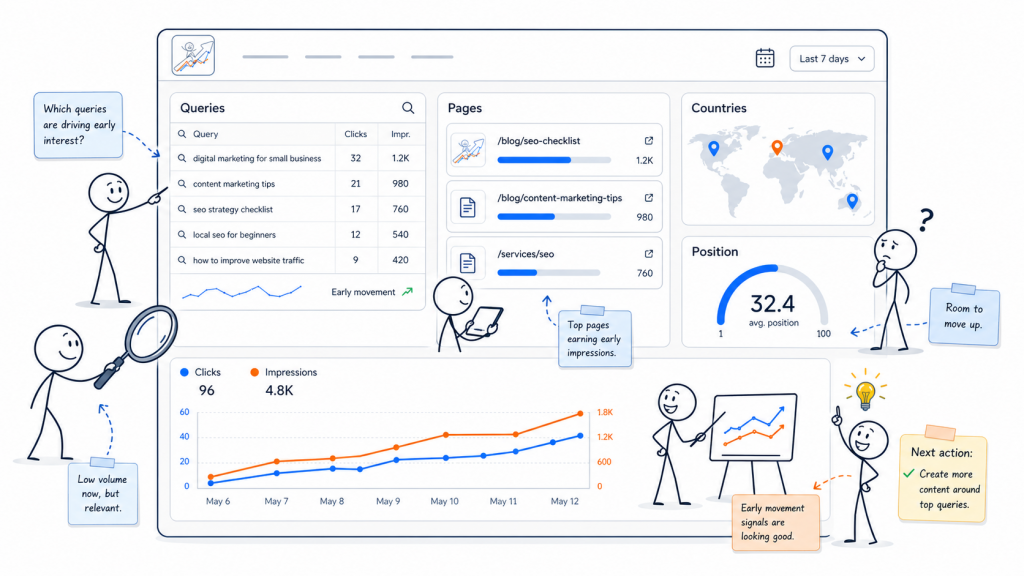
When the first impressions appear, I usually look at a few things before making any decisions.
Queries
Queries tell me how people search and how Google maps the page.
I want to know whether the article is appearing for phrases connected to its actual purpose.
If the article is about website traffic sources, I expect search visibility around website traffic, traffic channels, lead channels, SEO traffic, paid traffic, social discovery, and similar topics.
If the article starts appearing for completely different ideas, I need to understand why.
Sometimes it is harmless.
Sometimes it is a content clarity issue.
Sometimes it is an opportunity.
Pages
Page-level data tells me which articles are entering search first.
This matters because not every article will behave the same way.
A practical tools article may get different impressions from a strategic experiment article. A case study may get long-tail impressions. A foundational article may appear for broad searches but struggle to get clicks early.
Looking at pages helps me understand which type of content is creating the first search surface.
Countries
For a project like Web Idea US – Marketing Lab, country data matters because the site is in English and connected to a U.S.-facing brand identity.
Early impressions from different countries are not automatically bad. But I want to know where visibility is starting and whether that matches the long-term audience.
If impressions are broad, that may simply reflect informational content. If later monetization or services depend on a specific market, geography becomes more important.
Average Position
I use average position carefully.
It is useful, but only when interpreted with query and page context.
A low average position with relevant impressions may still be promising. A higher average position for irrelevant queries may not matter much.
Position is not the whole story. Relevance comes first.
Clicks
Clicks are the most exciting early signal, but I try not to overvalue them too soon.
One click can feel encouraging. Ten clicks can feel like momentum. But early clicks are still too small to prove much.
What they can prove is that the page is not completely disconnected from user interest.
Clicks tell me someone saw the result, found it relevant enough, and visited the page.
That is useful. But at this stage, I still care more about the pattern than the number.
What Early Impressions May Mean Strategically
When the first articles start getting impressions, I interpret it as a visibility opening.
Not a ranking win.
Not a traffic channel yet.
Not proof that the strategy is finished.
But a sign that the site is beginning to participate in search.
Strategically, that means three things.
The Site Is No Longer a Closed System
Before impressions, the site mostly exists from the owner’s perspective.
You publish content. You organize categories. You write meta descriptions. You design pages. You prepare the structure.
But once impressions appear, the site starts interacting with external demand.
Search queries become feedback.
They show what Google is testing, what users are searching, and where your content may have a place.
That turns the site from a static publishing project into a live visibility system.
The Content Base Starts Creating Directional Evidence
A content strategy on paper is still a theory.
Early impressions create evidence.
Small evidence, yes. Imperfect evidence, yes. But still evidence.
For example, if several early articles begin getting impressions around website launch analysis, traffic planning, marketing tools, and SEO visibility, that supports the idea that the site’s topical direction is understandable.
If impressions are scattered and unrelated, that may suggest the content architecture needs stronger focus.
The goal is not to force conclusions too early. The goal is to notice what the market and search system are reflecting back.
The Next Content Decisions Become Smarter
This is where early impressions become practical.
They can help decide what to publish next.
If an article about digital marketing analysis starts getting impressions around tools, that may support a tools article.
If a traffic article starts getting impressions around where website traffic comes from, that may support a deeper article about organic, paid, social, referral, and AI-driven discovery channels.
If an article about building content before optimization starts appearing for SEO process queries, that may support a future article about when to optimize early content.
The first impressions do not just measure past content. They can shape future content.
A Realistic Example: When an Article Gets Impressions but Few Clicks
Imagine a new marketing site publishes an article called “Why Website Traffic Does Not Start Automatically After Launch.”
After a few days or weeks, Search Console shows impressions for queries like:
- why my website has no traffic
- website launched but no visitors
- how long does SEO take after launch
- new website not getting traffic
- website traffic after launch
That is encouraging.
But the page has only one click.
A weak interpretation would be:
“The article failed.”
A better interpretation would be:
“Google is testing this page for highly relevant queries, but the page is probably not visible enough yet to earn consistent clicks.”
The next step would not necessarily be rewriting the entire article.
The next step might be:
- check whether the page is ranking too low to earn clicks
- compare title language to the actual queries
- create supporting articles around related questions
- add internal links from stronger pages
- improve the introduction to match search intent
- add practical examples
- wait for a larger data sample before making major changes
This is the difference between reacting and diagnosing.
What I Would Do Next
At this stage, I would not jump straight into heavy optimization.
I would keep building the content base while watching early signals.
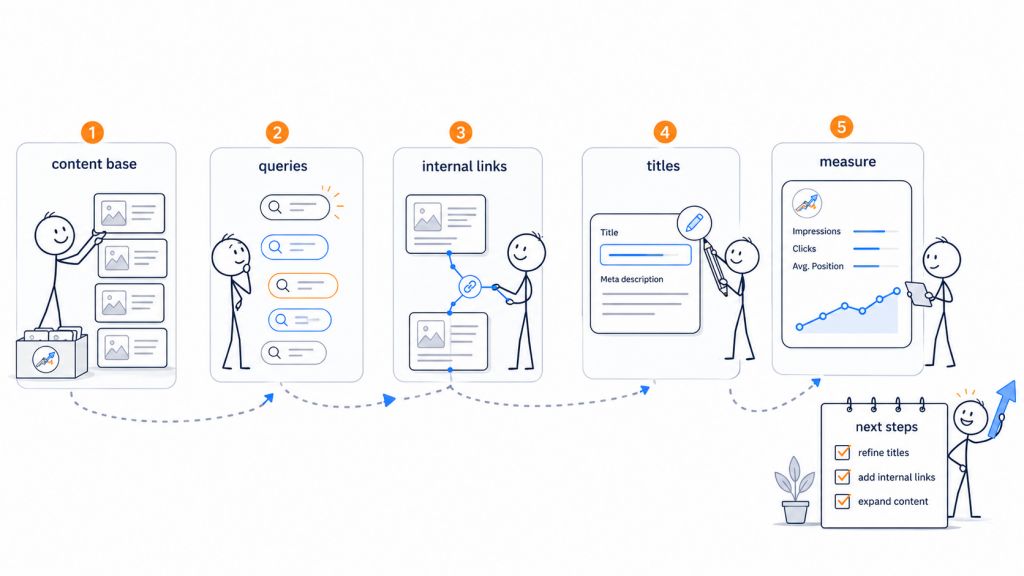
The next steps would be practical and measured.
Continue Publishing Strategically Related Articles
The first priority is still content depth.
A few articles are not enough for a strong topical map. The site needs enough connected material for both users and search systems to understand the project.
That means continuing to publish across the planned categories:
- Experiments
- Case Studies
- Tools & Reviews
- Build in Public
- Resources
But not randomly.
Each article should strengthen the broader theme: SEO, website traffic, digital visibility, analytics, AI discovery, and growth strategy.
Watch Query Patterns, Not Just Traffic
Traffic is the visible outcome, but query patterns are the early map.
I want to know what language Google connects to the site.
Are the impressions coming from business-owner questions?
Marketing strategy questions?
SEO process questions?
Tool-related searches?
Website launch problems?
Analytics questions?
That tells me where the site may have early traction.
Build Internal Links After There Is Enough to Link
Internal linking too early can feel forced.
Once several related articles exist, internal linking becomes more strategic.
For example, an article about early impressions can link to:
- a foundational article about digital marketing analysis before launch
- a traffic source article
- a content-before-optimization experiment
- a future Search Console interpretation guide
- a future internal linking experiment
That creates a stronger site structure than isolated posts.
Avoid Premature Perfection
This is probably the most important lesson.
Early-stage websites often suffer from too much polishing and not enough publishing.
That does not mean quality should be ignored. It means quality should be balanced with momentum.
At this stage, I would rather have 10 strong, connected, useful articles than two “perfect” articles that were rewritten 12 times before the site had enough data to justify the changes.
Search systems need content to understand.
Users need paths to follow.
The site needs a body of work.
Then optimization becomes more intelligent.
What Early Impressions Do Not Mean
To keep this grounded, it is important to say what first impressions do not mean.
They do not mean the site has authority yet.
They do not mean the article is ranking well.
They do not mean SEO is “working” in a mature sense.
They do not mean the content strategy is proven.
They do not mean the page should be monetized immediately.
They do not mean the title, structure, or internal links are finished.
Early impressions are an opening signal.
That is all.
But in SEO, opening signals matter because they show where a system starts responding.
The Bigger Lesson for Business Owners
For business owners, this stage is especially important because it teaches patience without passivity.
Many businesses launch a website and expect immediate traffic. When that does not happen, they assume SEO is not working or the website is broken.
But early visibility often develops in layers:
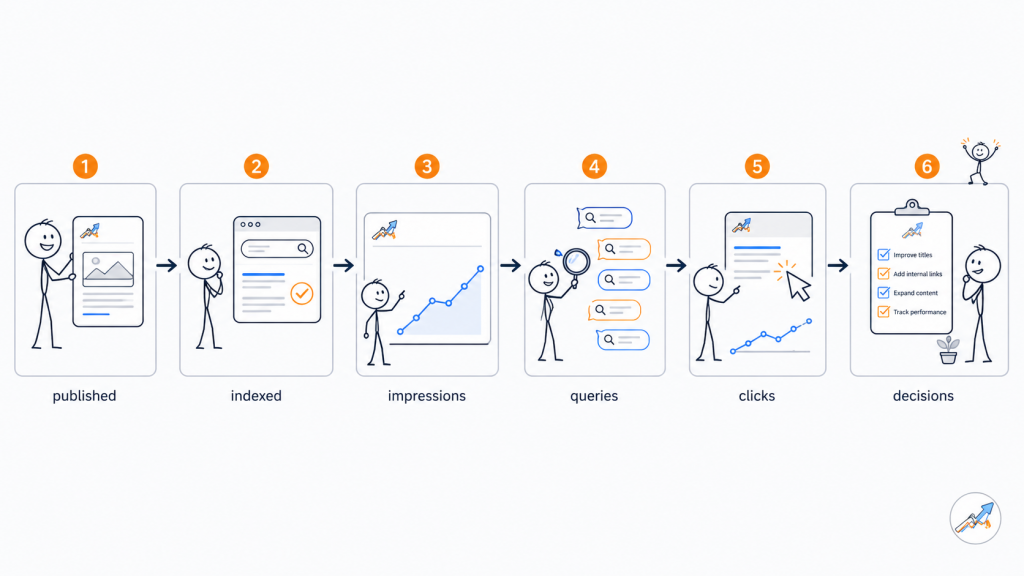
First, Google discovers the pages.
Then it indexes them.
Then impressions begin.
Then query patterns appear.
Then some pages move closer to click range.
Then traffic becomes more measurable.
Then conversions become a realistic conversation.
Skipping that sequence leads to poor decisions.
A business may start paid ads too early because organic traffic is not immediate.
It may redesign pages before knowing what search intent they attract.
It may abandon content before the content base has enough depth.
It may chase keywords without understanding visibility signals.
First impressions should not make a business impatient.
They should make the business more observant.
The Bigger Lesson for Marketers
For marketers, first impressions are a reminder that SEO is not just publication and ranking.
It is an interpretation.
The same data can produce two very different strategies depending on how it is read.
A nervous marketer may see low clicks and rewrite everything.
A more strategic marketer may see relevant impressions, identify query clusters, build supporting content, and strengthen internal linking.
The difference is not access to data.
The difference is judgment.
Google Search Console gives signals. It does not automatically provide strategy.
That is the marketer’s job.
Final Takeaway
When the first articles start getting impressions, the site has entered a new stage.
It is no longer just a published website.
It is becoming a tested website.
That does not mean the strategy is proven. It means the first feedback loop has started.
For Web Idea US – Marketing Lab, I see this as an encouraging early signal, but not a reason to rush. The right move is to keep building the content base, watch query patterns, avoid premature over-optimization, and use the data to make future decisions smarter.
The first impressions are not the finish line.
They are the first conversation between the website, Google, and real search demand.
And that conversation is exactly what this lab is designed to study.