
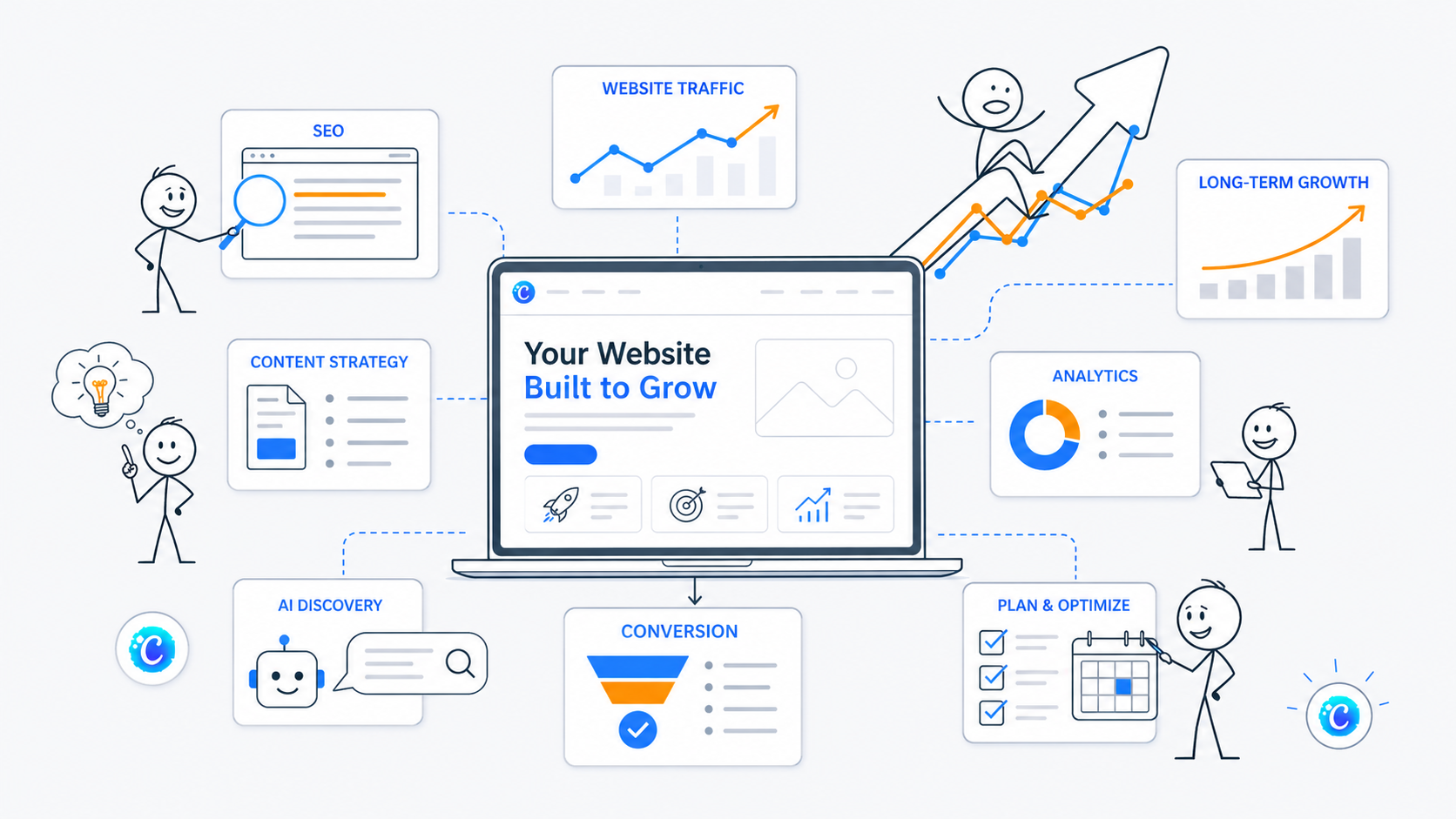
How to Build a Website That Can Actually Grow
A website can look finished and still not be ready to grow.
I have seen this happen many times. A business invests in a new website. The design looks modern. The homepage feels polished. The service pages are published. The navigation works. The site loads. Everyone involved feels like the project is complete.
Then the website goes live.
A few weeks pass. Then a few months.
Traffic is low. Google Ads feel expensive. Organic visibility is weak. The business cannot clearly tell which pages are creating leads. The analytics setup shows visitors, but not useful behavior. The website technically exists, but it is not becoming a real growth asset.
That is usually the moment when the real problem becomes clear: the website was built as a design and development project, not as a growth system.
A website growth strategy is the plan behind how a website will attract the right people, explain the business clearly, support traffic channels, convert visitors into leads or customers, and keep improving over time. It is not just SEO. It is not just design. It is not just analytics. It is the connection between all of those layers.
Google’s own SEO Starter Guide describes SEO as improving a site’s presence in Search and focuses on helping both search engines and users understand a website better. That matters because growth-ready websites are not built only for visual presentation. They are built to be understood, discovered, navigated, measured, and improved.
This article is my practical framework for building a website that can actually grow.
Not a perfect website. Not an over-engineered website. A website with enough strategic structure underneath it to support visibility, traffic, leads, learning, and long-term improvement.
A Growth-Ready Website Is Not Just a Brochure
A brochure website says, “Here is who we are. Here is what we do. Contact us.”
A growth-ready website says something more useful:
“We understand what our audience is looking for. We have organized our pages around real demand. We know where traffic may come from. We have clear conversion paths. We can measure what happens. We can add content without breaking the structure. We can improve based on data.”
That difference sounds simple, but it changes almost every website decision.
A brochure-style website usually starts with appearance:
What should the homepage look like?
What colors should we use?
What sections should be on the page?
What do we want to say about ourselves?
A growth-ready website starts with business and visibility logic:
Who needs to find this website?
What problems are they searching for?
Which services or offers need their own pages?
Which traffic channels will matter first?
What proof does the visitor need before taking action?
What should we track from day one?
What content will support authority over time?
Design still matters. A lot. But design should support the growth logic, not replace it.
A beautiful website with no traffic strategy is like a well-designed store hidden on a street nobody visits. A technically correct website with weak messaging is like a store with confusing signs. A website with traffic but no conversion path is like a store where people walk in, look around, and leave because nobody guides them toward the next step.
A website that can grow needs all three layers:
- visibility, so the right people can find it;
- clarity, so visitors understand why the business matters;
- conversion and measurement, so the business can learn what works.
That is the foundation.
Start Before Design: Pre-Launch Digital Marketing Analysis
One of the most expensive website mistakes happens before the design even begins.
The business starts with pages, colors, copy, layout, and development — but skips the analysis that should shape those decisions.
Before building or rebuilding a website, I want to understand four things.
First, what does the business need the website to do?
That sounds obvious, but many websites are built around vague goals like “look professional” or “get more leads.” Those are not enough. A website for a local service business, a B2B consulting firm, an e-commerce brand, and a SaaS product may all need very different structures.
A stronger goal sounds more like this:
“We need the website to generate qualified local service inquiries from people searching for emergency and non-emergency repair services in three target locations.”
Or:
“We need the website to support organic discovery for a niche consulting offer, explain our methodology, build trust, and convert visitors into consultation requests.”
That level of clarity changes the site architecture.
Second, what does the audience actually search for?
Businesses often describe services in internal language. Customers search in problem language. A company may say “integrated residential comfort solutions.” A customer searches “AC repair near me” or “why is my air conditioner blowing warm air.”
This is where keyword research becomes more than an SEO task. It becomes a translation layer between business language and customer behavior.
Third, who is already visible?
Competitor research is not about copying competitors. It is about understanding what Google, users, and now AI-driven systems already recognize as useful in the market.
Which competitors rank?
What pages do they have?
How specific are their service pages?
Do they use location pages?
Do they publish educational content?
Do they have comparison pages, pricing pages, FAQs, case studies, tools, or resources?
Where are they weak?
That tells you where the standard is and where the opportunity may be.
Fourth, which channels are realistic?
Not every business should expect SEO to produce results quickly. Not every business should start with paid ads. Not every offer is social-friendly. Not every market has high search volume. A growth-ready website should be built around the channels that make sense for the business stage, budget, timeline, and audience behavior.
This is why website launch strategy should include marketing strategy before design is finalized.
Website Architecture Should Support SEO and Future Growth
Website architecture is one of the most underappreciated parts of website growth strategy.
Most people notice the homepage. Search engines and users experience the full structure.
A scalable website architecture answers a simple question: can this website expand without becoming messy?
For a small service business, a weak structure might look like this:
Home
About
Services
Contact
Blog
That may be fine for a very early website, but it often becomes limiting fast. The “Services” page tries to explain everything. The blog becomes random. There are no clear landing pages for specific needs. Google has limited page-level signals. Users cannot quickly find the service that matches their problem.
A stronger structure might look like this:
Home
About
Services
Individual service pages
Location pages, if relevant
Case studies or examples
Resources or blog
Contact
FAQ or process page
For a consulting business, the structure may need offer pages, methodology pages, industry pages, case studies, insight articles, and conversion pages.
For a content-led site, the structure may need pillar articles, supporting articles, category hubs, internal links, tools, resources, and a clear editorial map.
Good structure helps search engines crawl and understand content. Google’s SEO documentation specifically emphasizes making content easier to crawl, index, and understand, which is exactly why architecture cannot be treated as an afterthought.
But architecture is not just for Google. It also helps humans.
A visitor should be able to answer:
Am I in the right place?
Does this business solve my problem?
Where should I go next?
Can I trust this?
What action should I take?
If the structure does not answer those questions, more traffic will not automatically solve the problem.
Search Intent Should Shape Page Mapping
A website that can grow needs pages mapped to real intent.
Search intent means the reason behind the search. Someone searching “what is digital marketing analysis” is not in the same mindset as someone searching “digital marketing consultant near me” or “best SEO audit tools.” Each query suggests a different level of awareness and a different page need.
This is where page mapping becomes important.
A homepage usually handles brand-level clarity. It explains who the business is, what it does, who it serves, and where the visitor should go next.
Service pages handle high-intent commercial searches. They need to be specific, useful, and built around what the customer wants to solve.
Location pages help local businesses match location-based demand, but only when they are genuinely useful and not thin duplicates.
Educational content helps answer earlier-stage questions and build topical authority.
Case studies help prove that the business understands real situations.
Comparison or decision-stage pages help people choose between options.
Resources help users take practical action and support internal linking.
Contact or booking pages remove friction when the visitor is ready.
A common mistake is trying to make one page do too much. A homepage cannot carry the entire SEO strategy. A generic services page cannot rank well for every specific service. A blog post cannot replace a strong commercial landing page. A contact page cannot fix weak trust signals earlier in the journey.
Growth-ready websites separate intent clearly.
They make room for visitors at different stages:
- people who are just learning;
- people comparing options;
- people looking for a specific solution;
- people ready to contact or buy.
This is one of the biggest differences between a website that sits still and a website that can grow over time.
Traffic Channels Influence Website Structure
A website should not be built in isolation from its traffic channels.
SEO traffic behaves differently from paid search traffic. Social traffic behaves differently from referral traffic. Email visitors behave differently from cold visitors. AI-driven discovery may send people with a summarized understanding before they even click.
Each channel creates different expectations.
SEO visitors often arrive through specific questions or service searches. They need the page to match intent quickly. If someone searches “emergency plumbing repair in Austin,” they do not want to land on a vague homepage that talks about company values for five paragraphs.
Paid search visitors usually cost money per click. That means landing page clarity matters immediately. If a campaign sends traffic to a page that does not match the ad promise, the business wastes budget.
Social traffic may be colder or more curiosity-driven. Those visitors may need more context, proof, and a softer path into the site.
Referral traffic may arrive with some trust already built, but still needs confirmation.
Email traffic may be warmer and more likely to respond to specific offers.
AI discovery adds another layer. As AI-powered search and answer systems become more common, websites need content that clearly explains entities, expertise, services, topics, and relationships between ideas. McKinsey described AI search as a “new front door to the internet” and reported that half of consumers use AI-powered search today, while traditional search behavior is also changing.
That does not mean traditional SEO is dead. It means websites need to be clear enough for both search engines and AI-assisted discovery systems to understand them.
A good website growth strategy asks:
Where will traffic come from first?
What will those visitors already know?
What page should they land on?
What action makes sense for that visitor?
How will we measure whether the page worked?
Without that channel logic, a website becomes a collection of pages instead of a growth system.
Content Strategy Gives the Website Room to Grow
A website with only a few static pages has limited growth potential.
That does not mean every business needs to publish constantly. It does mean the website should have a content structure that can expand intelligently.
Content strategy is not “write blog posts because SEO needs content.” That is too shallow.
A real website content strategy defines what the business needs to explain, prove, support, and become known for.
For a service business, content may include:
- service pages;
- location pages;
- FAQs;
- problem-solving articles;
- comparison articles;
- maintenance guides;
- case studies;
- pricing or process explanations;
- trust-building resources.
For a marketing or consulting site, content may include:
- pillar articles;
- experiment notes;
- case studies;
- tools and reviews;
- frameworks;
- resource pages;
- build-in-public updates.
That structure matters because topical authority is built over time. One article rarely changes everything. But a group of well-connected pages can help both users and search systems understand what the site is about.
Google’s helpful content guidance is clear that content should be created primarily to benefit people, not to manipulate rankings. That is a useful reminder because growth-focused content is not about stuffing keywords into pages. It is about building useful explanations that match real audience needs.
This is especially important in the AI-search era. Content that is vague, generic, and interchangeable is easier to ignore. Content that demonstrates experience, specific reasoning, clear structure, and useful examples has a better chance of being understood, cited, remembered, or selected.
A growth-ready website does not need hundreds of articles immediately.
It needs a structure that can support meaningful content expansion.
Conversion Architecture Turns Traffic Into Business Value
Traffic is not the final goal.
Traffic is only useful if the website can turn some of that attention into business value.
This is where conversion architecture matters.
Conversion architecture is the planned path from visitor intent to meaningful action. It includes CTAs, contact options, forms, trust signals, proof, page flow, and the logic of what should happen next.
A weak conversion path looks like this:
A visitor lands on a page.
They read some general information.
There is a “Contact Us” button somewhere.
The page gives no strong reason to act now.
The form asks too much or too little.
The business cannot track what happened.
A stronger conversion path looks like this:
The page matches the visitor’s intent.
The headline confirms relevance.
The service is explained clearly.
Proof appears before doubt increases.
The CTA matches the visitor’s stage.
The form is easy to complete.
The click or submission is tracked.
The business can connect the lead to the page and channel.
Different pages may need different CTAs.
A high-intent service page may use “Request a Quote” or “Schedule a Consultation.”
An educational article may use “Read the launch checklist” or “Explore the website growth framework.”
A case study may use “See how this applies to your website.”
A tools article may guide readers toward a resource page.
The mistake is using one generic CTA everywhere and hoping users figure it out.
Good conversion-focused website design does not pressure users. It helps them move.
Analytics Should Be Built In From the Beginning
A website that cannot be measured cannot be improved with confidence.
This does not mean every new website needs an advanced analytics setup on day one. But it should have a clean foundation.
At minimum, I want to see:
- Google Analytics 4 installed correctly;
- Google Tag Manager used when possible;
- Google Search Console connected;
- conversion events defined;
- form submissions tracked;
- important CTA clicks tracked;
- outbound clicks tracked if relevant;
- source and medium data reviewed;
- internal traffic filtered or understood;
- clear naming logic for events.
The point is not to collect data for the sake of collecting data. The point is to answer useful questions.
Which channels bring visitors?
Which pages attract organic impressions?
Which pages generate leads?
Do visitors scroll far enough to see the CTA?
Are paid campaigns sending traffic that converts?
Are informational articles assisting later conversions?
Are people clicking contact buttons but not submitting forms?
Many businesses wait until there is a problem before fixing analytics. That makes diagnosis harder because the missing data cannot always be recreated later.
A growth-ready website should launch with enough tracking to learn.
Not everything has to be perfect. But the core business actions should be measurable from the start.
Technical and UX Foundations Still Matter
Strategic structure does not replace technical quality.
If a website is slow, hard to use on mobile, blocked from indexing, confusing to navigate, or filled with broken pages, growth becomes harder.
The technical foundation should support the strategy.
That includes:
- mobile usability;
- fast enough page loading;
- crawlable pages;
- indexable important content;
- clean URL structure;
- logical navigation;
- readable content layout;
- accessible design basics;
- image optimization;
- internal links;
- no accidental noindex tags;
- no broken core templates;
- clear headings.
Mobile deserves special attention. HubSpot’s marketing statistics page, citing 2025 Statista data, reports that smartphones account for more than 78% of retail website visits worldwide. That does not mean every business has the same mobile behavior, but it does show why mobile experience cannot be treated as secondary.
For service businesses, mobile often matters because users search while they are busy, local, or ready to act. If the phone number is hard to find, the form is awkward, or the page is slow, the business may lose leads before analytics even tells the full story.
A website does not need to chase every technical trend. But it does need to be usable, accessible, discoverable, and stable enough for growth work to matter.
AI Search Visibility Changes the Standard for Clarity
AI-driven discovery does not eliminate website strategy. It raises the standard for clarity.
Traditional SEO often focused heavily on keywords, rankings, links, technical structure, and content relevance. Those still matter. But AI-assisted discovery adds more pressure around entities, context, expertise, and usefulness.
A website now needs to make it very clear:
Who is behind the site?
What does the business or author know?
What topics does the site cover deeply?
How are those topics connected?
What original perspective or experience is present?
Can the content answer questions directly and usefully?
Are claims supported where they should be?
This is one reason I like structured content systems: pillar articles, supporting articles, case studies, tools, experiments, and resources. They help create a body of work that is easier to understand than a random set of disconnected posts.
AI search is still evolving, and nobody should pretend to know exactly how every system will select, summarize, or cite sources. But the direction is clear enough: generic content is becoming less valuable, and clear expert content with strong topical structure is becoming more important.
For a business website, that means the old “five-page website and done” model is weaker than ever.
The website needs to explain the business, the offer, the problems it solves, the proof behind it, and the surrounding topic space.
Mini Case Study: The Website Looked Finished, But Could Not Grow
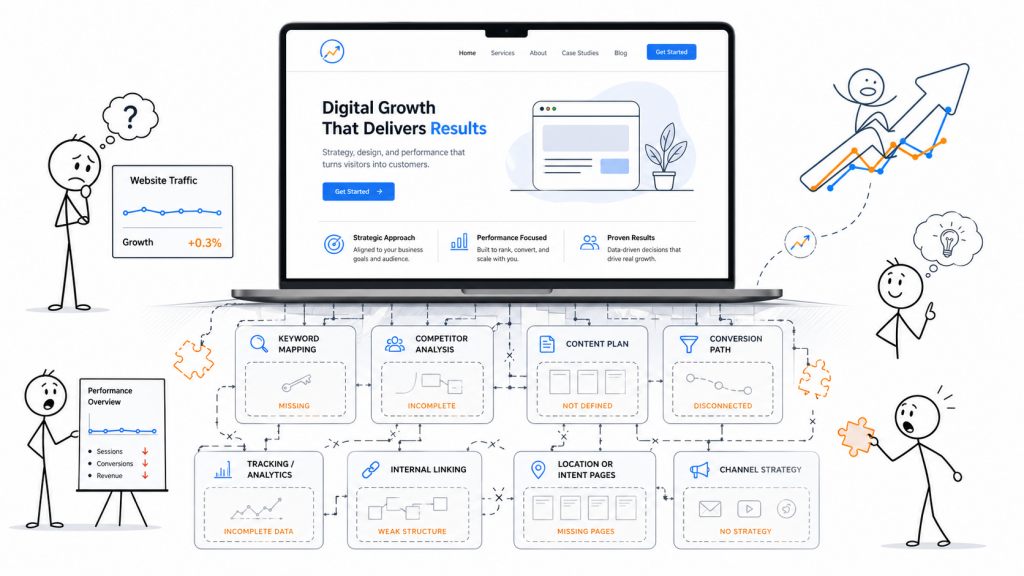
Here is a composite scenario based on patterns I have seen repeatedly.
A local service business invested in a polished new website. The homepage looked professional. The brand colors were clean. The site had pages for each major service. The contact form worked. On launch day, it felt like a successful project.
Three months later, the business had a problem.
Organic traffic was almost flat. Google Ads were producing clicks, but leads were expensive. The owner could not tell which services were getting the most interest. The analytics showed page views, but not enough useful lead-stage behavior. Some people filled out the contact form, but lead quality was inconsistent.
On the surface, nothing looked broken.
The deeper issue was that the website had not been built around growth logic.
There had been no keyword and search-demand mapping before launch. The service pages used broad company language instead of specific customer search language. There was no competitor visibility review. The business served multiple locations, but the site had no useful location strategy. The blog was empty because nobody had planned what content should support the main services. CTAs were generic. GA4 was installed, but important conversion events were not clearly configured.
The business had paid for presentation before building visibility, conversion, and measurement logic.
The recovery plan was not to “do SEO” in some vague way. It was more specific:
Rebuild the page architecture around search intent.
Create stronger individual service pages.
Add location pages where they could be genuinely useful.
Build educational content around common customer problems.
Connect GTM and GA4 around real conversion actions.
Review paid search landing pages before increasing budget.
Use internal links to connect informational content with decision-stage pages.
The lesson is simple: a website can look complete and still be strategically unfinished.
Common Mistakes That Make Websites Hard to Grow
Most growth problems are not caused by one dramatic mistake. They usually come from a stack of small missing decisions.
The most common ones are:
Building around company language instead of customer language.
Launching without keyword, audience, or competitor analysis.
Treating the homepage as the entire strategy.
Creating thin service pages that do not fully answer user intent.
Using generic CTAs across every page.
Installing analytics but not tracking meaningful actions.
Starting paid traffic before landing pages are ready.
Publishing blog posts without a content architecture.
Ignoring internal linking until the site becomes messy.
Designing for appearance before planning visibility.
Expecting SEO results within weeks without enough structure or authority.
Building no path for future content expansion.
These mistakes are common because they are easy to miss during a website project. Everyone is focused on launch. But growth is what happens after launch, and the website needs to be ready for that.
A Practical Website Growth Framework
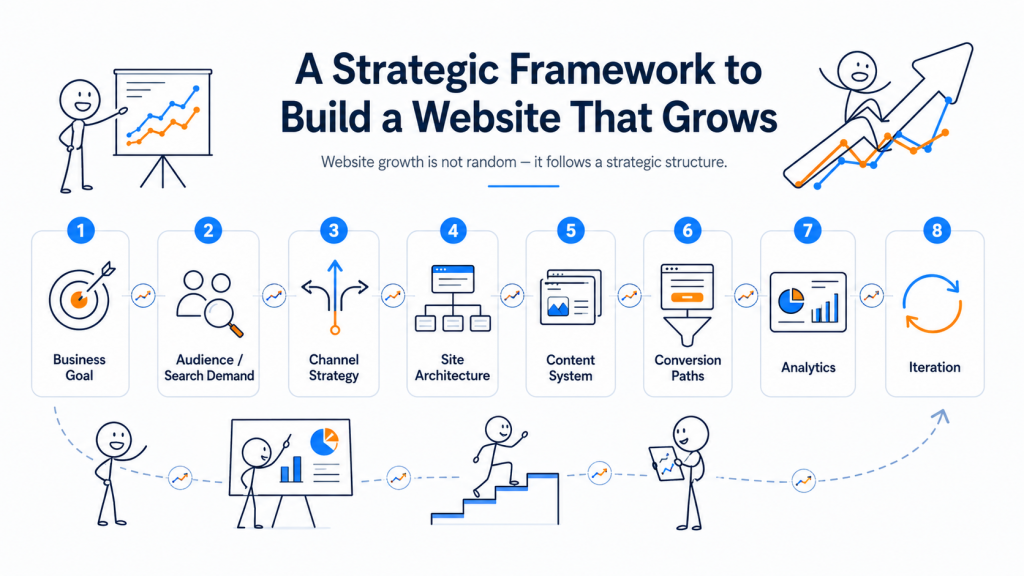
When I think about website growth strategy, I like to use a simple sequence:
Business goal → audience and search demand → channel strategy → site architecture → content system → conversion paths → analytics → iteration
Each step affects the next.
1. Business goal
Define what the website needs to create: leads, sales, bookings, authority, subscriptions, demos, calls, applications, or education.
2. Audience and search demand
Understand who the website needs to reach, what they care about, what they search for, and what problems they are trying to solve.
3. Channel strategy
Decide which channels matter first: SEO, paid search, social, referral, email, partnerships, AI discovery, or direct brand traffic.
4. Site architecture
Build the page structure around services, topics, locations, offers, resources, and user journeys.
5. Content system
Create room for pillar content, supporting articles, FAQs, case studies, tools, resources, and future expansion.
6. Conversion paths
Define what actions matter and make those actions clear, relevant, and measurable.
7. Analytics
Set up tracking so the business can understand traffic, behavior, conversions, and channel quality.
8. Iteration
Use real data to improve pages, content, CTAs, internal links, campaigns, and technical performance.
This framework is not complicated. But skipping any part of it usually creates problems later.
How to Audit Whether Your Website Can Grow
If you already have a website, you can use a simple audit question:
Is this website built to be found, understood, trusted, measured, and improved?
Break that into smaller questions.
Can search engines crawl and understand the important pages?
Does each major service or offer have a strong page?
Do pages match real search intent?
Is there a content plan beyond the main pages?
Are internal links helping users move through the site?
Are CTAs specific and visible?
Is mobile experience strong enough?
Are important conversion actions tracked?
Does Google Search Console show impressions for relevant queries?
Can the business tell which channels create leads?
Does the site have a structure for future growth?
If the answer is “no” to several of these, the website may not need a full rebuild. But it probably needs strategic work before more traffic is pushed into it.
That distinction matters.
Sometimes the problem is not that the business needs a new website.
Sometimes the problem is that the existing website needs a growth system underneath it.
Final Takeaway: Build the Growth Logic Before You Need It
A website that can actually grow is not built by accident.
It is built with a clear understanding of the business goal, audience demand, traffic channels, SEO structure, content strategy, conversion paths, analytics, and future iteration.
The best time to think about those things is before launch.
The second-best time is before spending more money on traffic.
A polished website can create a good first impression. But a growth-ready website can keep working after that first impression. It can attract the right visitors, answer better questions, support campaigns, generate stronger signals, and give the business data to improve.
That is the difference between a website that simply exists and a website that becomes a real business asset.
At Web Idea US – Marketing Lab, this is one of the core ideas I keep coming back to: growth does not start after the website is finished. Growth starts in the way the website is planned.

1 comment
[…] “website growth strategy” […]
Comments are closed.