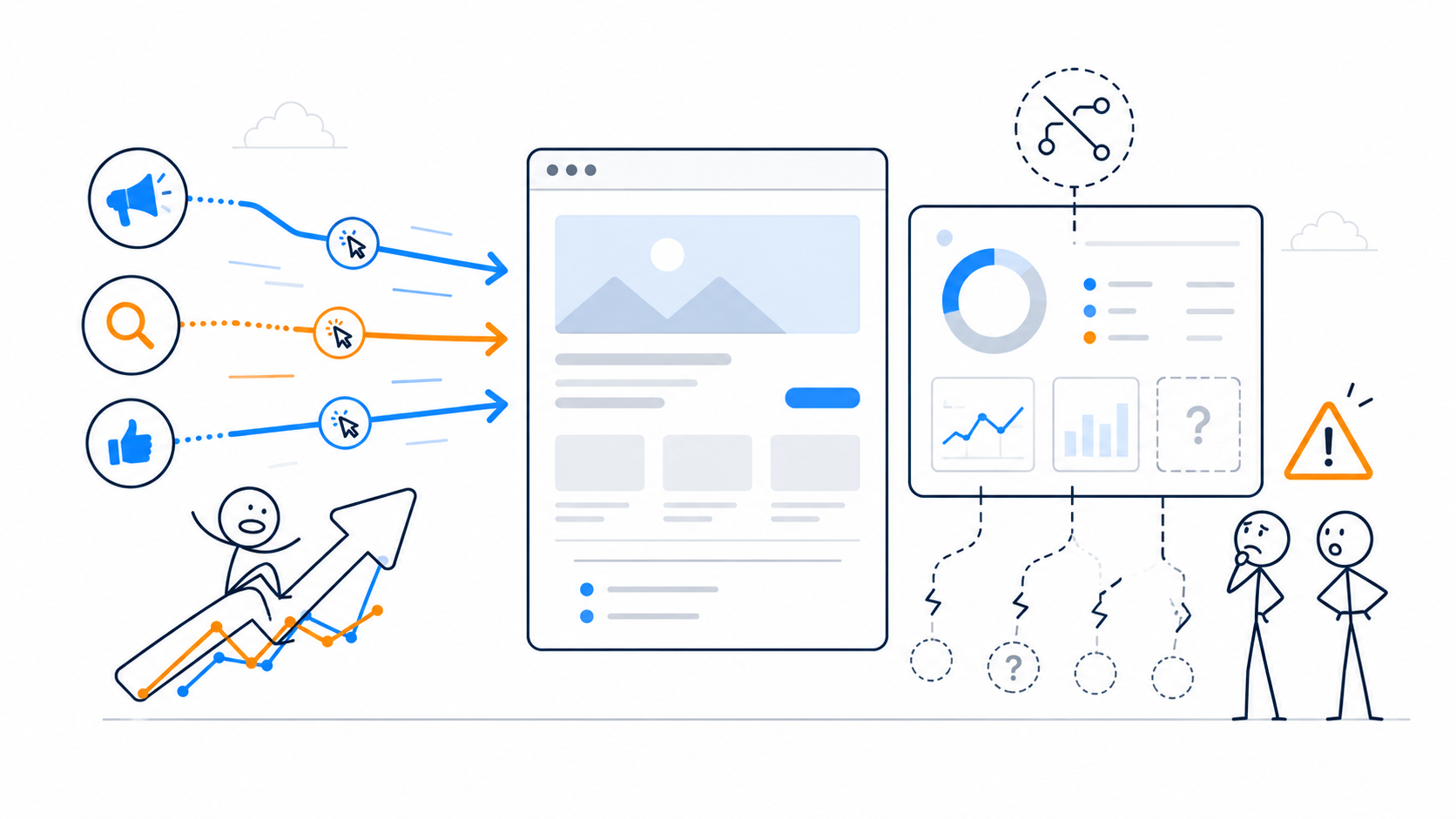
Paid traffic feels like one of the fastest ways to create momentum.
A website is live. The offer is ready. The business wants leads. Someone says, “Let’s run Google Ads,” or “Let’s test Meta ads,” or “Let’s send traffic to the new landing page and see what happens.”
I understand the temptation. Paid traffic gives businesses a feeling of action. Unlike SEO, which takes time, paid campaigns can start bringing visitors almost immediately. That speed is useful. Sometimes it is exactly what the business needs.
But there is one problem I have seen too many times.
The traffic starts before tracking is ready.
And when that happens, the business does not just risk wasting ad spend. It risks making decisions from incomplete, misleading, or completely unusable data.
This case study is a composite scenario based on patterns I have seen repeatedly in real marketing work: the business was ready to pay for traffic, but not ready to understand the traffic.
The Business Situation
Let’s imagine a local service business.
The company offers high-value services, has a new website, and wants to generate leads quickly. The website looks modern. The service pages are clear enough. There is a contact form, a phone number, and a few call-to-action buttons.
The business owner does not want to wait months for SEO. That is reasonable. Paid search looks like the fastest way to get in front of people who are already looking for the service.
So the team launches Google Ads.
The campaign setup looks acceptable on the surface:
The keywords are relevant.
The ads mention the main services.
The landing pages load properly.
The budget is not huge, but it is enough to start testing.
Traffic begins coming in.
For the first few days, everyone feels encouraged. There are clicks. There are impressions. The website is finally getting visitors.
Then the questions begin.
Which keywords generated real leads?
Which landing page worked better?
Did phone calls come from ads or from something else?
Did form submissions fire correctly?
Were leads coming from paid search, organic search, direct visits, or referrals?
Was the campaign learning from actual conversions or from shallow actions?
And suddenly the uncomfortable answer appears:
Nobody really knows.
What Looked Fine on the Surface
This is the part that makes the situation tricky.
Nothing looked obviously broken at first.
The website was live. The ads were approved. The campaigns were spending. Google Ads was showing clicks. Google Analytics was collecting visits. The business could see that people were coming to the website.
To a non-technical business owner, that may look like tracking.
But traffic tracking and conversion tracking are not the same thing.
Seeing that users visited the site is not the same as knowing whether they became leads. Seeing page views is not the same as knowing whether the ads produced business value. Seeing clicks in Google Ads is not the same as understanding whether those clicks created calls, forms, bookings, quote requests, or qualified opportunities.
Google’s own Google Ads documentation explains that conversion tracking helps show what happens after someone clicks an ad, such as whether they purchased, signed up, or completed another valuable action. It also connects that information to ROI and ad spend decisions.
That distinction matters.
In this case, the business had traffic data, but not reliable performance data.
What Was Actually Missing
The missing layer was not “more traffic.”
The missing layer was measurement architecture.
Before paid campaigns started, the business should have defined what counted as a meaningful conversion. For example:
- A completed contact form.
- A phone number is clicked from mobile.
- A quote request.
- A booking action.
- A lead magnet submission.
- A thank-you page visit after a form submission.
- A high-intent CTA click.
- A qualified call from a campaign landing page.
Instead, the campaigns started with vague goals.
The team knew they wanted “leads,” but the website and ad platforms were not fully prepared to measure lead behavior.
This is where many paid traffic mistakes begin. The campaign may be technically active, but the business has no clean way to separate valuable traffic from noise.
The Tracking Setup Was Too Shallow
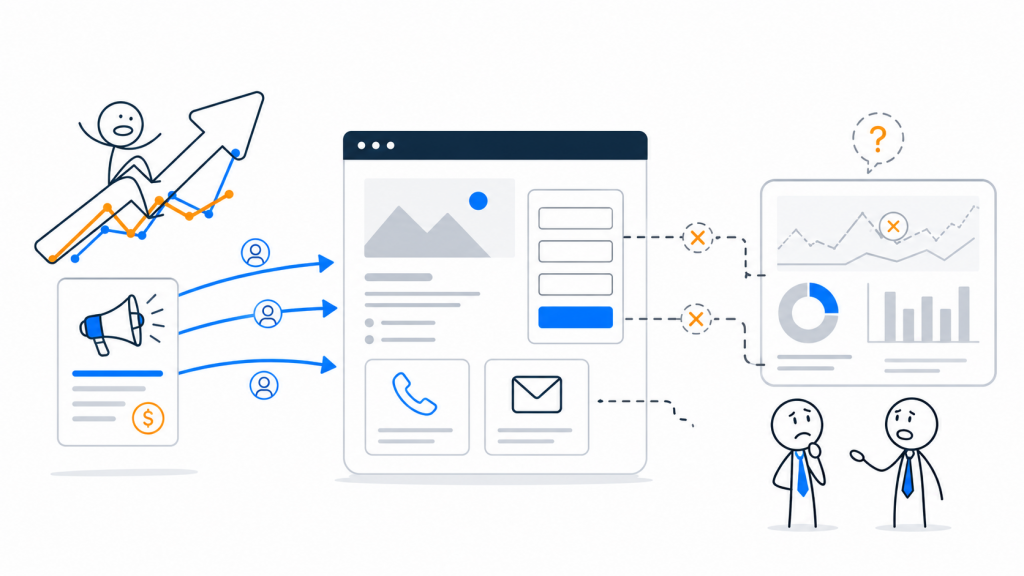
In this scenario, Google Analytics was installed, but only at a basic level.
The business could see page views, users, and sessions. But the real conversion actions were not mapped properly.
The contact form did not always redirect to a thank-you page. Phone clicks were not tracked as events. Some CTA buttons looked important visually, but they were not measured. The same phone number appeared across pages, but there was no call tracking logic. Google Ads was importing incomplete or poorly defined conversion signals.
In GA4, important actions can be marked and used as key events, and Google explains that Analytics key events can be used to create Google Ads conversions in a more consistent way across Google Ads and Google Analytics. But that only helps if the business has already decided which actions matter and configured them correctly.
Without that setup, the campaign was collecting activity, not intelligence.
What Happened Next
The campaign ran for several weeks.
The business received some leads, but the results were unclear.
The owner said, “We got a few calls, but I’m not sure if they came from ads.”
The marketer said, “The campaign has clicks, but conversion data looks too low.”
The web person said, “The form works, but I’m not sure whether GA4 is tracking it.”
The ad platform showed some conversion activity, but nobody fully trusted it.
This is one of the most frustrating paid traffic situations because the business spent real money but did not receive real clarity.
The campaign may have produced leads.
It may have produced poor-quality leads.
It may have produced better results from one keyword group than another.
It may have had one landing page that worked and another that wasted spend.
But because tracking was not ready, the team could not confidently separate what worked from what failed.
That means optimization became guesswork.
Why This Is Expensive
When tracking is incomplete, the business loses more than reporting accuracy.
It loses learning speed.
Paid traffic is not only a lead-generation channel. It is also a learning system. Every click, search term, landing page visit, form submission, call, and conversion signal should help the business understand what to improve next.
When tracking is weak, the campaign still spends money, but the learning loop breaks.
The business pays for data but cannot fully use it.
That creates several problems.
First, budget may continue going to the wrong keywords or audiences.
Second, landing pages may be judged unfairly. A page may look weak because conversions are not tracked correctly, or it may look strong because shallow actions are being counted as success.
Third, automated bidding may receive poor signals. Google Ads documentation notes that conversion measurement helps identify which campaigns, keywords, ads, and ad groups drive valuable customer activity, understand ROI, and use Smart Bidding strategies that optimize according to business goals. If the conversion signals are missing or wrong, the platform has less useful information to optimize toward.
Fourth, business conversations become emotional instead of analytical.
One person thinks the ads are failing.
Another thinks the website is the problem.
Another thinks the budget is too small.
Another thinks the leads are just not visible in reporting.
Everyone may be partly right, but nobody has enough clean data to decide.
The Real Problem Was Not the Campaign
This is important.
The campaign itself was not necessarily the main problem.
The problem was the order of operations.
The business treated paid traffic as the beginning of the growth system. In reality, paid traffic should have been launched after the basic measurement system was ready.
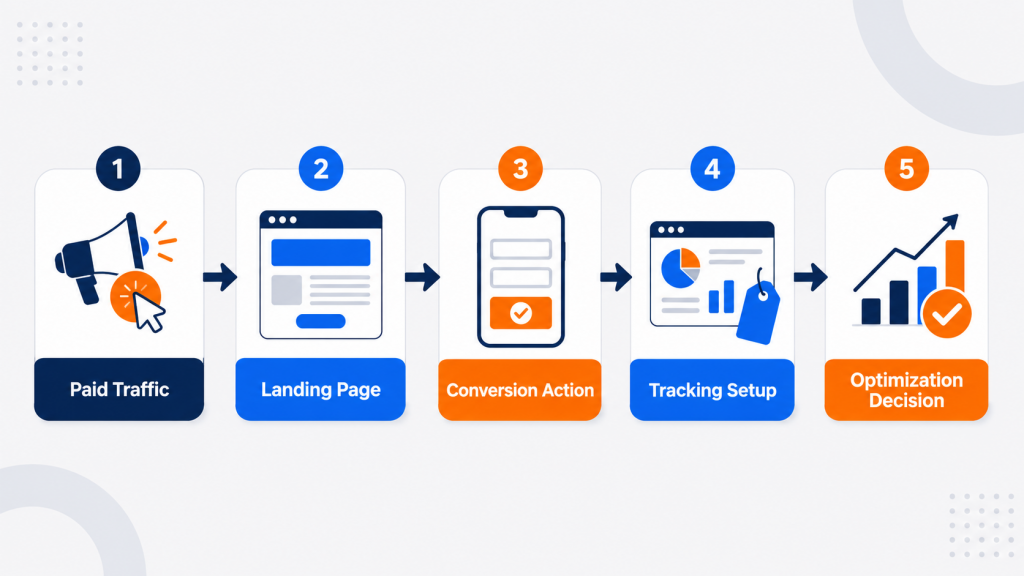
A better order would have been:
- Define the business goal.
- Define conversion actions.
- Map the landing page journey.
- Install and test tracking.
- Connect GA4, GTM, and Google Ads properly.
- Validate events before launch.
- Start with controlled campaign testing.
- Review data and optimize.
Instead, the business jumped from “website is live” to “ads are running.”
That shortcut created confusion.
What Should Have Happened Before Launching Paid Traffic
Before running paid campaigns, the business needed a simple but reliable tracking plan.
Not a massive enterprise analytics project. Not a complicated dashboard. Not a six-month measurement strategy.
Just the basics done correctly.
1. Define Primary and Secondary Conversions
The primary conversion should be the action closest to business value.
For a service business, that may be:
Contact form submission.
Booked consultation.
Phone call.
Quote request.
Secondary conversions may include:
CTA button click.
Pricing page visit.
Service page engagement.
Scroll depth on a landing page.
Download of a guide or checklist.
The key is not to treat every action as equal.
A page view is not a lead. A button click is not always a lead. A phone click may be important, but it still needs context.
2. Set Up GTM and GA4 Correctly
For most small and mid-sized marketing setups, I prefer a clean architecture:
Website → Google Tag Manager → GA4 and ad platform tags
This makes tracking easier to manage and less dependent on adding separate scripts all over the website.
But setup alone is not enough. It has to be tested.
Google Tag Manager’s preview and debug mode allows you to test a container configuration before publishing and inspect which tags fired and in what order. That kind of validation is exactly what should happen before campaigns start spending.
3. Test the Full Conversion Path
Someone should manually test the user journey.
Click the ad preview or landing page URL.
Open the landing page.
Click the CTA.
Submit the form.
Click the phone number.
Check whether events appear.
Confirm whether the correct conversion fires.
Check whether duplicate events are happening.
Confirm whether Google Ads receives the right conversion action.
This is not glamorous work, but it prevents expensive confusion later.
4. Avoid Optimizing to Weak Signals
One of the most dangerous mistakes is optimizing a campaign toward the wrong action.
For example, optimizing toward page views can make a campaign look active while doing very little for business value. Optimizing toward a low-intent click can make reports look better than reality. Tracking every form interaction as a lead can inflate results.
The campaign should optimize toward actions that reflect real business progress.
Not vanity activity.
How I Would Approach the Recovery
If I entered this situation after the campaign had already been running, I would not immediately say, “Stop all ads.”
Sometimes stopping is necessary. But often, I would first separate the damage from the learning opportunity.
Here is how I would approach it.
Step 1: Audit the Existing Tracking
I would check:
Is GA4 firing once or multiple times?
Is GTM installed correctly?
Are key events defined?
Are form submissions tracked reliably?
Are phone clicks tracked?
Are Google Ads conversions imported or created directly?
Are there duplicate conversions?
Are conversions counting every action or only meaningful ones?
Are thank-you pages indexed or accessible in a way that causes false conversions?
This step is about trust.
Before optimizing the campaign, I need to know whether I trust the data.
Step 2: Rebuild the Conversion Map
Then I would create a simple conversion map.
For example:
- Primary conversion: successful contact form submission
- Primary conversion: qualified phone call
- Secondary event: click on “Get a Quote” button
- Secondary event: visit to pricing or service detail page
- Diagnostic event: scroll depth on landing page
The goal is to know which events are for business reporting, which are for campaign optimization, and which are just diagnostic.
Step 3: Pause Aggressive Scaling
I would avoid increasing budget until tracking is corrected.
This does not always mean stopping campaigns entirely. Sometimes I would reduce spend and keep a controlled test running. But I would not scale based on data I do not trust.
Scaling unclear data is how small problems become expensive problems.
Step 4: Relaunch With Cleaner Learning
Once tracking is fixed, I would relaunch or restructure the campaign with a cleaner testing plan.
That may include:
- Separating branded and non-branded search.
- Separating high-intent service keywords from broader research keywords.
- Sending traffic to dedicated landing pages.
- Testing one primary CTA.
- Using clean conversion actions.
- Reviewing search terms and lead quality together.
- Connecting campaign data to actual business outcomes, not just platform numbers.
The purpose is not only to get more leads.
The purpose is to understand which paid traffic actually has business value.
What This Case Teaches
The big lesson is simple:
Paid traffic should not start before tracking is ready.
That does not mean every business needs a perfect analytics system before spending one dollar. Perfection is not the goal. But the business does need enough tracking to answer basic questions.
Where did the lead come from?
Which campaign influenced it?
Which landing page received it?
Which action counted as a conversion?
Was the conversion real?
Can we use this data to improve the next decision?
If those questions cannot be answered, the business is not really testing paid traffic.
It is buying visits and hoping the story becomes clear later.
In my experience, it usually does not become clear later. It becomes more confusing.
Final Takeaway
Paid traffic can be a powerful channel, but it is not magic.
It works best when the business has three things in place:
A clear offer.
A clear conversion path.
A clear tracking system.
When paid traffic starts before tracking is ready, the campaign may still generate clicks. It may even generate some leads. But the business loses the ability to understand what happened, why it happened, and what should happen next.
That is the real cost.
Not only wasted budget.
Wasted learning.
And in marketing, wasted learning is often more expensive than wasted clicks.

1 comment
[…] That is especially important before making SEO, content, UX, or paid traffic decisions. […]
Comments are closed.