
New website performance is easy to misunderstand in the first 30 days. There is data, but not enough data. There are impressions, but not enough pattern. There are clicks, but not enough volume. And that is exactly why I do not treat the first month after launch as a final performance report. I treat it as a baseline.
The first 30 days of a new marketing site are strange.
There is data, but not enough data.
There are impressions, but not enough pattern.
There are clicks, but not enough volume.
There are rankings, but not enough stability.
And this is exactly why I think the first month after launch should be treated carefully. It is not the moment to panic. It is not the moment to celebrate too loudly. It is not even the moment to make big SEO decisions based on one chart.
For a new marketing site, the first 30 days are mostly about watching the system wake up.
That is what I am doing with Web Idea US – Marketing Lab.
This site is still early. It is not a mature publication. It is not a site with hundreds of indexed pages, years of content depth, a strong backlink profile, or predictable organic demand. It is a public marketing lab, and part of the point is to observe the growth process while it is still messy, incomplete, and honest.
So instead of writing a polished “how we grew traffic by X%” article, I want to document something more useful: what I am actually watching in the first 30 days of a new marketing site, based on early Google Search Console and GA4 data.
The numbers are small. That matters.
But small numbers are not meaningless. They just need to be interpreted with discipline.
The early baseline: what the first 30 days show
For this first 30-day window, the main tools I am watching are Google Search Console and GA4.
Search Console helps me understand how Google is beginning to test the site in search results. GA4 helps me understand where actual sessions are coming from and how visitors behave once they arrive.
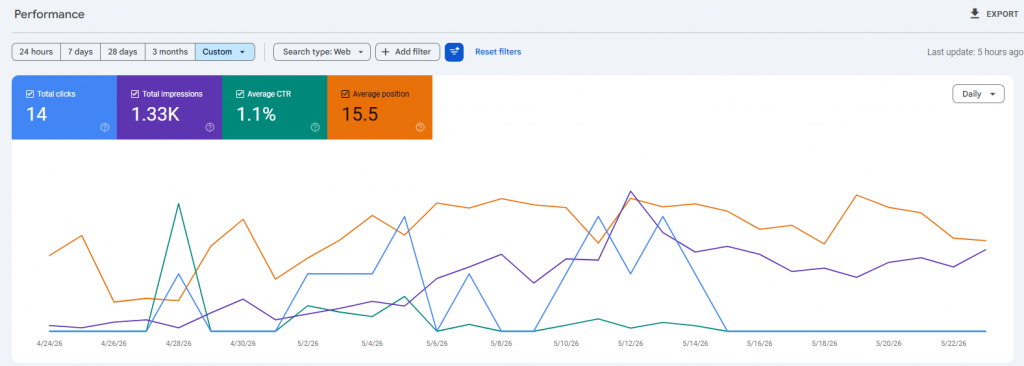
The early Search Console snapshot shows:
- 14 total clicks
- 1.33K total impressions
- 1.1% average CTR
- 15.5 average position
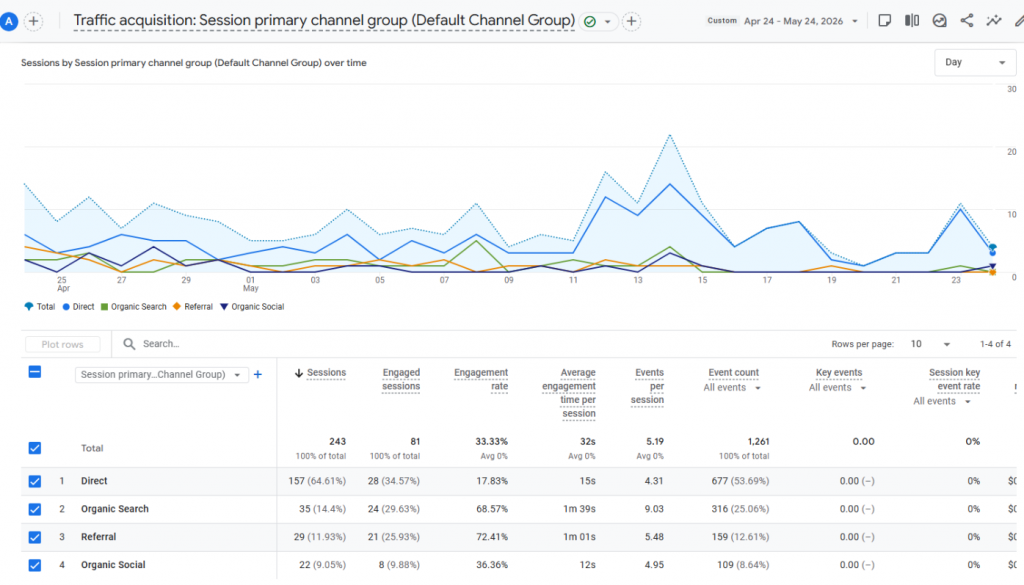
The GA4 traffic acquisition report shows:
- 243 total sessions
- 157 Direct sessions
- 35 Organic Search sessions
- 29 Referral sessions
- 22 Organic Social sessions
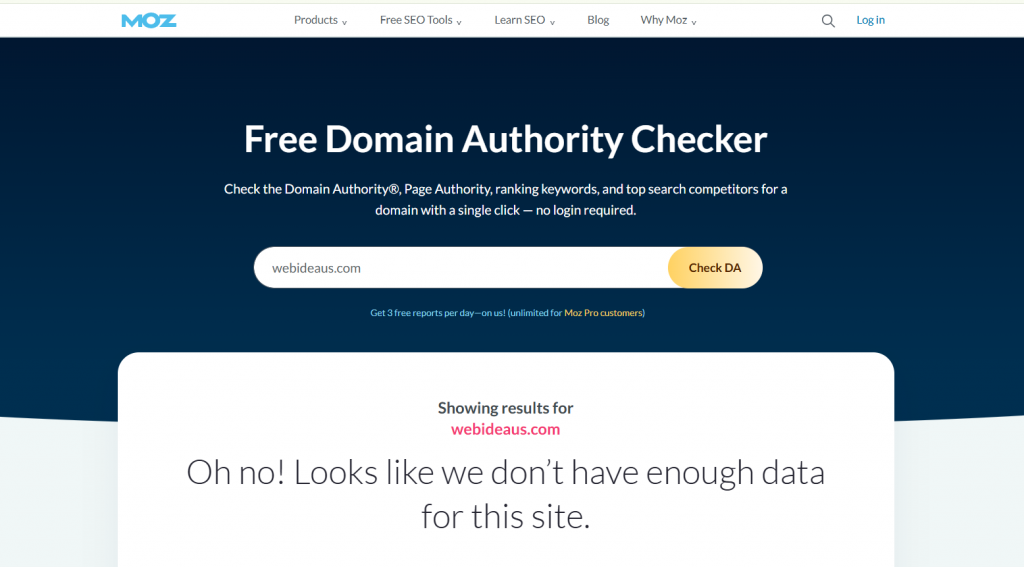
Moz’s Domain Authority checker does not yet have enough data for the site, which is also worth noting. Not because Domain Authority is a direct Google ranking factor — it is not — but because it is a useful reminder that third-party tools often need time before they can say much about a new or recently active site.
So the first conclusion is simple:
The site is visible, but early. Google is testing it. Users are arriving from multiple channels. Organic search exists, but it is not yet the dominant source. There is enough data to observe, but not enough data to make aggressive conclusions.
That is a healthy place for a new marketing site to be.
What I am not doing with this data yet
Before looking at what matters, I want to be clear about what I am not doing.
I am not calling 14 clicks a success story.
I am not calling 1.33K impressions a traffic breakthrough.
I am not treating an average position of 15.5 as a stable ranking result.
I am not assuming that every query shown in Search Console is part of the final keyword strategy.
I am not redesigning the site because one channel has a low engagement rate.
I am not rewriting every title because CTR is 1.1%.
This is one of the biggest mistakes I see after a website launch. People open analytics too early, see unstable data, and immediately start changing things.
A new marketing site needs observation before intervention.
That does not mean doing nothing. It means knowing the difference between a signal and noise.
In the first 30 days, I am looking for directional signals:
- Is Google finding the site?
- Are pages receiving impressions?
- Are any queries starting to match the intended positioning?
- Are users arriving from more than one channel?
- Is tracking working?
- Are there obvious technical or structural problems?
- Is the site beginning to create a measurable baseline?
That is the real job of the first month.
Signal 1: Google is already testing the site
The most important early Search Console signal is not the number of clicks. It is the presence of impressions.
A new or newly rebuilt marketing site does not automatically deserve search visibility. Google has to discover pages, crawl them, index them, and decide where they may be relevant.
In this case, Search Console is showing 1.33K impressions across the early 30-day period.
That tells me the site is not invisible.
It does not mean the site is strong yet. It does not mean the content has authority yet. It does not mean the rankings are stable. But it does mean that Google is already placing the site in search results often enough to create a measurable impression base.
For a young marketing site, that matters.
The average position is 15.5, which is interesting because it places the site around page two territory on average. Again, this is not something I would overstate. Average position can be messy, especially with small samples and varied query intent.
But strategically, I would rather see early impressions around positions 10–30 than no impressions at all.
Early visibility means Google has enough context to test the site.
Now the question becomes: which topics is Google associating with the site?
Signal 2: The query mix is already telling a positioning story
The top query in the attached Search Console data is:
That query generated:
- 6 clicks
- 118 impressions
- 5.1% CTR
- 14.6 average position
This is one of the more meaningful early signals because it aligns closely with the direction of the site.
Web Idea US – Marketing Lab is not only about SEO tactics. It is about marketing systems, website traffic, digital visibility, analytics, and growth logic. So seeing “website growth strategy” appear early is encouraging.
Not because the ranking is excellent. It is not.
But because the query matches the intended positioning.
That is important.
When I review the first 30 days of a new marketing site, I am not only asking, “How much traffic did we get?” I am asking, “What does Google think this site is about?”
Some early queries are messy. That is normal. Search Console shows phrases like:
- website growth
- pages with first impressions
- strategic web marketing analysis
- website traffic channels
- redirect plan relaunch
- web marketing evaluation
- paid traffic tracking
- website relaunch
- google tag manager reviews
- how to relaunch a website
- do I need google tag manager
- website traffic source analysis
This is exactly the kind of query spread I expect from a site that is still building its semantic map.
Some queries fit the site strongly. Some are adjacent. Some are too broad. Some may become future article opportunities. Some should simply be ignored until there is more data.
The important thing is that Google is already testing the site around website growth, traffic, analysis, relaunch, tracking, and marketing strategy. That is directionally aligned with the project.
Signal 3: Organic search exists, but direct traffic is still leading
In GA4, the traffic acquisition report shows 243 total sessions for the period.
The biggest channel is Direct, with 157 sessions, or roughly 64.6% of total sessions.
Organic Search is next with 35 sessions, followed by Referral with 29 sessions and Organic Social with 22 sessions.
This is a very normal early-stage pattern.
For a new marketing site, Direct traffic often includes a mix of actual direct visits, owner activity, bookmarked visits, untagged links, messaging app clicks, and traffic that GA4 cannot confidently classify into another source.
So I do not look at Direct traffic and say, “Great, the brand is strong.”
At this stage, that would be too generous.
I interpret it more carefully:
Direct traffic is currently the largest traffic bucket, but it may include mixed and partially unattributed traffic. Organic Search is present, but still small. Referral and Organic Social are also contributing enough to confirm that the site is not dependent on one source only.
That last point matters.
A healthy marketing site should eventually have multiple discovery paths. Search is important, but it should not be the only way users find the site.
In the first 30 days, I am not expecting channel balance. I am checking whether channel diversity is beginning to appear.
In this case, it is.
Signal 4: Organic Search engagement looks better than the volume suggests
One of the more interesting GA4 signals is the engagement rate by channel.
Organic Search generated 35 sessions and shows a much higher engagement rate than Direct traffic. Direct has more volume, but the engagement rate is much lower.
This is a useful early observation.
It suggests that some users arriving from organic search may be more intentional than users coming through Direct. That would make sense. A search visitor usually arrives with a question, problem, or need. If the article matches that intent, engagement can be stronger even at low volume.
But again, the sample is small.
I would not make a major conclusion from 35 organic sessions. I would not say, “Organic search traffic is high quality” as if this were proven.
A fairer interpretation is:
Organic Search is small but promising. The engagement pattern is worth watching as more articles are published and more search queries begin sending visitors.
That is the kind of sentence I trust in the first 30 days.
Signal 5: CTR is low, but not automatically a problem
The average CTR in Search Console is 1.1%.
At first glance, that may look weak. But CTR depends heavily on ranking position, query intent, SERP layout, brand recognition, and how closely the title matches the searcher’s need.
With an average position of 15.5, a low CTR is not surprising.
Many impressions may be happening below the top results. Some may be on page two. Some may be from broad or exploratory queries where the article is not the perfect match. Some may be from Google testing the page briefly before moving it around.
So I am not treating 1.1% CTR as a title problem yet.
I am watching it, but I am not reacting aggressively.
The stronger CTR clue is at the query level. For example, “website growth strategy” has a 5.1% CTR, which is much more interesting. That tells me that when the site appears for a query close to its strategic positioning, some users are clicking.
That is more valuable than the average CTR.
Averages can hide the useful story.
Signal 6: The site is still too young for authority tools to say much
The Moz Domain Authority checker says it does not have enough data for the domain.
That is not a red flag.
This is where business owners and early marketers often get distracted. They check a third-party authority tool, see no score or weak data, and assume something is wrong.
But authority tools are not real-time truth machines. They rely on their own crawls, link indexes, and data models. For a site that is newly active or recently rebuilt, tool data can lag behind what is actually happening in Google Search Console or GA4.
So for the first 30 days, I treat third-party authority checks as secondary.
The more important questions are:
- Is the site indexed?
- Are pages getting impressions?
- Are any relevant queries appearing?
- Are users reaching the site?
- Is tracking collecting usable data?
- Are there obvious crawl or indexing issues?
Domain-level authority will matter later. But at this stage, I care more about whether the site is entering the search ecosystem at all.
What I’m watching query by query
The query list is where the early SEO story starts to become more useful.
Some queries point toward current content fit. Some point toward future content opportunities. Some point toward possible confusion.
For example, these queries look aligned with the project:
- website growth strategy
- website growth
- strategic web marketing analysis
- website traffic channels
- web marketing evaluation
- paid traffic tracking
- website relaunch
- google tag manager reviews
- do I need google tag manager
- website traffic source analysis
- how to get website analytics
This tells me the site is beginning to appear around topics connected to growth, traffic, analysis, tracking, and website performance.
That is good.
But I also see query fragments that are not yet strong enough to act on. Some have only one or two impressions. Some are broad. Some may never become meaningful. Some are not worth chasing.
This is why I do not build content strategy from one 30-day query export.
Instead, I separate queries into three groups.
1. Queries that confirm positioning
These are queries that match the intended identity of the site.
“Website growth strategy” is the best example so far.
If more queries like this appear over time, that tells me Google is beginning to associate the site with the right strategic themes.
2. Queries that suggest future articles
These are phrases that may deserve their own content later.
For example:
- website traffic channels
- paid traffic tracking
- redirect plan relaunch
- how to relaunch a website
- do I need google tag manager
- website traffic source analysis
Each of these could become a useful article if the pattern repeats or if the topic fits the editorial roadmap.
3. Queries that are too early to trust
These are one-impression or low-volume queries that may be noise.
I do not ignore them completely, but I do not let them drive strategy.
A new marketing site needs enough content and enough time before query patterns become reliable.
What I’m watching in GA4
In GA4, I care less about total sessions in the first 30 days and more about whether the data structure makes sense.
The current GA4 report shows four main channels:
- Direct
- Organic Search
- Referral
- Organic Social
This is useful because it confirms that GA4 is receiving channel-level data and that traffic is not being captured as one messy block.
The most important GA4 checks at this stage are:
- Are sessions being recorded?
- Are channel groups visible?
- Is Organic Search separated from Direct?
- Are referral sources showing?
- Is engagement data collecting?
- Are events firing?
- Are key events configured correctly?
In the attached report, key events are still showing 0.00, which means this is an area to review later.
That may be fine if key events have not been configured yet. But from a performance marketing perspective, a site cannot stay at the “sessions only” stage forever.
Eventually, I want to know more than “people visited.”
I want to know:
- Did they scroll?
- Did they click important links?
- Did they visit Start Here?
- Did they move from an article to a resource?
- Did they click a CTA?
- Did they engage with a dashboard?
- Did they return later?
- Did they enter through organic search and explore more than one page?
The first 30 days tell me that traffic measurement exists.
The next stage is making sure conversion and engagement measurement are more meaningful.
Why I’m not optimizing everything yet
This is where discipline matters.
A new marketing site can easily become a victim of over-optimization. You publish a few articles, check Search Console every day, and start adjusting titles, headings, categories, menus, internal links, and metadata before Google has had enough time to understand the site.
That can create noise.
For this project, the current strategy is still to build a base of content before deep SEO optimization. That means publishing enough articles for Google and users to understand the site’s topical direction.
In practical terms, I want the site to build a stronger semantic foundation around:
- website traffic
- digital marketing analysis
- SEO experiments
- post-launch performance
- analytics setup
- traffic channels
- content architecture
- visibility strategy
- tools and reviews
- realistic case studies
Once there are more articles, internal linking will become more useful. Category pages will have more substance. Start Here can become a stronger curated entry point. Tools and Resources can support commercial intent later.
But right now, the site is still building its base.
So the first 30 days are not a final judgment. They are a calibration period.
What would worry me in the first 30 days
The current data is early but not concerning. However, there are some things that would worry me if they appeared.
I would be concerned if:
- Search Console showed no impressions at all.
- GA4 showed no Organic Search sessions after pages were indexed.
- Every query was completely unrelated to the site’s positioning.
- Direct traffic was the only visible channel.
- Pages were published but not indexed.
- Engagement was near zero across every channel.
- Important pages had no internal path from the homepage or Start Here.
- Tracking was broken or double-counting sessions.
- The site had no clear category structure.
- Search visibility appeared only for branded or irrelevant queries.
That is not what I see here.
Instead, I see a site that is beginning to show up, beginning to receive mixed traffic, and beginning to generate relevant search impressions.
That is enough for now.
What I would do next
Based on the first 30 days, I would not rush into heavy technical changes.
I would do a few practical things.
First, I would continue publishing strategically aligned articles. The early query data suggests that website growth, traffic sources, marketing analysis, relaunch planning, and tracking are natural topic clusters.
Second, I would start building internal links more intentionally, but not excessively. A new site needs clean paths between related ideas. For example, an article about early website performance should connect to articles about digital marketing analysis before launch, website traffic sources, and GA4 tracking.
Third, I would review GA4 key events. If the site has meaningful actions — newsletter signup, contact click, resource download, dashboard visit, affiliate click, or Start Here visit — those should eventually become measurable.
Fourth, I would keep watching query movement in Search Console. The most useful question is not whether one query ranks today. It is whether the same topical themes keep appearing over time.
Fifth, I would avoid obsessing over Domain Authority right now. The site needs content depth, crawl consistency, internal structure, and eventually links. A third-party authority score will not be the first meaningful indicator.
The fair interpretation of the first 30 days
Here is the fairest way I would describe this data:
Web Idea US – Marketing Lab is visible in early search testing. Google Search Console is showing impressions, clicks, and relevant queries around website growth, marketing analysis, traffic, tracking, and relaunch topics. GA4 shows traffic from multiple channels, with Direct currently leading and Organic Search beginning to contribute. The sample is still small, so the data should be treated as directional rather than conclusive.
That is not dramatic.
But it is useful.
And honestly, that is how early marketing data usually works.
The first 30 days of a new marketing site are not supposed to answer every question. They are supposed to show whether the system is alive.
In this case, the system is alive.
Now the work is to keep building the content base, strengthen the internal structure, improve measurement, and watch which topics earn more visibility as the site grows.
That is the experiment.
And this is the baseline.