
At the beginning, a marketing blog can feel simple.
You choose a topic.
You write an article.
You publish it.
Maybe you share it on social media.
Then you check Google Search Console and hope something starts moving.
That is how many blogs begin. And honestly, that is not a bad starting point. Publishing is often the first real step because until something is live, there is nothing to measure, nothing to improve, and nothing for search engines or readers to react to.
But at some point, a blog has to become more than a place where articles are posted.
That is the shift I am making now with Web Idea US – Marketing Lab.
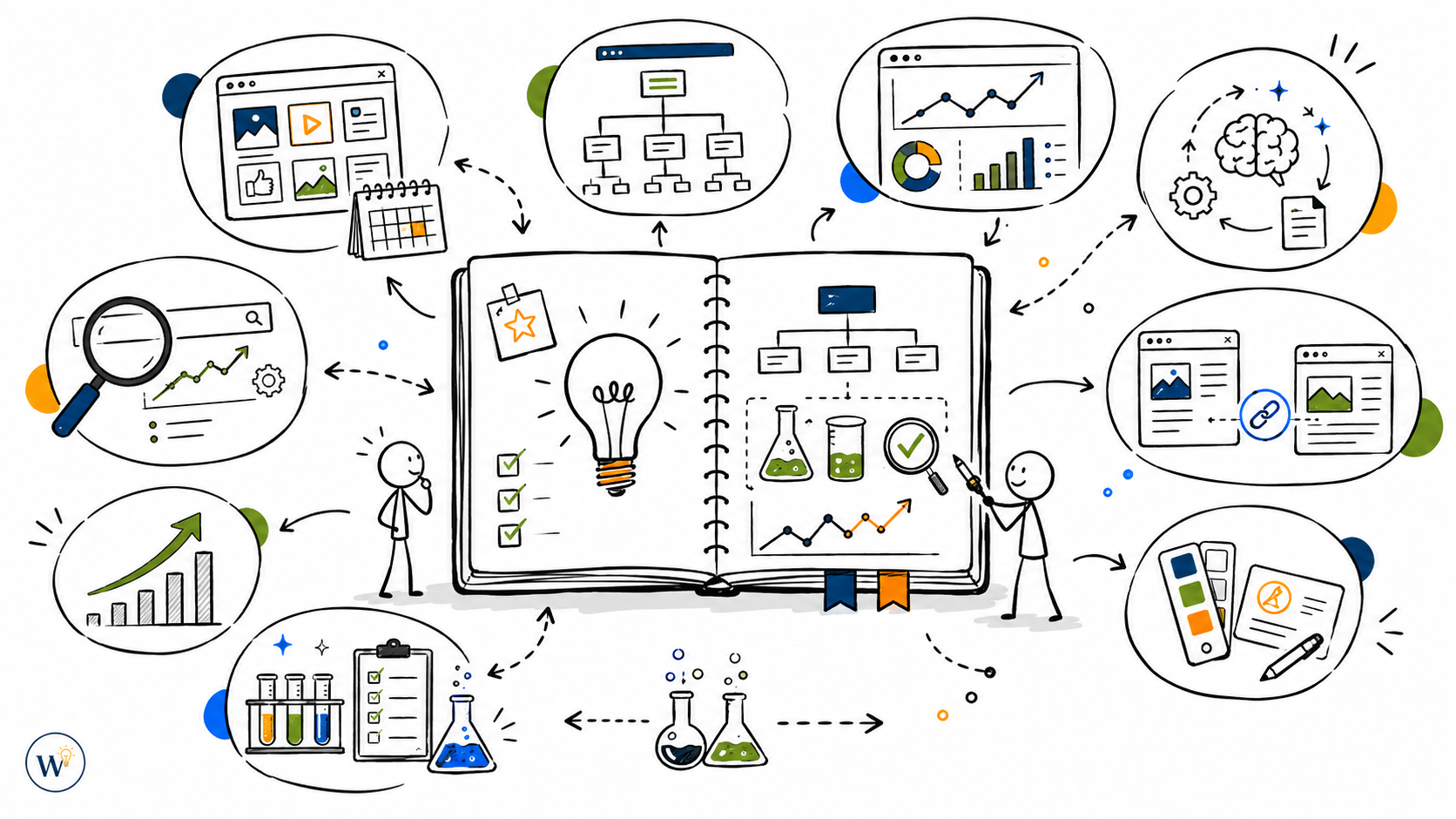
I am not treating this website as a generic marketing blog. I am treating it as a growth system: a connected structure where content, SEO, visuals, GPT-assisted workflows, internal links, analytics, and future monetization all work together.
This article is a build-in-public note about that shift.
It is also a practical look at my current marketing blog growth strategy: what I am building, why I am building it this way, and what I am watching as the system starts to take shape.
The difference between publishing articles and building a growth system
Publishing articles is an activity.
Building a growth system is a strategy.
That difference matters.
A blog can have many articles and still feel weak if those articles are disconnected. One post answers one question. Another post targets a different idea. A third article is interesting but has no clear relationship to the rest of the site. Over time, the website becomes a collection of content, but not necessarily a strong digital asset.
A growth system works differently.
In a growth system, every article has a role. Some articles explain foundational ideas. Some document experiments. Some break down realistic case studies. Some review tools. Some show the project’s own evolution. Some become resources that readers can return to again and again.
The goal is not just to publish more. The goal is to create stronger connections between topics, categories, user questions, search intent, and business outcomes.
That is why I am thinking about this blog in layers:
- content strategy
- SEO structure
- visual identity
- GPT-assisted workflow
- internal linking
- tracking and analytics
- future monetization
- AI search and discovery
Each layer has value on its own. But the real value comes when they start supporting each other.
Why I am building the system before over-polishing every page
One decision I made early is not to over-optimize every article too soon.
That may sound strange coming from someone who works with SEO, SEM, analytics, traffic, and digital strategy. But for a young content project, premature polishing can become a trap.
It is easy to spend too much time adjusting one title, rewriting one intro, testing five meta descriptions, or perfecting one hero image before the website has enough content depth to show a pattern.
Right now, the stronger priority is building a solid base.
For Marketing Lab, that means creating a first group of articles across the main site categories:
Experiments.
Case Studies.
Tools & Reviews.
Build in Public.
Resources.
This gives the site a clearer semantic shape. It helps readers understand what the project is about. It gives Google more context. It creates future internal linking opportunities. It also gives me something real to measure.
Google’s own guidance emphasizes helpful, reliable, people-first content rather than content created only to manipulate rankings. That aligns with how I want this site to grow: useful first, structured carefully, optimized without becoming mechanical.
The first stage is not perfection.
The first stage is enough structured depth for the site to become understandable.
My current marketing blog growth strategy
My current marketing blog growth strategy is built around one idea:
A blog becomes stronger when it behaves like a system, not a sequence of isolated posts.
For this project, I am organizing the system around five practical questions.
First, what topics should this site be known for?
Second, what categories help organize those topics clearly?
Third, what article types support the site’s authority?
Fourth, how will readers and search engines move from one idea to another?
Fifth, how will I measure whether the system is actually working?
Those questions sound simple, but they change how I make decisions.
For example, I am not choosing topics only because they sound interesting. I am choosing topics because they support the site’s larger positioning around SEO, website traffic, visibility, analytics, growth strategy, AI discovery, and practical marketing logic.
I am also not treating each article as a standalone asset. I am thinking about how each one can connect to future case studies, tool reviews, resource pages, and build-in-public updates.
That is the real strategy behind the blog.
Not just “write more content.”
Build a structure that can grow.
Layer 1: Content as the foundation
Content is the visible layer of the system.
It is what people read. It is what search engines crawl. It is what can be shared, linked, quoted, updated, and repurposed.
But content is only useful when it has a clear role.
For Marketing Lab, I am using different article types for different jobs.
Experiment articles document what I am testing or observing. They are useful because they show thinking in motion.
Case studies explain realistic business situations and what went wrong. They are useful because they show cause and effect.
Tools & Reviews articles help readers understand what tools are useful, when they help, and where they are limited.
Build in Public articles show how this project is evolving as a real asset.
Resources will eventually become the reference layer: tools, checklists, frameworks, templates, and useful pages readers can come back to.
This category structure matters because it prevents the blog from becoming random.
A business owner may come for an article about website traffic. A marketer may come for a tools article. A future employer or collaborator may come to understand how I think. Google may enter through one article and then crawl related pages.
Each content type has a job.
That is the foundation of the growth system.
Layer 2: SEO structure without turning the site into a content machine
SEO is part of the system, but I do not want the site to feel like it was built only for search engines.
That balance is important.
I want each article to have a clear keyword direction, but I do not want the writing to become stiff. I want strong titles and metadata, but not titles that feel manufactured. I want internal links and topical clusters, but not a website that feels over-engineered for bots instead of people.
The SEO structure I am building is practical:
Each article has one main keyword idea.
Secondary keywords support the topic naturally.
Headings help organize the article for both readers and search systems.
Categories create topical separation.
Internal links will eventually connect related ideas.
Search Console data will show which queries Google is testing.
The goal is not to force every article to rank immediately.
The goal is to help the site become clearer over time.
That matters even more now because discovery is no longer only about classic Google rankings. Search results are more complex, AI answers are changing how people find information, and content needs to be understandable across different discovery systems.
Research and industry reporting continue to show that marketers are investing in thought leadership, AI for content optimization, and content formats that support trust and visibility. Content Marketing Institute reported that 52% of B2B marketers expected increased investment in thought leadership content in 2025, and 40% expected increased investment in AI for content optimization and performance.
That does not mean every business needs to chase every trend.
It means content needs stronger structure, clearer expertise, and better systems behind it.
Layer 3: Visuals as part of the growth system
Visuals are not decoration for this project.
They are part of recognition.
Every article needs to feel like it belongs to the same world: Web Idea US – Marketing Lab. That means consistent visual language, brand colors, recognizable design elements, and images that feel connected to the article’s concept.
This matters for several reasons.
First, visuals influence trust. A reader may not consciously analyze the design system, but they feel whether a site looks intentional or random.
Second, visuals support social sharing. When an article is shared on Facebook, LinkedIn, or elsewhere, the featured image becomes part of the first impression.
Third, visuals help the project feel like a real brand, not just a folder of blog posts.
For me, the goal is not to create overly polished corporate graphics. The goal is to create a clean, strategic, slightly lab-like visual identity that matches the project’s positioning: where marketing ideas are tested in public.
So the visual workflow is now part of the publishing workflow.
Article idea.
Keyword direction.
Structure.
Draft.
SEO metadata.
Featured image concept.
Social sharing copy.
Publication.
Tracking.
That sequence is important because it turns publishing into a repeatable process.
Layer 4: GPT workflow as a production system, not a shortcut
AI is part of my workflow, but not in the lazy way people often imagine.
I am not using GPT to replace strategy. I am using it to structure thinking, speed up production, test angles, organize article formats, and support repeatable editorial workflows.
That distinction matters.
A weak AI content workflow starts with a vague prompt and produces generic text.
A stronger GPT workflow starts with context, role, audience, article type, keyword direction, category logic, tone, internal linking goals, and the business problem the article should solve.
For Marketing Lab, I am building reusable prompt systems for:
- pillar articles
- experiment articles
- case studies
- tools and reviews
- SEO titles and meta descriptions
- internal linking suggestions
- hero image prompts
- social sharing posts
- future resource pages
This is not just about saving time. It is about consistency.
When every article follows the same strategic logic, the site becomes easier to grow. The voice stays more consistent. The category distinctions become clearer. The internal linking opportunities become easier to identify. The future product layer becomes more natural because the workflow itself can eventually become a paid artifact.
That is one of the long-term ideas behind this project: the prompts and workflows used inside the lab may later become part of a practical Marketing Lab Prompt System.
Not as “random AI prompts.”
As tested content workflows built from a real website.
Layer 5: Internal linking as the site’s connective tissue
Internal linking is where a blog starts to become a structure.
Without internal links, articles can sit separately from each other. A reader lands on one page, reads it, and leaves. Google crawls pages, but the relationship between ideas may not be as clear as it could be.
With internal linking, the site starts to behave more intelligently.
A foundational article can point to a case study.
A case study can point to a tool review.
A tool review can point to a resource page.
A build-in-public update can point back to the experiment it is discussing.
A Start Here page can guide new readers into the strongest materials.
Google’s link guidance explains that links help Google find pages and understand relevance, and that useful anchor text helps both people and Google make sense of the linked content.
That is why I am not treating internal linking as an afterthought.
I am treating it as part of the growth system.
At this stage, I am still building the base. I do not need a perfect internal linking structure on day one. But I do need to know which articles are likely to become central nodes.
For example, an article about digital marketing analysis before website launch can become a foundational link target. A case study about a business launching without analysis can support that idea with a realistic scenario. A tools article can show what resources help with the analysis. A Build in Public article can explain how I am applying similar thinking to my own project.
That is how topical authority becomes more than a phrase.
It becomes architecture.
Layer 6: Tracking turns publishing into learning
A growth system needs feedback.
Without tracking, publishing becomes guesswork.
For this project, the basic measurement setup matters because I want to understand what is happening after each article goes live.
I am watching signals like:
- indexing speed
- impressions
- early queries
- ranking movement
- clicks
- page engagement
- referral sources
- social sharing behavior
- future CTA clicks
- internal link movement
Not every signal is equally important at the beginning.
For a young content project, I care a lot about whether Google is discovering the pages, what queries appear, whether impressions start coming in, and whether certain topics receive faster early testing than others.
Later, I will care more about stronger engagement metrics, conversion paths, resource downloads, affiliate clicks, email signups, and product interest.
This is why GA4, Google Search Console, and GTM are not just technical tools in the background.
They are part of the learning system.
The article is not finished when it is published.
Publication is the moment the test begins.
Layer 7: Blog growth is not only about traffic
Traffic matters, of course.
But traffic by itself is not the whole goal.
A marketing blog can attract visitors and still fail strategically if the visitors do not understand what the site is about, do not trust the author, do not move to another page, do not remember the brand, and do not connect the content to a larger value proposition.
That is why I am thinking about blog growth in a wider way.
For Marketing Lab, growth means:
More search visibility.
Clearer topical authority.
Better internal structure.
More recognizable branding.
Stronger proof of expertise.
More useful content assets.
Better measurement.
Future monetization paths.
A stronger professional portfolio.
This is especially important because the site has more than one purpose.
It is not only a content site. It is also a public portfolio, a testing environment, a future affiliate base, a possible artifact shop, and a professional positioning asset.
That changes the strategy.
A generic blog might ask, “How do I get more traffic?”
This project asks, “How do I build a system that can create traffic, trust, evidence, and future opportunities?”
That is a better question.
A simple example: one article can support several parts of the system
Let’s say I publish an article about tools for digital marketing analysis.
On the surface, that is one article.
But inside the growth system, it can do several jobs.
It can rank for tool-related keywords.
It can support a foundational article about pre-launch marketing analysis.
It can link to a case study where a business skipped analysis.
It can become part of a Resources page.
It can support future affiliate opportunities.
It can become a social post.
It can produce a visual asset.
It can later be updated based on new tools or workflow changes.
It can become part of a downloadable prompt or checklist product.
That is how one article becomes more than content.
It becomes a node in the system.
The same logic applies to this article. This build-in-public post explains the strategy behind the blog. Later, it can link to actual experiments, dashboard notes, internal linking updates, tool reviews, and monetization reflections.
That is the difference between writing posts and building an asset.
What I am not trying to do right now
It is also important to define what I am not doing yet.
I am not trying to monetize too early.
I am not hiding the best content behind a paywall.
I am not trying to publish thin articles just to increase volume.
I am not chasing every keyword with no connection to the site’s positioning.
I am not obsessing over perfect design before the content base exists.
I am not pretending early signals are final conclusions.
At this stage, the goal is to build the base intelligently.
That means enough content to show direction, enough structure to support discovery, enough tracking to learn, and enough consistency to make the project recognizable.
Later, I can polish.
Later, I can refine older titles.
Later, I can improve internal links.
Later, I can create stronger resource pages.
Later, I can package workflows into products.
But first, the system needs enough substance.
What I will watch next
As the blog grows, I will be watching several signals.
Which categories get indexed and tested fastest?
Which topics start receiving impressions first?
Which articles attract clicks, not just impressions?
Which pages naturally support internal links?
Which visuals perform better in social previews?
Which GPT workflows save time without weakening quality?
Which topics feel useful enough to become resources or artifacts?
Which articles should become Start Here recommendations?
I do not expect every article to perform equally.
That is normal.
Some articles are designed for search. Some are designed for authority. Some are designed to explain the project. Some are designed to support future monetization. Some are connective pieces that make the whole site easier to understand.
A growth system needs all of those roles.
The mistake would be judging every article by the same metric too early.
Final takeaway: the blog is becoming infrastructure
The biggest shift in my thinking is this:
I am no longer building “a blog.”
I am building marketing infrastructure.
Content is part of it. SEO is part of it. Visuals are part of it. GPT workflow is part of it. Internal linking is part of it. Tracking is part of it. Future products and affiliate logic may become part of it too.
That is what makes the project interesting.
A blog can publish ideas.
A growth system can organize ideas, test them, connect them, measure them, and turn them into long-term value.
That is the direction I am building toward with Web Idea US – Marketing Lab.
Not a content machine.
Not a random blog.
A public marketing lab where the system itself becomes part of the experiment.