
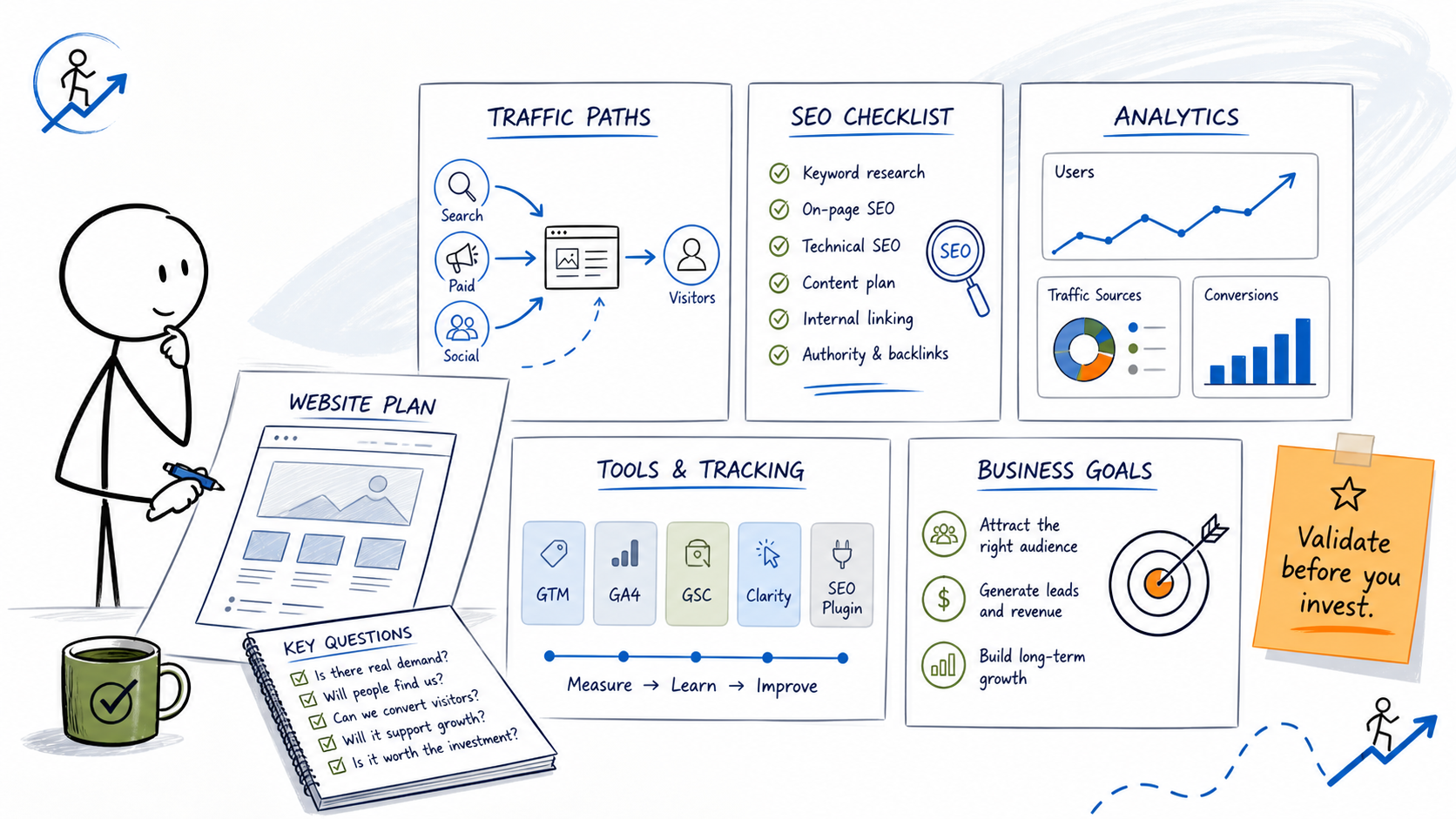
A website can be one of the smartest business investments a company makes.
It can clarify the offer, support sales, attract search traffic, build trust, help paid campaigns convert, educate prospects, and create a digital asset that keeps working after the first launch excitement is gone.
But a website can also become an expensive decoration.
I have seen businesses invest in design, development, branding, copy, photos, plugins, and advertising before answering the most important question:
What exactly does this website need to prove, attract, explain, and convert?
That question sounds simple. In practice, many website projects skip it.
The result is familiar. The website looks good, but traffic does not come. Ads are launched, but leads are weak. SEO is discussed after launch instead of before structure decisions are made. Analytics are installed, but nobody knows what signals matter. The business owner starts asking, “Why is nothing happening?”
Usually, the answer is not that the website is “bad.”
The answer is that the website was built before the business validated the strategy behind it.
This article is my practical framework for what businesses should validate before investing in a website. Not because every project needs months of research, but because every serious website investment needs enough strategic clarity to avoid preventable mistakes.
A Website Is Not the Strategy. It Is the Asset That Carries the Strategy.
One of the most common mistakes I see is treating the website as the solution by itself.
A business says:
“We need a new website.”
But under that sentence, there are usually several different needs:
The business needs more leads.
The business needs better trust.
The business needs to explain a complicated service.
The business needs to compete locally.
The business needs to support paid traffic.
The business needs to look more professional.
The business needs to replace referrals with a scalable acquisition channel.
Those are different business problems.
They may all involve a website, but they do not require the same website strategy.
A local service company that needs phone calls from nearby customers does not need the same website structure as a SaaS startup educating prospects over a long buying cycle. An e-commerce brand does not need the same conversion path as a consulting business. A clinic, moving company, law firm, home care agency, and B2B service provider may all need “websites,” but the validation work behind them is completely different.
Before investing in a website, the business needs to validate the job of the website.
Is it supposed to generate leads?
Support sales conversations?
Rank in Google?
Convert paid traffic?
Build authority?
Educate buyers?
Support hiring?
Help local customers find the business?
Prepare for future content and affiliate monetization?
When this is unclear, everything else becomes blurry.
The design becomes subjective. The copy becomes generic. The SEO structure becomes an afterthought. The analytics setup becomes decorative. The launch becomes a moment, not a growth system.
Validate the Business Goal First
The first thing to validate is not the color palette, the homepage layout, or the platform.
The first thing to validate is the business goal.
A website investment should be connected to a measurable business objective. That does not mean every business needs complex forecasting before launch, but it does mean the website should have a clear purpose.
For example:
A dental clinic may want more local appointment requests.
A moving company may want more quote requests from specific cities.
A consultant may want better-qualified discovery calls.
An e-commerce brand may want higher conversion from product pages.
A SaaS startup may want demo requests from a defined buyer segment.
A personal brand may want credibility, subscribers, and inbound opportunities.
Each goal changes the website.
If the goal is lead generation, the site needs strong service pages, trust signals, clear calls to action, and conversion tracking.
If the goal is organic visibility, the site needs keyword mapping, content architecture, technical SEO basics, and crawlable structure.
If the goal is paid traffic, the landing pages need message match, fast loading, conversion clarity, and clean tracking.
If the goal is authority building, the site needs content depth, editorial consistency, and internal linking.
A vague goal creates a vague website.
A validated goal gives the website a direction.
Validate Search Demand and Customer Intent
The next thing to validate is whether people are actually searching for what the business offers — and how they describe it.
This is where many businesses make a quiet but expensive mistake. They build their website around internal language instead of customer language.
The company says “integrated relocation support.”
Customers search “moving company near me.”
The company says “aesthetic dental solutions.”
Customers search “cosmetic dentist in [city].”
The company says “growth enablement consulting.”
Customers search “marketing consultant for small business.”
The business may not be wrong in how it describes itself. But if the website ignores how customers search, the site can become invisible to organic demand.
Google’s own SEO guidance emphasizes helping search engines discover and understand content, and that SEO works best when it supports people-first content rather than content created only for search engines.
That balance matters.
Keyword research is not just about stuffing phrases into pages. It is a validation exercise. It helps answer:
What are people searching for?
Are they searching locally, nationally, or globally?
Are they looking for information, comparison, pricing, reviews, or direct service?
Which searches show buying intent?
Which searches are too broad?
Which searches are realistic for the business to compete for?
Which topics require dedicated pages?
A website should not be built only around what the business wants to say. It should also be built around what the market is already trying to find.
Validate the Traffic Strategy Before Launch
A website without a traffic strategy is like a store with no road leading to it.
It may exist. It may look professional. It may be technically live. But that does not mean the right people will arrive.
Before investing in a website, the business should validate where traffic is expected to come from.
Organic search?
Google Ads?
Local SEO?
Social media?
Email?
Referrals?
Marketplaces?
AI search and answer engines?
Partnerships?
Content distribution?
Direct brand traffic?
Each traffic source has different requirements.
SEO needs structure, content, technical accessibility, and time.
Google Ads need landing pages, conversion tracking, budget clarity, and keyword economics.
Local SEO needs location relevance, Google Business Profile alignment, reviews, local landing pages, and trust signals.
Social traffic needs strong hooks, shareable positioning, and a reason to move from platform to website.
AI discovery needs clear, well-structured, helpful content that explains topics in a way machines can understand and summarize.
Referral traffic needs credibility, proof, and fast clarity when someone lands on the site.
This is where I like to ask a very practical question:
If the website launches next month, what are the first three realistic sources of traffic?
If nobody can answer that, the business is not ready to treat the website as a growth asset.
It may still be ready to build a basic credibility site. But that is a different investment logic.
Validate the Competitive Visibility Landscape
Before investing in a website, businesses should look at who is already visible.
Not just who the business owner considers a competitor in real life, but who appears when customers search.
These are not always the same companies.
A business may think its competitors are the three companies down the street. But in Google, the real competitors may be directories, national brands, marketplace platforms, review sites, local aggregators, Reddit discussions, YouTube videos, AI-generated answers, or businesses with stronger content architecture.
A competitor visibility review should answer:
Who ranks for the most important service searches?
What types of pages are ranking?
Are they homepages, service pages, blog posts, directories, maps, or review pages?
How strong is their content?
Do they have local landing pages?
Do they explain pricing, process, or comparisons?
What trust signals do they show?
Are they using paid search?
Are they visible in map results?
Do they dominate informational searches before the customer is ready to buy?
This does not require overcomplication at the beginning.
Even a basic competitor visibility audit can prevent bad assumptions.
For example, if every visible competitor has dedicated city pages and your site plans to launch with only one generic service page, that is a signal. If competitors explain pricing and your site avoids it entirely, that is a signal. If directories dominate the search results, the traffic strategy may need to include profile optimization and reputation building, not only website pages.
A website investment becomes smarter when the business understands the visibility environment before building into it.
Validate the Offer and Messaging
A website cannot fix an unclear offer.
It can expose it faster.
Before investing in a website, the business should validate whether the offer is understandable to a new visitor within seconds.
What does the business do?
Who is it for?
Where does it operate?
Why should someone trust it?
What problem does it solve?
What should the visitor do next?
This sounds basic, but many websites fail here.
They open with broad statements like:
“Solutions for modern businesses.”
“Your trusted partner in success.”
“We help you grow.”
“Quality service you can count on.”
These lines may sound polished, but they do not help the visitor make a decision.
Strong website messaging does not need to be aggressive. It needs to be specific.
For example:
“We help local service businesses build website and traffic strategies before they spend money on redesigns or ads.”
That sentence does more work than “We help businesses grow online.”
Before investing in the website, the business should validate the message. This can be done through customer conversations, sales call notes, search query research, competitor review mining, ad testing, or simple landing page experiments.
The goal is not to find a perfect slogan.
The goal is to avoid building a full website around language that customers do not recognize or care about.
Validate the Conversion Path
Traffic alone does not create business value.
The website needs a conversion path.
A conversion path is the route from visitor attention to meaningful action. That action could be a form submission, phone call, booking, quote request, purchase, email signup, demo request, consultation request, or another key step.
Before investing in a website, the business should validate what conversion actually means.
For example, a lead generation website may need:
A clear primary CTA
Service-specific forms
Clickable phone numbers
Trust signals near decision points
Testimonials
Before/after examples
Pricing guidance or expectation setting
FAQ sections
Location details
Fast-loading pages
Thank-you pages or event tracking
A content-driven site may need:
Email signup
Related article paths
Resource downloads
Internal links to pillar content
CTA blocks
Author credibility
Topic clusters
An e-commerce site may need:
Product clarity
Shipping and return information
Reviews
Size or compatibility guidance
Cart flow
Payment trust
Mobile checkout speed
Google has long reported that mobile users are likely to abandon slow pages, and one Google-cited benchmark says 53% of visits may be abandoned if a mobile page takes longer than three seconds to load.
That matters because conversion is not only about copy. It is also about friction.
A website can have the right offer, but if the page is slow, confusing, or difficult on mobile, the conversion path breaks.
Before investing heavily, businesses should validate the journey from landing page to action.
Validate Measurement Before Spending on Traffic
One of the most expensive mistakes is launching campaigns before measurement is ready.
A business invests in a website, starts Google Ads, boosts posts, hires an SEO vendor, publishes content, and then realizes nobody knows which actions matter.
Page views are visible. But are form submissions tracked?
Phone clicks?
Quote requests?
Bookings?
Newsletter signups?
Outbound clicks?
Scroll depth?
Important button clicks?
Thank-you page visits?
Google Analytics 4 uses events to measure user interactions, and Google’s documentation explains that recommended and custom events can be configured to measure more useful behaviors for a business.
That is an important point.
Analytics should not be treated as a plugin installed at the end. It should be part of website planning.
Before investing in a website, the business should define:
What is a meaningful lead?
Which actions should be tracked?
Which events should become key events?
Will Google Tag Manager be used?
Will Google Ads conversions be imported or configured separately?
Will form submissions be tracked reliably?
Will phone calls be tracked?
Will CRM data connect later?
What reports will actually be reviewed?
Google’s Analytics Help documentation explains that Google Ads conversions can be created from Google Analytics key events, which helps create a more consistent way to measure important actions across Google Ads and Analytics.
In practical terms, this means tracking choices made before launch can affect how cleanly the business understands performance later.
A website investment without measurement is not just incomplete. It is harder to improve.
Validate Whether SEO Should Be Built In From the Start
SEO does not need to make a website slow or overcomplicated. But SEO thinking should be present before launch.
This does not mean every page needs perfect optimization on day one. It means the structure should not block future visibility.
Before investing in a website, validate:
What pages are needed for core services?
Do important services deserve separate pages?
Are locations important?
Should location pages exist?
Are informational articles needed?
What should the URL structure look like?
How will internal linking work?
What should the homepage rank for, if anything?
Which pages are commercial and which are educational?
Are there duplicate or thin pages?
Can Google crawl and understand the site?
A common mistake is building one beautiful page that tries to cover everything.
That can work for a very simple business or early validation stage. But for SEO, one generic page often cannot satisfy multiple search intents.
If a business offers five distinct services, customers may search for each service differently. If the website puts all five services into one short section, the site may not have enough relevance for any of them.
Website structure is not just a design decision. It is a visibility decision.
Validate Paid Traffic Economics Before Building Landing Pages
Paid traffic can create speed, but it does not fix weak economics.
Before investing in a website that will rely on Google Ads, Meta Ads, LinkedIn Ads, or another paid channel, the business should validate the basic numbers.
What is the expected cost per click?
What conversion rate is realistic?
What is a lead worth?
What percentage of leads become customers?
What is the average order value or customer lifetime value?
How much can the business afford to pay for a lead?
How long is the sales cycle?
Does the landing page match the ad promise?
Is there enough budget to learn?
If the numbers do not work, a prettier landing page will not solve the problem.
For example, if clicks cost $18 and the landing page converts at 2%, the business is paying roughly $900 per lead before sales qualification. That may be fine for a high-value service. It may be impossible for a low-margin offer.
This is why paid traffic planning should happen before the site structure is finalized.
A website built for organic search may need educational depth and topical architecture. A website built for paid campaigns may need focused landing pages, stronger offer clarity, and tighter conversion paths.
Sometimes it needs both.
But the business should know that before investing.
Validate Trust Signals and Proof
A website asks visitors to believe something.
Before investing in design, the business should validate what proof it can show.
Proof can include:
Reviews
Testimonials
Case studies
Before/after examples
Certifications
Client logos
Portfolio work
Years of experience
Process explanation
Media mentions
Guarantees
Transparent pricing
Team information
Photos of real work
Local presence
Industry knowledge
Not every business has all of these. That is normal.
But every business should know which trust signals are available and where they belong.
A new business may not have dozens of reviews, but it can show founder experience, process clarity, examples, strong educational content, or transparent expectations.
An established business may have reviews but fail to use them near conversion points.
A service business may have great offline reputation but no digital proof.
A website investment becomes stronger when proof is planned into the structure instead of added randomly later.
Validate Content Architecture for the Future
A website is rarely finished at launch.
At least, a growth-oriented website should not be.
Before investing, businesses should validate whether the website can grow.
Can new articles be added easily?
Can future case studies be published?
Can tools or resources be organized?
Can internal links support topic clusters?
Can service pages expand?
Can landing pages be created for campaigns?
Can analytics support future experiments?
Can the site support AI-era discovery with clear, structured explanations?
This matters because many websites are built as static brochures. They look complete on launch day but become difficult to expand.
For businesses that want SEO, content marketing, thought leadership, resources, affiliate content, or long-term visibility, this is a problem.
A website should be designed as a system, not just a set of pages.
That does not mean the first version needs everything. It means the foundation should not fight future growth.
A Practical Example: The Website That Looked Ready But Wasn’t
Imagine a local home service company preparing to invest in a new website.
The old website looks outdated. The owner wants something modern. A designer creates a clean layout. The homepage is attractive. There are pages for services, a contact form, and a few stock images. The business launches and expects better results.
But after launch, traffic stays low.
The business starts ads. Clicks come in, but leads are expensive. Some visitors fill out the form, but many are outside the service area. Google Analytics is installed, but form submissions are not tracked correctly. The service pages use company language, not customer search terms. The site has no city-specific structure. Competitors are ranking with location pages, reviews, and detailed service content.
Nothing about this situation is unusual.
The website looked fine. But the business skipped validation.
Before investing, they should have checked:
Which services had search demand
Which cities mattered most
Who was ranking locally
What competitors included on service pages
Whether paid traffic economics made sense
What counted as a qualified lead
How forms and calls would be tracked
What trust signals needed to appear
Whether each major service needed its own page
The redesign was not wasted entirely. But it had to be corrected after launch, which is usually more expensive than planning properly before launch.
The Website Investment Validation Checklist
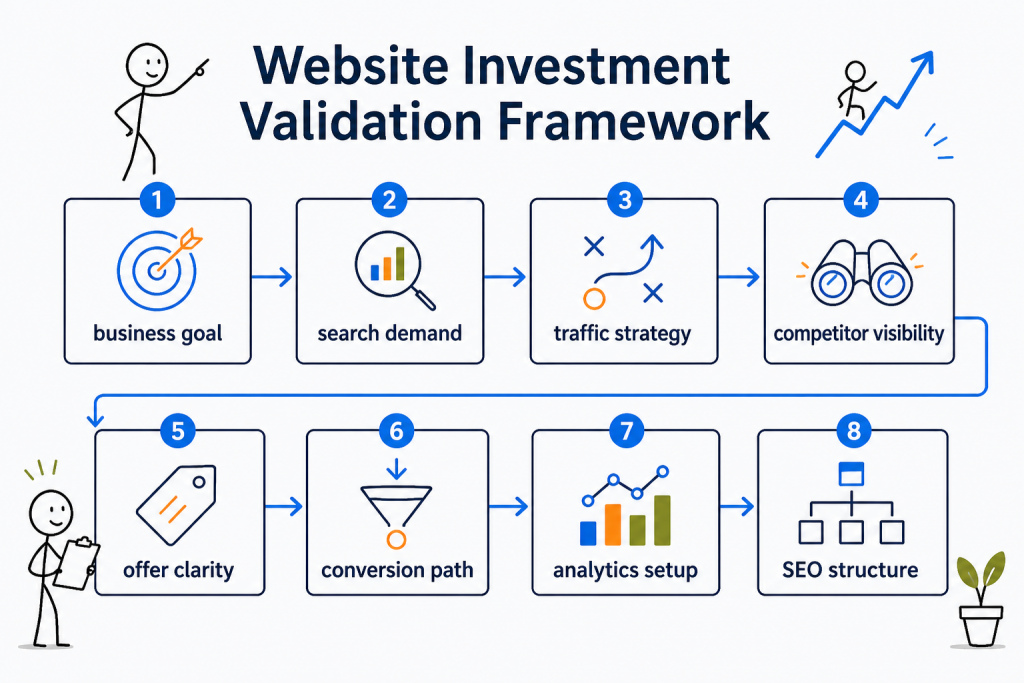
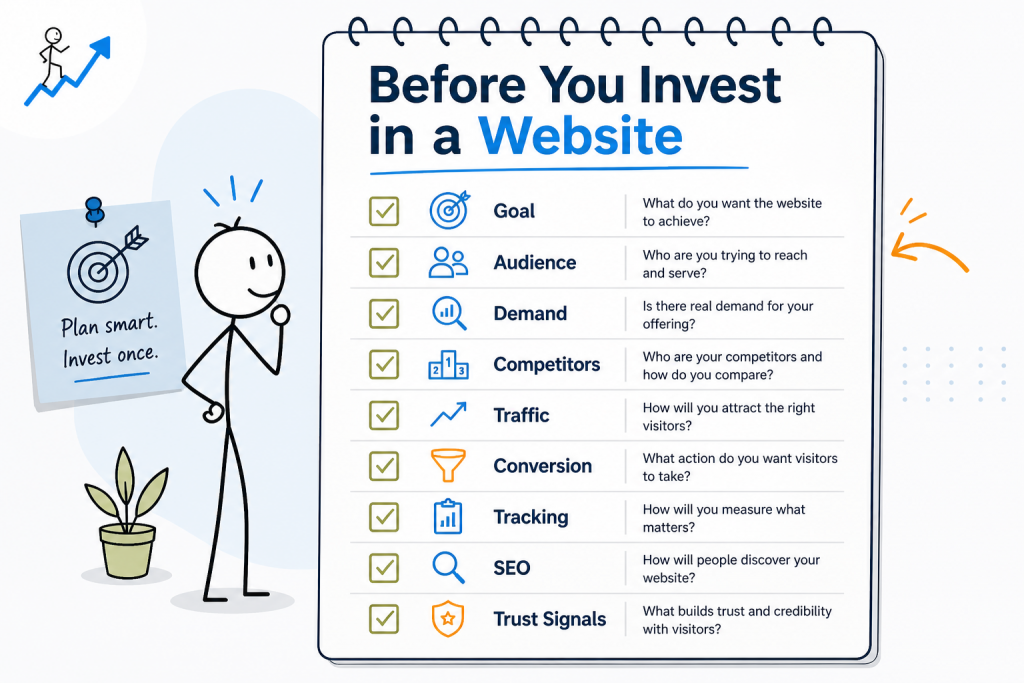
Before investing in a website, I would validate at least these areas:
- Business goal: What is the website supposed to accomplish?
- Audience: Who needs to visit, understand, trust, and act?
- Search demand: Are people searching for the offer, and what language do they use?
- Traffic strategy: Where will visitors come from after launch?
- Competitor visibility: Who already owns attention in search, maps, ads, directories, and AI-driven discovery?
- Offer clarity: Can a new visitor understand the business quickly?
- Conversion path: What action should visitors take, and what supports that action?
- Measurement: Which events, leads, calls, forms, and conversions need tracking?
- SEO structure: What pages, topics, URLs, and internal links are needed?
- Paid traffic feasibility: Do the economics make sense before campaigns start?
- Trust signals: What proof will reduce hesitation?
- Content growth: Can the site expand into articles, case studies, resources, or landing pages later?
This checklist does not need to slow every project down.
It should make the investment sharper.
What I Would Validate First If Budget Is Limited
Not every business has the budget for a deep strategy phase. That is reality.
If the budget is limited, I would prioritize five things before investing in the website:
First, clarify the business goal.
Second, validate search demand and customer language.
Third, review visible competitors.
Fourth, define the conversion path.
Fifth, plan basic tracking before launch.
Those five steps can prevent many expensive mistakes.
They help the business avoid building a website around assumptions that have never been tested.
Final Takeaway
A website is not just something a business buys.
It is something a business depends on.
That means the smartest question is not “How should the website look?”
The smarter question is:
What must be true for this website to become a useful business asset?
Before investing in a website, validate the market, the message, the traffic path, the conversion logic, the measurement plan, and the structure needed for future visibility.
Design still matters. Development still matters. Branding still matters.
But they work better when they are built on validated strategy.
That is the difference between launching a website and building a digital asset.

1 comment
[…] GTM does not automatically mean your analytics reports will be clean, useful, or aligned with your measurement plan. DebugView helps you see the event stream and catch problems before they become reporting […]
Comments are closed.