
A marketing website does not grow because someone publishes random articles whenever inspiration appears.
At least, not in a way I would trust.
A website grows when content has a job. Some articles build authority. Some explain important ideas. Some support internal links. Some document what is happening behind the scenes. Some become future resources, tools, or lead magnets. The problem is that many websites treat all content as the same thing: “We need a blog post.”
That is usually where the mess starts.
For Web Idea US – Marketing Lab, I am trying to build the content base differently. This site is still in an early stage, but the logic is already clear: I do not want a generic marketing blog. I want a structured public marketing lab where SEO, website traffic, visibility, analytics, content architecture, and growth ideas are tested in real conditions.
So when I plan content for the month, I do not start with a random list of topics.
I start with the workflow.
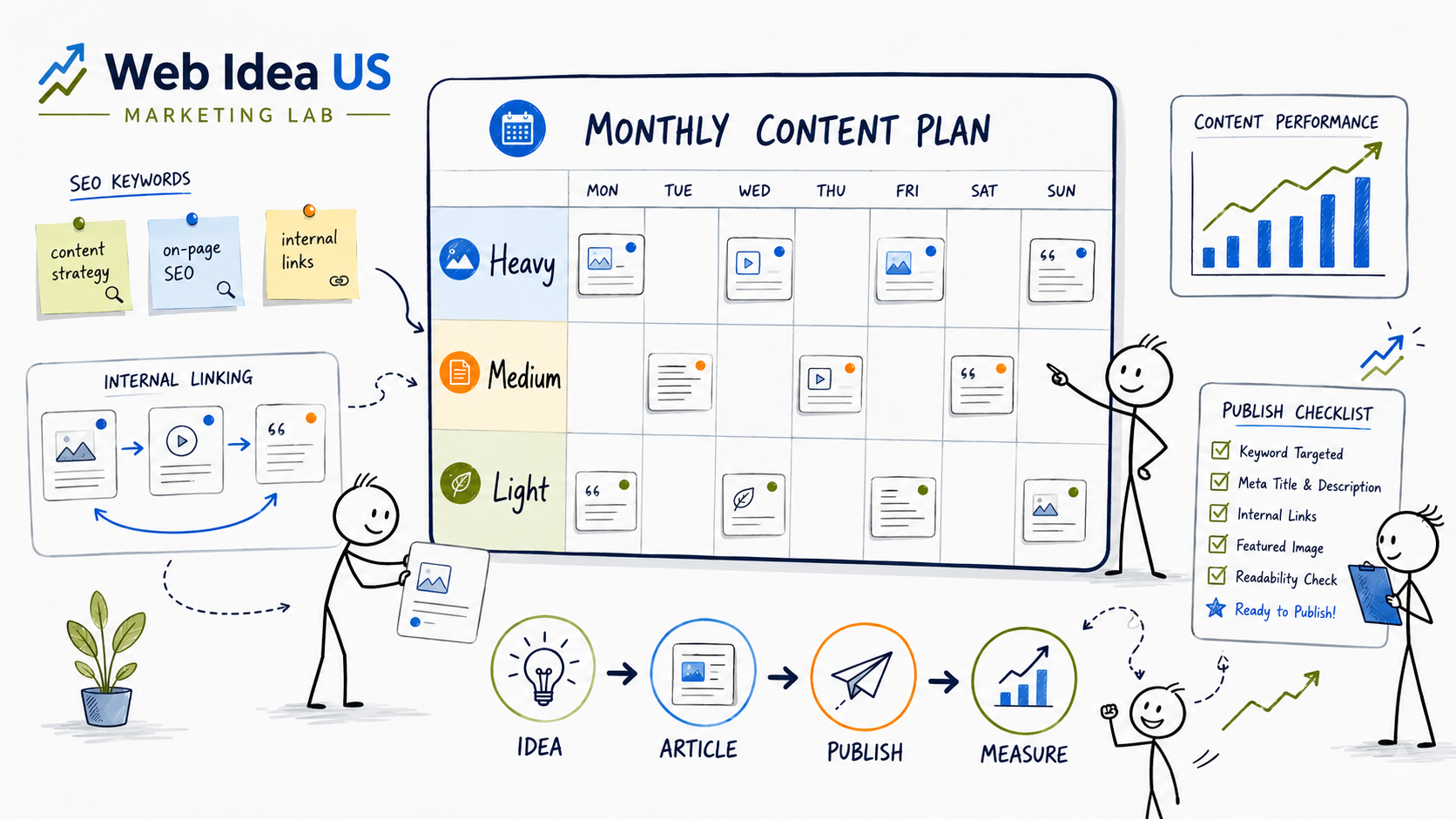
The workflow has several layers:
- heavy articles
- medium articles
- light articles
- SEO-first planning
- visual support
- internal linking
- future downloadable resources
This article documents how I think about monthly content planning for a marketing website — not as a calendar-filling exercise, but as a practical system for building visibility, structure, and future assets.
Why Monthly Content Planning Needs More Than a Topic List
A topic list is useful, but it is not enough.
A workflow answers a different question: how does an idea move from a raw note into something useful, publishable, connected, and measurable?
That matters because a marketing website is not only a collection of pages. It is a visibility system. Every article has the potential to influence how search engines, AI systems, and human readers understand the site.
This is why I do not want to separate writing from SEO too much.
SEO should not make the article robotic. But SEO should help define the article’s purpose before writing begins.
When I plan content monthly, I can ask better questions:
What role does this article play?
Is it a foundational article, a supporting piece, a project update, a tool review, or a future resource?
What should it link to later?
What should it help Google understand?
What should it help a reader understand?
What visual would make the idea more recognizable?
What future asset could come from this?
Those questions are more useful than simply asking, “What should I post this month?”
The Monthly Content Workflow: Heavy, Medium, and Light Articles
For monthly planning, I separate content into three practical levels: heavy, medium, and light.
This is not only about word count. It is about strategic weight.
Some pieces need deeper thinking because they become future internal linking nodes. Some pieces can be shorter because their job is to document progress or clarify one decision. Some pieces sit in the middle because they explain a useful concept without becoming a full pillar article.
I like this model because it helps me protect both quality and publishing rhythm.
If every article is treated like a major pillar, publishing becomes too slow. If every article is light, the site lacks depth. A healthy monthly content plan needs both.
Heavy Articles: Building Authority and Content Architecture
Heavy articles are the strongest strategic pieces.
These are the articles that explain a core idea deeply enough to become future reference points. They are usually longer, more structured, and more important for topical authority.
For Web Idea US – Marketing Lab, heavy articles may include topics like:
- digital marketing analysis before website launch
- where website traffic actually comes from
- why content should sometimes come before deep SEO optimization
- how to plan visibility before building a website
- how AI discovery changes content planning
- how analytics and tracking affect growth decisions
A heavy article should not feel like filler. It should answer a real business or marketing problem. It should also create internal linking opportunities for future case studies, tools articles, resource pages, and experiments.
For example, an article about digital marketing analysis before a website launch can later support:
- a case study about a business that launched without analysis
- a tools article about SEO and analytics tools
- a checklist for pre-launch visibility planning
- a resource page with templates
- an experiment about early indexing signals
That is why I see heavy articles as structural content.
They are not just “big posts.” They are the beams of the content system.
In a monthly content plan, I usually do not need many heavy articles. One strong heavy article can be enough if it has a clear role and connects to the rest of the site.
Medium Articles: Supporting the System Without Overbuilding Every Idea
Medium articles are practical support pieces.
They are useful enough to stand alone, but they do not need to carry the entire site architecture. Their job is often to clarify one important part of a bigger topic.
For example, a medium article might explain:
- why I organize articles by intent before writing
- how I choose a focus keyword for a new article
- why internal links should be planned before the site has too many posts
- how I think about branded visuals for blog articles
- when a tools article belongs in Tools & Reviews instead of Resources
- why I do not want to over-optimize too early
These articles are valuable because they help fill the semantic gaps between heavy articles.
They also make the website feel more alive.
A marketing website with only pillar articles can feel too polished and static. A marketing lab needs evidence of thinking in motion. Medium articles help show that process.
They can also become bridges.
A medium article may link upward to a heavy article, sideways to a case study, and forward to a future resource. That is powerful because it creates a more natural internal linking structure.
Light Articles: Momentum, Notes, and Build-in-Public Signals
Light articles are shorter, more focused, and usually more connected to the project’s current stage.
For this site, light content belongs especially well in the Build in Public category.
These articles can document:
- what changed in the project
- what I am testing next
- why I changed a content decision
- what I noticed in Search Console
- how I am thinking about future monetization
- what I learned from publishing recent articles
- why I created a specific visual or page structure
Light articles are not “low value.” They simply have a different job.
Their job is to create continuity.
When someone reads Web Idea US – Marketing Lab later, I want them to see not only finished theories, but also the decision path behind the project. That is part of the value of a public marketing lab.
A traditional company blog may hide the messy middle. A lab should show enough of the process to make the thinking visible.
That does not mean publishing every small note. It means selecting the notes that reveal strategy.
SEO Comes First, But Not in a Mechanical Way
When I say “SEO first,” I do not mean that keywords control the article.
I mean that search intent, page role, and topical alignment should be understood before writing begins.
For every serious article, I want to know:
- What is the primary focus keyword?
- What is the related search intent?
- What secondary keywords support the topic?
- What questions should the article answer?
- What category does it belong in?
- What internal links should it support?
- What future article could naturally connect to it?
This prevents one of the most common content mistakes I see: publishing articles that are individually decent but structurally disconnected.
A disconnected article may still be readable. It may even be useful. But it does not help the website as much as it could.
For a marketing website, content has to work as a system.
The article should help the reader, but it should also help the site become easier to understand. Search engines need context. AI systems need structured clarity. Readers need a path.
SEO-first planning helps create that path before the article is written.
Why Visual Support Is Part of the Workflow
Visuals are not just decoration for this project.
For Web Idea US – Marketing Lab, every strong article should ideally have visual support: a branded hero image, a social preview image, or some kind of visual concept that reinforces the topic.
This matters for several reasons.
First, visual consistency makes the site more recognizable. If someone sees several articles shared on Facebook or LinkedIn, I want them to feel like they belong to the same project.
Second, visual planning forces clarity. If I cannot explain the article visually, the idea may still be too vague.
Third, social sharing works better when the article looks intentional. A strong preview image can make a serious marketing topic feel more approachable.
In my monthly workflow, visual planning happens after the article angle is clear.
I define the topic first.
Then I define the article’s role.
Then I decide what the visual should communicate.
Then I keep it aligned with the Marketing Lab identity: clean, strategic, slightly playful, but not casual in a careless way.
The goal is not to create beautiful images for their own sake. The goal is to support recognition, memory, and shareability.
Internal Links Are Not an Afterthought
Internal links are one of the most important parts of this workflow.
Many websites add internal links later only because an SEO checklist says they should. I prefer to think about them earlier.
Before I publish an article, I want to understand:
- What existing article should this piece support?
- What future article should link back to it?
- Is this article a hub, a supporting article, or a bridge?
- What anchor text would feel natural?
- What page should a reader visit next?
Internal linking is not only technical. It is editorial.
A good internal link says, “This idea continues here.”
For example, this article could link to a future downloadable workflow page once that exists. It could also link to articles about content-before-SEO optimization, tools for digital marketing analysis, and digital marketing analysis before launch.
That creates a practical content path:
content planning → SEO logic → tools → workflow → resource
That path is much stronger than isolated blog posts.
How I Decide Which Article Type an Idea Becomes
One raw idea can become several different article types depending on the angle.
For example, take the idea: “I am planning monthly content.”
That could become:
A Build in Public article if the focus is how I am planning the project.
An Experiments article if the focus is testing whether a heavy/medium/light content structure improves publishing consistency.
A Resources page if the focus is a downloadable content workflow template.
A Tools & Reviews article if the focus is the tools used to manage the workflow.
A pillar article if the focus is a broad evergreen guide to content workflows for marketing websites.
For this article, the Build in Public angle makes the most sense because I am documenting how the project itself is being built.
But later, the same thinking can become a Resource.
That is important.
Not every idea should be forced into one format forever. Sometimes the first version is a public note. Later, it becomes a framework. Later, it becomes a downloadable asset.
That is how content can mature.
The Future Downloadable Workflow
One reason I like documenting this process now is that it may become useful later as a downloadable workflow.
Not immediately. I do not want to turn everything into a product too early.
At this stage, the priority is still building the content base, testing ideas, and proving the process through real publishing. But I can already see how this workflow could become a useful resource.
A future downloadable version might include:
- a heavy / medium / light article planner
- SEO-first article brief template
- category decision guide
- internal linking planner
- visual prompt checklist
- publishing workflow
- social sharing checklist
- monthly content review sheet
That could work as a free lead magnet first.
Later, it could become part of a paid Marketing Lab workflow kit, especially if it is tested through real articles and refined with actual experience.
I like this direction because it follows the logic of the project: show the process publicly, then package the best parts into reusable assets.
That feels much more aligned than selling something abstract before it has been tested.
A Simple Monthly Planning Example
Let’s say I am planning content for a new month.
I might choose one heavy article, two medium articles, and one or two light Build in Public notes.
The heavy article might explain a foundational concept, such as how to plan visibility before launching a website.
The medium articles might support that concept with practical angles, such as keyword mapping or internal linking.
The light article might document what I am testing on the site that month.
Then I would check the workflow:
Does each article have a clear category?
Does each article have a focus keyword?
Does each article connect to at least one existing or future article?
Does each article support a bigger content cluster?
Does each article need a branded hero image?
Does one of these ideas have future resource or lead magnet potential?
This keeps monthly planning practical.
It gives me enough structure to avoid randomness, but enough flexibility to respond to what I am observing in the project.
Why This Matters More in the AI Search Era
Content planning is becoming more complex because discovery is no longer only about traditional rankings.
People still use Google. They also use social platforms, AI assistants, YouTube, Reddit, newsletters, and direct recommendations. AI-driven discovery is changing how brands and websites are understood across the web.
That does not mean traditional SEO is dead. It means structure matters more.
A website needs to be clear enough for humans, search engines, and AI systems to understand what it is about.
That requires consistency:
Consistent topics.
Consistent category logic.
Consistent internal links.
Consistent language.
Consistent author perspective.
Consistent visual identity.
This is why I see monthly content planning as more than a productivity system. It is also an identity system.
It helps answer the question: what is this website becoming?
My Practical Monthly Publishing Logic
My monthly goal is not to publish the maximum number of articles.
My goal is to keep building a meaningful content base.
That means I want a balanced mix:
A few heavy pieces that strengthen the foundation.
Several medium pieces that support the main themes.
A few light Build in Public notes that show the real evolution of the project.
I also want each article to move through the same basic workflow:
- Choose the topic.
- Define the article type.
- Choose the primary keyword.
- Map secondary keywords.
- Decide the category.
- Clarify the angle.
- Draft the article.
- Create or plan the visual.
- Add internal linking suggestions.
- Prepare the CTA.
- Publish.
- Watch early signals.
- Improve later in batches.
This last point is important.
I am not trying to perfect everything before publishing. In an early content phase, too much polishing can slow down the site before it has enough material to form a real structure.
The smarter move is to publish strong, useful, structured content first. Then improve the system as the site grows.
What I Watch After Publishing
A workflow is only useful if it creates something measurable or observable.
After publishing new monthly content, I watch several signals:
- which topics get indexed quickly
- which articles start getting impressions
- which queries appear in Search Console
- whether titles match actual search behavior
- whether internal links create better content paths
- which articles feel strongest as future Start Here features
- which topics could become downloadable resources
- which visuals work better for sharing
I do not expect every article to perform immediately.
That is not how early-stage content usually works.
But I do expect the structure to become clearer. I expect patterns to appear. I expect some articles to show early signs of demand, while others may work better as supporting content.
That is useful data.
A marketing lab should not only publish. It should observe.
Final Takeaway
My monthly content planning workflow for Web Idea US – Marketing Lab is built around one simple idea:
Content should not be random.
For a marketing website, every article should have a role. Some pieces build authority. Some support structure. Some document the project. Some create future resource opportunities. Some help readers move from one idea to the next.
The heavy / medium / light model helps me publish with balance.
SEO-first planning helps me avoid disconnected content.
Visual support helps the project feel recognizable.
Internal links help the site become easier to navigate and understand.
And the workflow itself may eventually become a downloadable resource or paid artifact.
For now, I am using it where it matters most: inside the real project.
That is the point of Marketing Lab.
The process is not theoretical. It is being built, tested, published, and improved in public.