
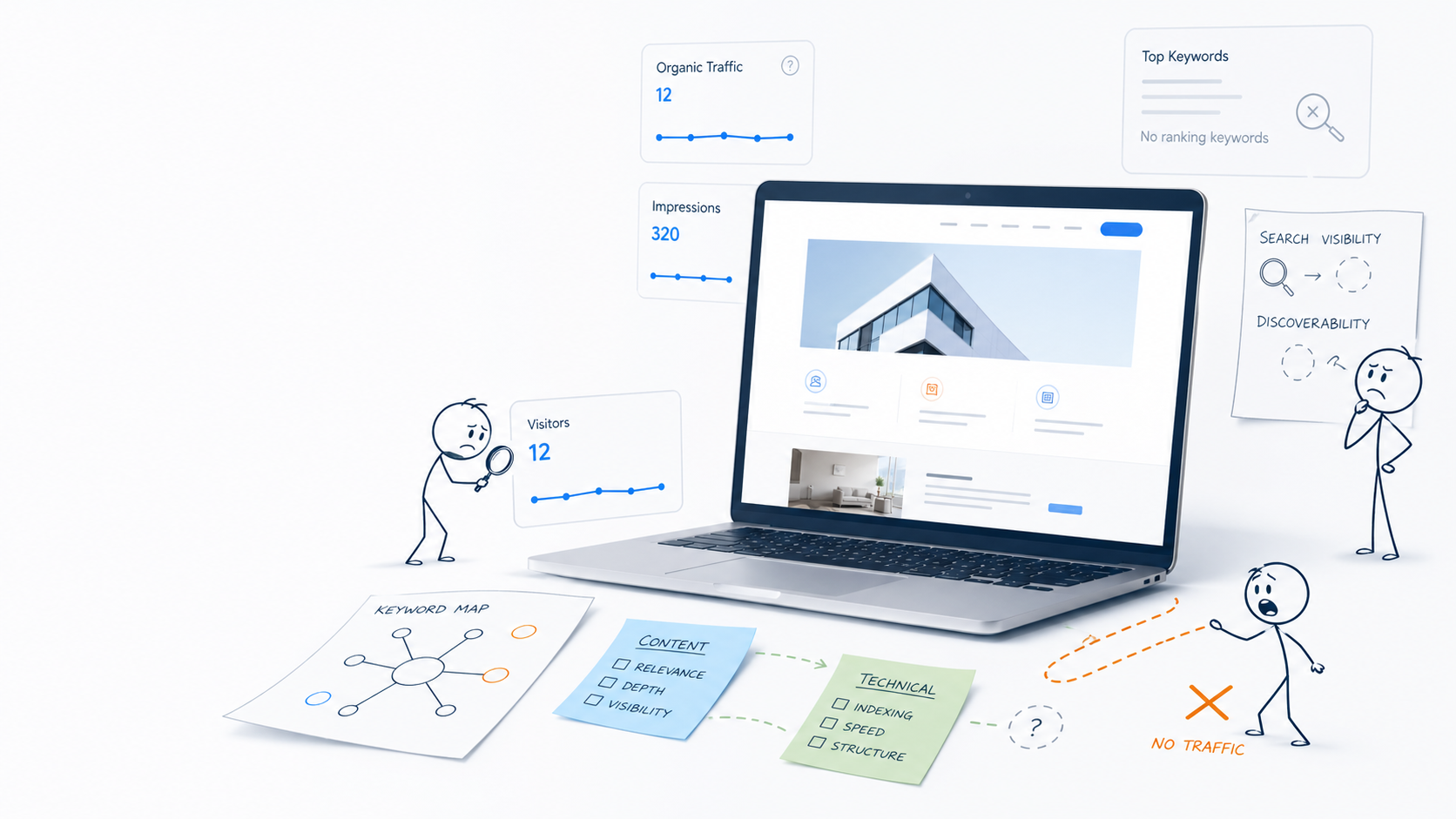
A good-looking website can create a dangerous kind of confidence.
The homepage looks clean. The colors feel professional. The photos are polished. The service pages exist. The business owner opens the site on a laptop, then on a phone, and thinks, “Finally, we have a real website.”
Then a few weeks pass.
Nothing much happens.
No steady traffic. No search visibility. No meaningful inquiries. Maybe a few visits from friends, employees, existing customers, or people who clicked from social media once. But the website itself does not become a real growth channel.
I have seen this pattern many times in different forms. A business invests in design, branding, copy, development, and launch — but traffic stays low because the website was built as a presentation layer, not as a visibility system.
This case study is a composite scenario based on repeated patterns I have seen in real marketing work. The details are fictional, but the logic is very real.
It is also one of the reasons I keep returning to the same principle in Marketing Lab: a website should not be judged only by how it looks. It should also be judged by whether people can find it, understand it, trust it, and take the next step.
Google’s own SEO documentation explains that search-friendly content matters because it helps relevant users find a site, and that when Google Search has trouble understanding a page, the site may miss an important source of traffic.
That is exactly what happened here.
The Business Situation
Let’s imagine a local service business.
The company provides specialized home services in a competitive metro area. It has been operating for several years, mostly through referrals, repeat customers, and a small amount of local networking. The owner decides it is time to “get serious online.”
The goal is straightforward:
The business wants a modern website that can help generate leads.
The owner hires a web designer. The designer creates a clean website with:
- a homepage
- an About page
- a Services page
- several individual service sections
- a Contact page
- nice photos
- a simple lead form
- basic mobile responsiveness
From a visual perspective, the website looks much better than the old one.
The owner feels confident after launch. The team shares the site on Facebook. A few customers compliment the design. The designer sends the final invoice. Everyone feels like a major business problem has been solved.
But three months later, the traffic is still weak.
Search Console shows very few impressions. Google Analytics shows small visitor numbers. The contact form barely gets used. The business owner starts asking a familiar question:
“Why are we not getting traffic if the website looks good?”
What Looked Fine on the Surface
This is the part that makes the situation frustrating.
Nothing looked obviously broken.
The website was not outdated. It did not look unprofessional. It loaded reasonably well. It worked on mobile. It had a menu, service descriptions, images, and a contact form.
From a business owner’s point of view, this seemed like enough.
And honestly, I understand why. Most people judge websites visually first. That is natural. We open a website and immediately notice design, colors, layout, fonts, photos, and whether the company looks trustworthy.
But search engines, paid traffic systems, AI discovery tools, and potential customers evaluate much more than surface design.
They look for structure, relevance, clarity, intent, topical depth, trust signals, location logic, content usefulness, and whether the page matches what someone is actually trying to solve.
This is where the gap appeared.
The website looked like a finished project, but strategically it was underbuilt.
What Was Actually Missing
The main missing layer was not “better design.”
The missing layer was website visibility strategy.
Before the site was built, no one had clearly answered questions like:
What are customers actually searching for?
Which services have real search demand?
Which pages should exist based on search intent?
Which locations matter?
Who are the visible competitors in Google?
What does the business need to rank for locally?
Which traffic channels are realistic?
What should be tracked as a lead?
What content should support the decision process?
How will the site earn visibility after launch?
Without those answers, the site became a digital brochure.
A digital brochure can be useful when someone already knows the business. It can support referrals. It can make a company look more credible. It can help existing prospects confirm that the business is legitimate.
But a brochure does not automatically create traffic.
Traffic has to come from somewhere.
This is why I often separate website design from website growth. Design helps people experience the business once they arrive. Visibility strategy helps people arrive in the first place.
The Website Had Pages, But Not Search Architecture
One of the biggest problems was the page structure.
The site had a Services page, but it grouped several important services into one broad page. Each service had a short section, maybe 150–250 words, but not enough depth to compete for specific search queries.
For example, instead of creating dedicated pages for high-intent searches, the site used general language like:
“Our services include installation, maintenance, repair, inspection, and emergency support.”
That sounds clear to a human who already knows the company. But from an SEO perspective, it is weak.
A person searching for emergency repair has a different intent than someone searching for installation. A person comparing maintenance options has a different need than someone looking for a same-day service provider. A homeowner searching in one city may need different signals than someone searching in another nearby area.
When all of that gets compressed into one generic Services page, the site loses relevance.
The issue was not that the website had no content. The issue was that the content was not mapped to search behavior.
Google’s SEO Starter Guide emphasizes improving a site’s presence in Search and helping Google understand content. It also makes clear that eligibility to appear in search is not the same thing as guaranteed visibility.
In this case, the pages existed, but they did not give Google enough clear, structured reasons to rank them for valuable searches.
The Business Used Company Language, Not Customer Language
Another problem was messaging.
The website described the business the way the business described itself internally.
That is common.
Companies often use phrases that make sense inside the business but do not match how customers search. They use broad service labels, brand language, industry shorthand, or polished copy that sounds professional but does not match demand.
For example, a company might say:
“Complete property care solutions for modern homeowners.”
But a customer might search:
“emergency roof leak repair near me”
“AC repair in [city]”
“weekly lawn maintenance cost”
“water heater replacement company”
“home care agency near me”
Search traffic usually begins with the customer’s language, not the company’s preferred wording.
This is one of the reasons keyword research is not just an SEO task. It is a market research task. It shows how people describe their problems before they know which company to trust.
When a website ignores that language, it can look elegant and still fail to connect with demand.
The Site Had No Clear Local SEO Logic
Because this was a local service business, location structure mattered.
But the website did not have a strong local SEO framework.
It mentioned the main city in the footer and maybe once on the homepage. It had a contact address. It had a Google Business Profile. But the site did not clearly explain service areas, local relevance, neighborhood coverage, or city-specific service intent.
This created a visibility problem.
Local businesses often need more than a nice homepage. They need a structure that helps Google and users understand where the business operates and what services are available in each area.
That does not mean creating low-quality duplicate city pages. It means building a thoughtful local architecture that reflects real service coverage, real customer questions, and real local competition.
For example, if the business serves five important cities, the website may need:
- a clear service area page
- strong local signals on core pages
- location-specific proof where appropriate
- locally relevant FAQs
- internal links between service and location pages
- Google Business Profile alignment
- consistent name, address, and phone information
Without that structure, the business may technically “serve” the area, but the website does not communicate that clearly enough to compete.
The Website Launched Without a Traffic Plan
The biggest strategic mistake was assuming launch equals traffic.
It does not.
A website launch is not a traffic source.
A website can receive traffic from organic search, paid search, social media, referrals, email, direct visits, partnerships, directories, AI-driven discovery, local listings, and content distribution. But those channels need planning.
In this case, the business launched the website and expected Google to “pick it up.” But there was no SEO plan, no paid search plan, no content plan, no local visibility plan, and no measurement plan.
The website was published, but no real acquisition system existed around it.
This is where the difference between a website project and a growth project becomes very clear.
A website project asks:
“Can we build the site?”
A growth project asks:
“How will this site attract qualified people, from which channels, for which offers, with which pages, and how will we measure whether it works?”
Those are very different questions.
What Happened Next
After launch, the business saw some activity, but not enough to matter.
The first traffic came from predictable sources:
- the owner sharing the site with friends
- a few employees clicking around
- existing customers checking the new design
- some branded searches
- occasional referral visits
- random low-intent traffic
But non-branded organic traffic stayed very low.
The site ranked for the company name, but not for the service terms that could bring new customers. The homepage received a few impressions, but the service pages did not gain meaningful visibility. The Contact page had traffic, but mostly from people who already knew the business.
The business owner started to feel disappointed.
From their perspective, they had invested in a professional website and still had the same lead problem.
From my perspective, the outcome was predictable.
The site had improved presentation, but it had not solved discovery.
Why the Website Failed to Generate Traffic
The website failed to generate traffic because it was designed around appearance before visibility.
That does not mean design was unimportant. Good design matters. Trust matters. UX matters. Clear visual presentation matters.
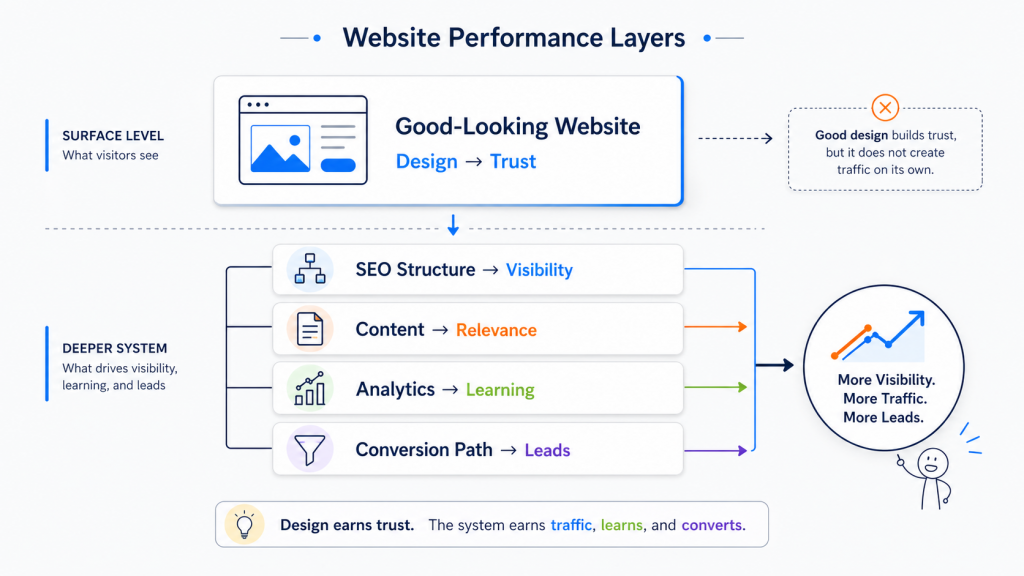
But design is only one layer of website performance.
The deeper problems were strategic:
The site had no demand analysis.
The page structure did not match search intent.
The service pages were too broad.
The content used company language instead of customer search language.
The local SEO framework was weak.
The internal linking was minimal.
There was no content plan after launch.
The analytics setup did not clearly define lead actions.
There was no traffic channel strategy.
In other words, the website was built as if traffic would naturally follow design.
But traffic usually follows relevance, distribution, authority, demand alignment, and channel execution.
BrightEdge has repeatedly reported that organic search remains one of the largest sources of trackable website traffic, with one report showing organic channel share at 53.3%. That does not mean every site automatically receives organic traffic. It means organic search is important enough that ignoring search architecture before launch can create a serious growth problem.
The Tracking Problem Made It Harder to Diagnose
Another issue appeared after launch: tracking was too basic.
Google Analytics was installed, but the business had not clearly defined what counted as a meaningful conversion.
Was a phone click tracked?
Was a form submission tracked?
Were quote requests separated from general contact messages?
Were paid clicks separated from organic traffic?
Were service pages evaluated individually?
Was the business measuring engaged visitors or just page views?
Without clear measurement, the conversation stayed vague.
The owner could see that traffic was low, but could not easily answer:
Which pages attract the right people?
Which traffic source is most valuable?
Where do users drop off?
Which service pages need improvement?
Are visitors reading, clicking, calling, or leaving?
Is the problem traffic, conversion, or both?
This matters because “no traffic” and “no leads” are related, but not identical.
Sometimes a website has traffic but poor conversion. Sometimes it converts well but has too little traffic. Sometimes it attracts the wrong audience. Sometimes tracking is broken, so the business cannot see what is happening.
In GA4, conversion rate depends on defined conversion events, and session conversion rate is calculated based on sessions with a conversion event divided by total sessions. That means the measurement system is only useful if the business has defined the right events in the first place.
In this case, the business could not confidently diagnose performance because the tracking layer was treated as an afterthought.
What Should Have Happened Before Launch
Before design began, the business needed digital marketing analysis.
Not a massive corporate strategy deck. Not months of research. But enough analysis to make better structural decisions.
At minimum, I would have wanted to see:
- service demand research
- keyword mapping
- competitor visibility review
- local search analysis
- traffic channel assumptions
- page architecture plan
- conversion path planning
- tracking requirements
- content roadmap
- launch and post-launch visibility plan
This would have changed the website build.
Instead of one broad Services page, the site might have had dedicated pages for high-intent services. Instead of vague brand copy, the content would have reflected real customer problems. Instead of weak location signals, the site would have had a clearer service area structure. Instead of launching and hoping, the business would know which channels needed work after launch.
This is the part that many businesses miss: marketing analysis before launch does not slow the project down. It often prevents expensive rebuilding later.
How I Would Approach the Recovery
If I were brought into this situation after launch, I would not immediately redesign the website again.
That is another common mistake.
When traffic is low, people often assume the site needs another visual redesign. Sometimes it does. But in this case, the first step would be strategic diagnosis.
I would start with four questions.
1. What traffic should this website realistically get?
Not every business has the same search opportunity.
Some services have strong search demand. Others depend more on referrals, paid traffic, partnerships, outbound sales, or social proof. Before fixing the site, I would want to understand the actual traffic opportunity.
This includes keyword research, competitor review, local SERP analysis, and channel feasibility.
2. Which pages are supposed to attract new visitors?
A homepage usually cannot do everything.
The business needs clear entry pages for different types of intent. Some pages should target high-intent service searches. Some may support local visibility. Some may answer informational questions. Some may help users compare options before contacting the company.
A good website architecture gives each important page a job.
3. What counts as a valuable action?
The business needs to define conversion stages.
For a local service business, that might include:
- contact form submission
- phone click
- quote request
- appointment booking
- email click
- direction click
- service-area page engagement
Once those are defined, tracking can be improved through GA4 and Google Tag Manager.
4. What needs to happen after the site is fixed?
SEO is not a one-day switch.
Even after improving the website structure, the business still needs ongoing visibility work. That may include content development, local SEO improvements, Google Business Profile optimization, review strategy, internal linking, technical cleanup, paid search testing, or landing page improvement.
The recovery path is not just “edit pages.” It is rebuilding the connection between business goals, search demand, traffic channels, and conversion measurement.
The Practical Recovery Plan
For this type of business, I would likely recommend a phased recovery plan.
Phase 1: Visibility Diagnosis
First, I would review the current site structure, Search Console data, GA4 setup, indexed pages, competitor visibility, and local search landscape.
The goal is to understand whether the site has an indexing problem, a relevance problem, a demand problem, a competition problem, a content depth problem, or a measurement problem.
Often, it is a combination.
Phase 2: Keyword and Page Mapping
Next, I would map services to search intent.
This does not mean forcing keywords into every paragraph. It means deciding which pages should exist and what each page should be responsible for.
For example:
Homepage: brand trust and broad positioning
Main service pages: high-intent commercial searches
Location pages: local relevance where justified
Blog or resource content: education and early-stage discovery
Case studies or testimonials: proof and decision support
Contact page: conversion clarity
This helps the site become easier for both users and search systems to understand.
Phase 3: Content and Internal Linking Improvement
Then I would improve the content.
The goal would be to make service pages more useful, specific, and aligned with customer questions. I would add clearer explanations, better headings, FAQs where appropriate, proof points, location references, and internal links.
Internal linking is especially important because it helps connect related pages into a stronger structure.
A site with disconnected pages often feels thin, even if each page looks nice individually.
Phase 4: Tracking and Conversion Setup
After that, I would fix measurement.
The business needs to know not only whether traffic is growing, but whether the right users are taking the right actions.
At minimum, I would want clean tracking for form submissions, phone clicks, important CTA clicks, and traffic source performance.
This turns the website from a static brochure into a measurable business asset.
Phase 5: Channel Strategy
Finally, I would decide how traffic will actually be generated.
For this business, the mix might include:
Organic search for service demand
Local SEO for map and location visibility
Paid search for high-intent immediate demand
Referral partnerships for trust-based leads
Email follow-up for longer decision cycles
Content for education and authority
Social only where it supports trust or distribution
The exact mix depends on the business, budget, competition, and timeline.
But the important point is this: traffic should not be treated as a mystery after launch. It should be part of the website strategy before launch.
The Bigger Lesson
The biggest lesson from this case is simple:
A good-looking website can still fail if it is not built around visibility logic.
Design helps people trust you when they arrive.
SEO helps people find you.
Content helps them understand you.
Analytics helps you learn what is working.
Conversion structure helps them take action.
Traffic strategy connects the website to actual demand.
When one of those layers is missing, the website may look finished but still underperform.
This is why I do not like treating website launch as the final milestone. For a business that depends on digital visibility, launch is only the beginning of the performance cycle.
A better website process starts earlier.
Before design, ask what people search for.
Before copy, understand customer language.
Before page layout, define page purpose.
Before launch, set up measurement.
Before expecting leads, decide where traffic will come from.
That is how a website becomes more than a nice digital object.
It becomes part of a growth system.
Final Takeaway
The website in this case did not fail because it looked bad.
It failed because it was built without enough connection to demand, search behavior, local visibility, content structure, and traffic strategy.
That is the uncomfortable truth for many businesses: the website can be attractive, modern, and technically functional — and still not generate meaningful traffic.
A good-looking website is a strong starting point.
But if the goal is visibility, leads, and growth, the real question is not only:
“Does the website look professional?”
The better question is:
“Can the right people find it, understand it, trust it, and take action?”
That is where website strategy begins.