
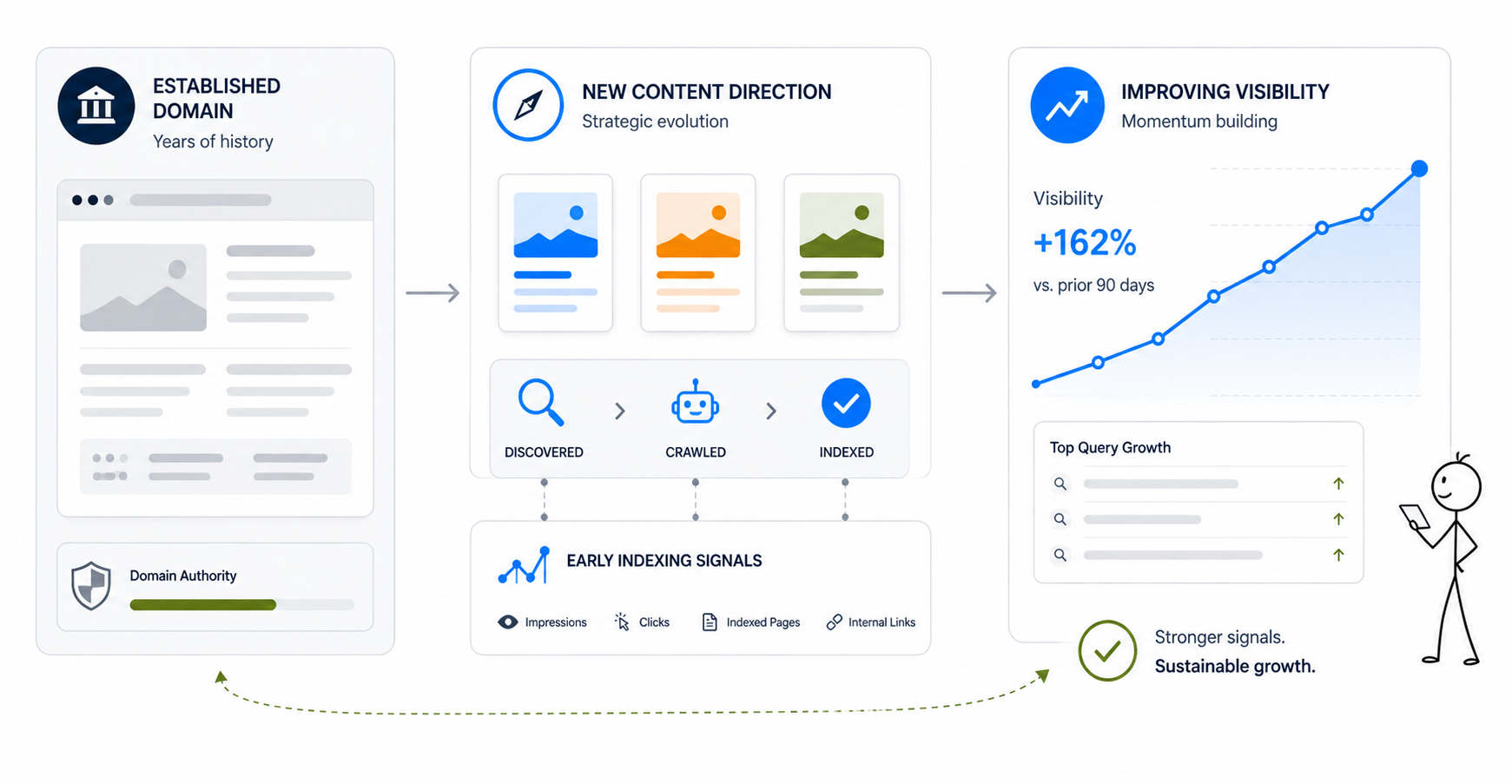
When you rebuild or redirect the purpose of an older domain, one of the first things I watch is not traffic.
It is indexing behavior.
That may sound a little technical, but it matters. Before a website can grow through organic search, Google first has to discover the pages, crawl them, understand them, decide whether they are worth indexing, and then begin testing them against real search queries.
For Web Idea US – Marketing Lab, this is especially interesting because the site is not a brand-new domain. The domain has history, but the current content direction is new. It is being shaped as a public marketing lab focused on SEO, website traffic, analytics, digital visibility, growth strategy, and AI-driven discovery.
So the experiment is not simply:
“Can a new article get indexed?”
The better question is:
What happens when an older domain begins publishing consistent, strategic content under a new topical direction?
That is what I am watching now.
What I Wanted to Test
The core test behind this observation is simple:
If an older domain starts publishing a clear new content structure, will Google begin discovering and indexing new articles quickly enough to show early visibility signals?
I am not treating this as a ranking success story yet. That would be too early and too easy to overstate.
Early indexing signals are not the same as strong organic performance. They do not prove topical authority. They do not guarantee traffic. They do not mean the website has “won” anything.
But they do tell me something important:
Google is not ignoring the site.
That matters because one of the first problems with many website projects is not that they fail to rank. It is that they barely enter the search system in a meaningful way. Pages sit unseen, uncrawled, unindexed, or technically accessible but strategically unclear.
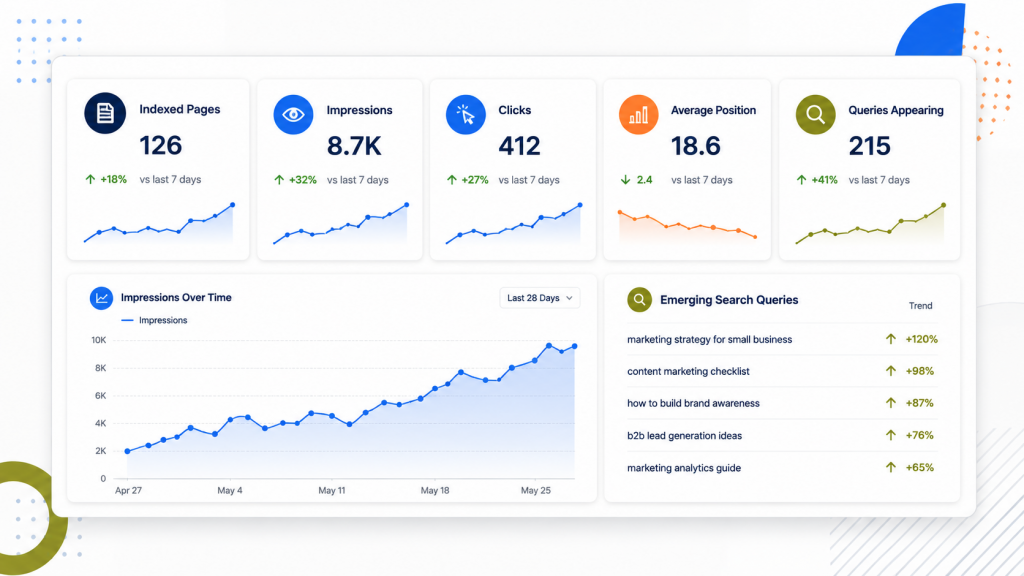
For this site, the early observation is different. New pages are being picked up, Search Console is showing impressions, some queries are appearing, and the site is beginning to enter the first layer of search visibility testing.
Google explains Search as a process with three broad stages: crawling, indexing, and serving search results. It also makes clear that not every page makes it through each stage, and indexing is not guaranteed.
That is why I do not take indexing for granted.
Why Early Indexing Signals Matter
In practical marketing work, indexing is easy to misunderstand.
A business owner may think:
“We published the page. So now we are on Google.”
A marketer may think:
“The URL is indexed. So now SEO is working.”
Neither interpretation is fully correct.
Publishing a page only means the content exists on the website. Indexing means Google has processed enough of the page to include it in the index. Ranking and traffic are separate steps.
Still, indexing is the first serious gate.
For an older domain with a new content direction, early indexing signals can help answer several strategic questions:
Does Google still discover this domain efficiently?
Can new content be crawled without obvious technical barriers?
Are new articles entering the index?
Is Google beginning to associate the site with new topics?
Are impressions appearing for relevant or semi-relevant queries?
Are early positions scattered but directionally useful?
These are not final performance questions. They are diagnostic questions.
In Search Console, the Page indexing report shows the indexing status of URLs Google knows about, while Search Console’s performance data can show queries, impressions, clicks, and average position.
For a site like this, that combination is useful. Indexing tells me whether pages are entering Google’s system. Performance data tells me whether those pages are beginning to touch actual search demand.
The Setup: An Older Domain With a New Strategic Purpose
Web Idea US is not starting from a completely blank domain history.
The domain is older, but the current direction is different. It is now being built as Web Idea US – Marketing Lab, a public-facing project where SEO, SEM, traffic, visibility, analytics, UX, content architecture, growth strategy, and AI discovery are explored in real conditions.
That creates a specific SEO situation.
An older domain can have some advantages, but I am careful not to romanticize domain age. An older domain is not automatically authoritative. Age alone does not create relevance, trust, rankings, or traffic.
What matters more is what Google can currently understand about the site.
If the previous version of the website did not have a strong content system, or if the new version has a different topical focus, then the search engine needs new signals. It needs content patterns. It needs internal structure. It needs repeated topical evidence.
That is why I am not rushing into deep page-level optimization yet.
At this stage, the bigger job is to build a meaningful content base. The project strategy is to create roughly 10–15 strong early pieces before moving into deeper polishing, internal linking refinement, technical improvements, and title/meta testing. That direction is part of the current Marketing Lab content strategy.
In other words, I am not trying to perfect one article in isolation.
I am trying to help the site become understandable.
What Changed
The site began publishing articles with a more consistent strategic direction.
The early content base includes topics such as:
- digital marketing analysis before website launch
- where website traffic comes from
- why content is being built before deep SEO optimization
- what happens when a business launches without marketing analysis
- free and paid tools for digital marketing analysis
This matters because the articles are not random.
They create a content cluster around website visibility, traffic strategy, marketing analysis, SEO thinking, tools, and real-world growth logic. That is exactly the kind of structure this project needs if Google and AI discovery systems are going to understand what the site is about.
The change is not only “more content.”
The change is:
more consistent content direction.
That distinction matters.
A website can publish 50 disconnected articles and still feel unclear. Another website can publish 10 strategically connected articles and start forming a recognizable topical identity.
For an early-stage content system, I would rather build the second version.
What Happened So Far
The early signals are encouraging, but still preliminary.
New content is being discovered and indexed. Search Console is showing early impressions, query visibility, position data, and some clicks. That means the site is not sitting completely passive in the index.
This does not mean the site is ranking strongly yet. It does not mean the articles have reached their final positions. It does not mean Google has fully understood the project.
But it does mean the system is responding.
From a strategist’s perspective, I separate this into four layers.
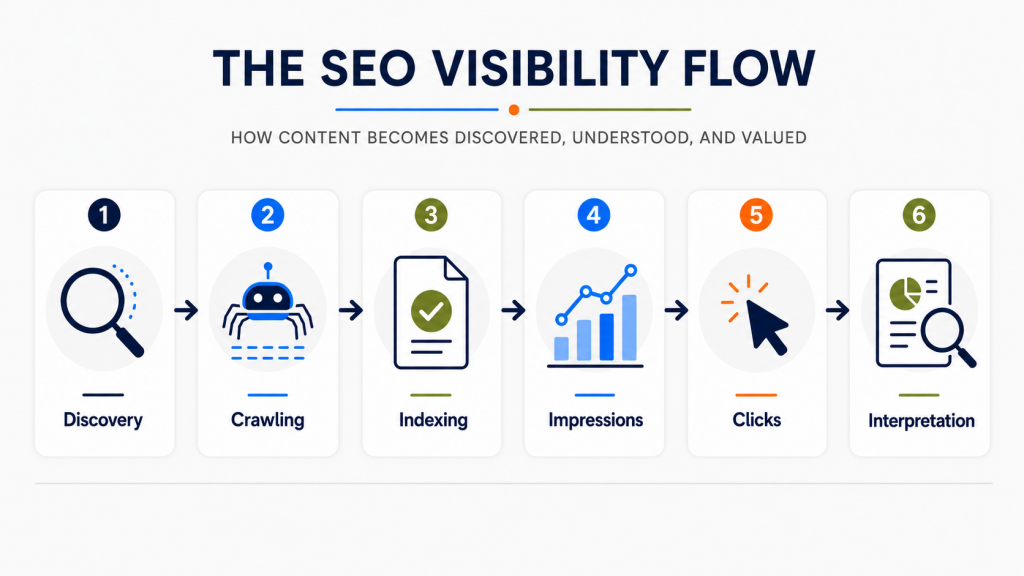
Signal 1: Google Can Discover the New Content
The first signal is discovery.
Google has to find new URLs before anything else can happen. Google says new pages can be discovered through links from known pages, sitemaps, and other discovery paths.
For this project, the fact that new pages are being picked up relatively quickly suggests that the site is accessible enough for discovery and crawling to begin.
That does not mean everything is perfect.
It simply means the first gate is open.
At this stage, I care about whether new content is visible to Google, whether the sitemap and internal structure are helping, and whether there are obvious crawl barriers.
If discovery were slow or inconsistent, I would look more closely at sitemap submission, internal links, robots.txt, indexability settings, canonical tags, and theme-level technical issues.
But when discovery is happening, I can focus more on content direction and structure.
Signal 2: Google Is Processing the New Direction
Indexing is not just storage. Google describes indexing as the stage where it tries to understand what a page is about, including textual content, title elements, images, videos, and canonical signals.
That is important for this site because the new content direction is not generic.
Marketing Lab is not trying to become another broad “digital marketing tips” blog. It is building around a more specific identity:
a public marketing lab where ideas are tested in real conditions.
That positioning needs repeated evidence.
One article cannot fully establish it. A homepage alone cannot fully establish it. A tagline alone cannot fully establish it.
The site needs a body of content that consistently shows:
- what topics are being explored
- what problems the project solves
- what kind of thinking the site represents
- how SEO, traffic, analytics, and visibility connect
- what categories matter in the broader content system
When early articles begin entering the index, I see that as the beginning of this process.
Google is not only finding pages. It is beginning to process what the pages are about.
Signal 3: Impressions Are Appearing Before Strong Rankings
This is one of the most useful early signals.
Impressions can appear before meaningful clicks. That is normal.
In early SEO work, I do not expect immediate ranking strength from a small content base. What I want to see first is whether pages are being tested in search results at all.
Search Console can show which queries bring users to the site and provide impressions, clicks, and position data.
For a young content system, impressions can reveal whether the content is entering the right neighborhood.
The early questions I ask are:
Are impressions appearing for topics that make sense?
Are the queries related to the intended content direction?
Are some pages appearing for broader terms while others appear for more specific long-tail searches?
Are positions weak but directionally relevant?
Are clicks rare but possible?
This is where nuance matters.
A page showing impressions at low positions is not failure. It may be the first sign that Google is testing the page against certain queries.
The real problem would be if impressions appeared only for irrelevant topics, or if pages were indexed but had no query exposure at all over time.
Signal 4: The Site Is Entering Early SERP Testing
I think of this phase as early SERP testing.
The content is not mature. The internal linking system is not fully built. The site has not yet gone through deep polishing. The content base is still developing.
But Google has enough to start testing pages.
That is the key.
In early-stage SEO, I am not looking for final answers too soon. I am looking for directional movement.
This is similar to paid media in one way: the first data is rarely the final data. Early impressions, early click-through behavior, and early query matching are not perfect, but they show where the system is beginning to place the asset.
With SEO, the feedback loop is slower and less direct than paid campaigns, but the same strategic discipline applies:
Do not overreact to one signal.
Do not ignore repeated signals.
What I Think This Means
My interpretation is that the older domain is still usable, discoverable, and capable of supporting the new content direction.
That is not the same as saying the domain has strong authority.
It means the site has passed the first practical test:
new strategic content can enter Google’s discovery and indexing system.
For me, that is enough to continue the current plan.
At this stage, I would not radically change the strategy. I would not rewrite every article. I would not obsess over every title. I would not chase every query that appears in Search Console.
Instead, I would keep building the content base.
Why?
Because the site needs more topical evidence before the data becomes mature enough for deeper optimization.
If I optimize too early, I may end up reacting to incomplete signals. I may polish pages before the broader architecture is clear. I may force keywords into articles before the site has enough depth to support them naturally.
That is a common mistake.
Many website owners want to optimize before they have enough substance. They want rankings before structure. They want traffic before clarity.
For this project, I want the sequence to be stronger:
content base first, structure second, optimization third.
What This Does Not Mean
This part is important.
Early indexing signals do not mean the site has authority.
They do not mean Google trusts every article.
They do not mean the content will rank well.
They do not mean the older domain gives the project an automatic advantage.
They do not mean the strategy is finished.
Google itself states that it does not guarantee crawling, indexing, or serving, even when pages follow Google Search Essentials.
So I am treating the early signals as useful, not conclusive.
This is where SEO can become dangerous if people overinterpret data.
A page indexed quickly can still fail to rank.
A page with impressions can still fail to earn clicks.
A page with clicks can still fail to convert.
A site with an older domain can still lack topical clarity.
That is why I prefer to frame this as an experiment, not a victory lap.
Why the Older Domain Angle Matters
An older domain with a new content direction creates a slightly different situation than a brand-new site.
With a brand-new domain, everything starts from zero: discovery, trust, topical identity, link history, crawl patterns, and brand recognition.
With an older domain, there may already be some history. But that history can help, hurt, or simply be irrelevant depending on what existed before.
The real question is not:
“Is the domain old?”
The real question is:
Can the current version of the domain create clear enough signals for the direction it wants to grow into now?
For Marketing Lab, that means the content must consistently support the new identity.
The articles need to make it obvious that the site is about:
- SEO strategy
- website traffic
- visibility systems
- analytics and measurement
- website launch thinking
- digital marketing analysis
- AI-era discovery
- practical growth decision-making
If the content keeps reinforcing those themes, the older domain becomes a container for a new strategic layer.
If the content becomes scattered, the domain age will not save it.
How I Am Reading the Early Data
At this stage, I am not trying to extract too much meaning from individual numbers.
I care more about patterns.
The early data I would watch includes:
- how quickly new URLs are discovered
- how quickly important pages are indexed
- whether articles appear in Search Console performance data
- which queries trigger impressions
- whether queries align with the intended content clusters
- whether clicks appear on long-tail or specific-intent searches
- whether category pages or individual posts begin appearing
- whether Google chooses the expected canonical URLs
- whether any pages are crawled but not indexed for concerning reasons
The Page indexing report is useful here because it shows indexed and non-indexed URLs Google knows about, and Google advises that website owners should not expect 100% coverage. The goal is to have the canonical version of every important page indexed.
That is a good reminder.
More indexed URLs is not always better. The goal is not to index everything. The goal is to index the right things.
The Strategic Risk: Optimizing Too Early
One reason I am documenting this experiment is because early indexing signals can tempt people into premature optimization.
A few impressions appear, and suddenly the website owner wants to rewrite titles, change slugs, add keywords everywhere, build backlinks, redesign the homepage, and install five more plugins.
I understand the impulse.
But early data needs breathing room.
For this project, I want to avoid three mistakes:
Mistake 1: Treating early impressions as final keyword direction
Early queries are useful, but they are not always the final target. Sometimes Google tests a page against broad or adjacent terms before the page settles into stronger relevance.
Mistake 2: Polishing individual articles before the content base exists
One optimized article on a thin site can only do so much. A connected content system gives each article more context.
Mistake 3: Confusing indexing with strategy validation
Indexing tells me Google can process the page. It does not prove that the strategy is complete.
That is why the current experiment supports continued publishing, not aggressive rewriting.
What I Would Do Next
The next step is to continue building the content base while keeping the tracking clean.
For Marketing Lab, I would focus on five actions.
1. Publish the next group of strategically connected articles
The site needs enough content for Google and readers to understand the recurring themes. The next articles should continue supporting the SEO, traffic, analytics, tools, launch strategy, and visibility clusters.
2. Keep internal linking light but intentional
I would not overbuild internal linking too early. But I would begin connecting obvious relationships between articles.
For example, an article about indexing signals should naturally link to:
- building content before deep SEO optimization
- digital marketing analysis before website launch
- where website traffic comes from
- free and paid tools for digital marketing analysis
- future performance dashboard notes
3. Watch Search Console weekly, not obsessively daily
Daily SEO checking can create noise. Weekly review is usually more useful at this stage.
I would watch indexing status, query patterns, impressions, clicks, and page-level movement.
4. Avoid changing slugs unless necessary
In an early site, clean slugs matter. But once a post is published and indexed, I do not want to change URLs casually.
5. Document the experiment publicly
This is the whole point of Marketing Lab.
The site is not only publishing advice. It is documenting real strategic decisions, observations, uncertainty, and interpretation.
That is what makes it different from a generic marketing blog.
A Practical Example: What This Might Look Like for a Business
Imagine a local consulting business has owned its domain for eight years.
The old website had five pages: Home, About, Services, Blog, Contact. The blog had a few outdated posts. Then the business decides to reposition around a more specific expertise area and starts publishing high-quality articles.
After a few weeks, Search Console shows that the new articles are indexed. Some impressions appear. A few long-tail queries show up. There are almost no clicks yet.
The wrong interpretation would be:
“SEO is working. We are done.”
The better interpretation would be:
“Google is discovering and testing the new direction. Now we need to keep building the content structure and watch which topics begin to earn visibility.”
That is the difference between tactical excitement and strategic patience.
Early indexing is a signal.
It is not the finish line.
What I Am Learning From This Experiment
The main lesson so far is that an older domain can begin supporting a new content direction if the structure is clear enough and the publishing pattern is consistent.
But the content direction has to be visible.
A vague website with random articles will not suddenly become clear because the domain is old. A stronger website begins to emerge when the content, categories, internal logic, and positioning all point in the same direction.
For Web Idea US – Marketing Lab, early indexing signals are encouraging because they suggest the new version of the site is entering Google’s system.
Now the work is to continue building enough depth for that system to understand the project better.
That means more strategic articles.
More connected topics.
More useful examples.
More experiments.
More documentation.
More patience.
Final Takeaway
Early indexing signals on an older domain with a new content direction are worth paying attention to, but they need to be interpreted carefully.
They do not prove authority.
They do not guarantee rankings.
They do not mean traffic is coming automatically.
But they can show that the site is discoverable, crawlable, indexable, and beginning to enter search visibility testing.
For me, that is a useful early signal.
Not a conclusion.
A signal.
And in a real marketing lab, signals are exactly what I want to observe before making the next move.