
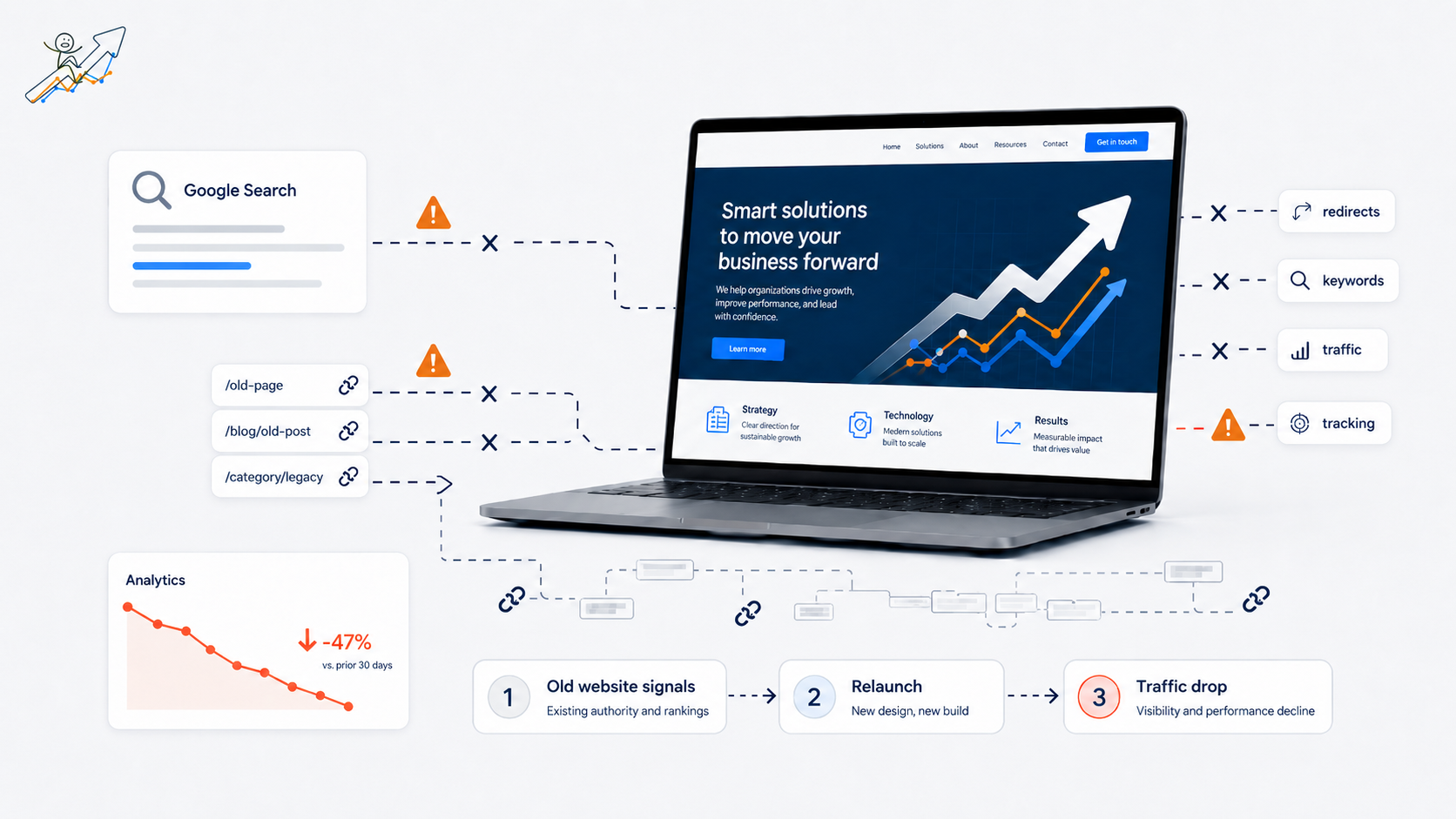
A website relaunch is supposed to feel like progress.
The old website looks outdated. The messaging feels tired. The design no longer reflects the business. The team wants something cleaner, faster, more modern, and more professional. So the company invests in a redesign, approves the new layout, updates the brand visuals, launches the new site, and finally feels like the business has “caught up.”
Then a few weeks later, the uncomfortable part begins.
Organic traffic is lower. Some important pages are no longer visible. Google Search Console shows fewer impressions. Leads slow down. Paid traffic feels more expensive than expected because the landing pages are not converting clearly. The team starts asking a question that should have been asked before the relaunch:
Why did the new website perform worse than the old one?
This case breakdown is about that situation.
It is a composite scenario based on a pattern I have seen many times: a business relaunches a website with strong design intentions but no real visibility plan. The website looks better, but the digital growth system behind it becomes weaker.
That is the hidden risk of a website relaunch. A redesign changes what people see. A relaunch can also change what search engines understand, what traffic sources connect to, what users click, what analytics can measure, and what pages still carry business value.
When that layer is ignored, the launch may look successful on the surface while quietly damaging visibility.
The Business Situation
Imagine a local service business that had been operating for several years.
The company had a functional but outdated website. It was not beautiful. It had inconsistent page layouts, old photos, long paragraphs, and some service pages that looked like they had not been touched in years.
But it had something valuable: history.
Some pages had been indexed for a long time. A few service pages were bringing organic traffic. Several blog posts were ranking for informational searches. The homepage had backlinks from local directories, partner websites, and older mentions. Google had already spent years understanding the structure of the website.
The business owner wanted a relaunch because the site no longer matched the quality of the company.
The goals were reasonable:
The website should look more modern.
The service pages should be easier to read.
The contact path should be clearer.
The brand should feel more trustworthy.
The new website should help generate more leads.
Nothing about that is wrong.
The problem was not the desire to redesign the website. The problem was that the redesign was treated mostly as a visual and development project, not as a visibility project.
That difference matters.
What Looked Fine on the Surface
From the outside, the relaunch looked organized.
The business hired a designer and developer. The homepage was rebuilt. The service pages were redesigned. The navigation was simplified. The site became faster and cleaner. The mobile experience improved. The new visuals looked more professional.
The team felt good because the new website finally looked like a real brand asset.
There was also a launch checklist, but it was mostly technical and visual:
The pages loaded.
The forms worked.
The logo looked correct.
The menu opened on mobile.
The SSL certificate was active.
The homepage looked good on desktop and mobile.
The contact button went to the right place.
That kind of checklist is useful, but it is not enough.
A website can pass a design launch checklist and still fail a visibility relaunch.
That is what happened here.
The business had checked whether the website worked for humans who already arrived on it. It had not checked whether the website could still be found, understood, ranked, measured, and connected to actual demand.
What Was Actually Missing
The missing layer was a website relaunch visibility plan.
By that, I mean a plan for preserving and improving the site’s ability to be discovered, crawled, indexed, ranked, clicked, measured, and converted after the relaunch.
This is where many relaunches go wrong. The old website is treated like something to replace completely. But from a search and traffic perspective, the old website is not just old design. It is a collection of signals.
Those signals may include:
- existing indexed URLs
- ranking pages
- backlinks
- internal links
- search impressions
- historical engagement
- patterns
- service page relevance
- local visibility signals
- content that already answers real search demand
When a relaunch ignores those signals, the business can accidentally throw away value it does not realize it has.
In this case, several important things were skipped.
There was no URL inventory before launch.
There was no ranking page review.
There was no keyword mapping.
There was no redirect map.
There was no content preservation plan.
There was no analytics measurement plan.
There was no internal linking review.
There was no local SEO structure review.
There was no post-launch monitoring process.
That is a lot to miss.
But in real projects, this happens often because each team member is focused on their part of the launch. The designer is focused on the interface. The developer is focused on build quality. The business owner is focused on presentation. The content person is focused on updated copy.
Visibility falls between the cracks.
What Happened After the Relaunch
For the first few days, nothing seemed obviously wrong.
The website was live. The team shared it on social media. A few customers said it looked great. The homepage felt much more polished.
Then the performance data started to tell a different story.
Organic impressions dropped for several service-related queries. Some older URLs disappeared from Google results. Search Console began showing crawl and indexing changes. A few pages that previously brought traffic had been removed or merged into broader pages. Several old URLs returned 404 errors instead of redirecting to relevant new pages.
The business also noticed that leads were not improving.
This was frustrating because the new website looked better. And that is one of the most confusing moments for a business owner: when the visible quality improves but the performance does not.
From a marketing perspective, the explanation was not mysterious.
The redesign improved presentation, but the relaunch damaged the path between search demand and page relevance.
The old website had separate pages for specific services. The new website combined several of them into fewer, cleaner pages. That made the navigation simpler, but it also weakened the site’s ability to match specific search intent.
The old blog posts had internal links pointing to service pages. During the redesign, many of those links were removed or the destination URLs changed. That reduced contextual support inside the site.
Some URLs changed because the new structure looked cleaner. But not every old URL was redirected properly. Google recommends using permanent server-side redirects when a page URL changes, and its site move documentation specifically focuses on minimizing negative impact during URL changes.
Analytics also became less useful after launch because event tracking had not been reviewed. Form submissions worked, but the business did not have a clean view of which pages, channels, or campaigns were actually producing leads.
So the company relaunched the website, but it did not relaunch the measurement system.
That made recovery harder.
Why This Happened
This situation happened because the website was treated as a finished object instead of a traffic-dependent system.
That is one of the biggest mindset problems in website projects.
A business may think:
“We need a better website.”
But in reality, the better strategic question is:
“We need a website that can be discovered, understood, trusted, measured, and improved.”
Those are not the same thing.
A visually stronger website can still lose visibility if the relaunch disrupts the search structure. A cleaner service page can still underperform if it combines too many different search intents. A faster homepage can still fail to generate leads if the conversion paths are unclear. A beautiful design can still create business problems if tracking is incomplete.
The deeper issue was that nobody owned visibility during the relaunch.
The project had design ownership.
It had development ownership.
It had business approval.
But it did not have search and traffic ownership.
That is usually where the damage starts.
The Visibility Plan That Should Have Existed
Before relaunching the website, the business should have created a visibility plan.
This does not need to be complicated, but it does need to be intentional.
A good website relaunch visibility plan should answer several practical questions.
Which pages currently get impressions, clicks, rankings, backlinks, or leads?
Which URLs are changing?
Which URLs must be preserved?
Which old URLs need redirects?
Which service pages need to stay separate because they match different search intent?
Which pages should be improved, merged, removed, or rewritten?
Which keywords does each important page support?
Which internal links need to be rebuilt?
Which conversion actions should be tracked after launch?
What will be monitored during the first 30, 60, and 90 days?
That kind of plan changes the entire relaunch.
Instead of starting with design alone, the team starts with business value and visibility risk.
It does not mean the website cannot be redesigned. It means the redesign is informed by the traffic structure that already exists.
This is especially important when URLs change. Google’s migration guidance explains that site moves with URL changes should be handled carefully to reduce negative impact in search results. Google also recommends 301 or 308 redirects when a page has permanently moved.
That is not just a technical detail. It is business protection.
Every important old URL should have a planned destination. Not every page deserves to survive forever, but every valuable page deserves a decision.
What Should Have Happened Before Launch
If I were involved before this relaunch, I would have slowed the project down at one specific point: before the new site structure was approved.
That is where many relaunch mistakes become expensive.
Before approving the new sitemap, I would review the old website from four angles.
1. Existing Visibility
First, I would look at Google Search Console, GA4, and available SEO tools to identify which pages already had value.
Not every valuable page produces leads directly. Some pages support discovery. Some support comparison. Some support local relevance. Some help users understand the service before they contact the business.
The goal is not to keep everything. The goal is to understand what should not be accidentally destroyed.
2. Search Intent and Page Mapping
Next, I would map important services to search intent.
This is where a clean design decision can conflict with SEO reality.
For example, a business may want one simple page called “Services.” But users may search for very specific services, problems, locations, and comparisons.
If the business offers five different high-intent services, those services may need five different pages. Not because more pages are always better, but because different searches deserve different answers.
A relaunch should improve page architecture, not flatten it blindly.
3. URL and Redirect Planning
Then I would create a URL map.
This is a basic but critical step:
Old URL → New URL → Redirect status → Priority → Notes
If an old page had rankings, backlinks, traffic, or business relevance, it should either remain at the same URL or redirect to the most relevant replacement.
A redirect to the homepage is usually not a strong replacement for a specific service page. It may be technically better than a 404, but it often creates a poor relevance match.
The user wanted a specific page. Google had indexed a specific page. The backlink may point to a specific page. Sending everything to the homepage is rarely a thoughtful migration strategy.
4. Measurement and Conversion Tracking
Finally, I would review tracking before launch.
The business should know what it wants to measure:
- form submissions
- phone clicks
- email clicks
- booking clicks
- CTA clicks
- scroll depth on key pages
- traffic by landing page
- traffic by source
- organic search impressions and clicks
- paid campaign performance
- lead quality indicators where possible
A relaunch without measurement is like opening a new storefront and not counting who comes in, where they came from, or what they asked for.
You may feel busy, but you are not learning enough.
How I Would Approach the Recovery Now
Once the website has already relaunched and traffic has dropped, the goal is not to panic. The goal is to diagnose the damage and rebuild the visibility system.
I would start with the old URLs.
If the business has access to old sitemap files, crawl data, Search Console exports, or analytics history, I would reconstruct the previous structure as much as possible. Then I would compare it against the new website.
The recovery process would usually include these steps.
Step 1: Identify Lost or Changed URLs
I would look for old pages that now return 404 errors, redirect poorly, or no longer exist.
The key question is:
Did we remove a page that search engines or users still valued?
If yes, the page needs a decision. Restore it, redirect it properly, or create a better replacement.
Step 2: Rebuild the Service Page Structure
If specific services were merged into broad pages, I would review whether those services deserve their own pages again.
This is not about creating thin pages. It is about matching real search behavior.
If people search for a specific service, and that service matters commercially, it may need a dedicated page with clear intent, useful content, local relevance if applicable, FAQs, proof, and a conversion path.
Step 3: Fix Redirects
I would create or repair a redirect map.
Important old pages should point to the most relevant new pages. Google’s documentation recommends permanent redirects when URLs change, and Google Search Console’s Change of Address guidance also emphasizes 301 redirects for site moves, including canonical pages on the old site.
For a redesign on the same domain, the Change of Address tool may not apply, but the redirect principle still matters.
Step 4: Restore Internal Linking Logic
Internal links often get damaged during redesigns because old content is rewritten, shortened, or removed.
I would rebuild links between:
informational blog posts and service pages
service pages and related service pages
location pages and core services
case studies and conversion pages
FAQ content and decision-stage pages
Internal links are not just SEO decoration. They help users and search engines understand which pages matter and how ideas connect.
Step 5: Review Tracking
I would confirm that GA4, Google Tag Manager, Search Console, and conversion events are working correctly.
This is important because recovery decisions should not be based only on impressions or rankings. The business also needs to understand which traffic produces meaningful actions.
Sometimes a relaunch loses traffic but improves lead quality. Sometimes traffic drops and conversion rate also drops. Sometimes tracking breaks and the business thinks performance changed more than it actually did.
Without clean tracking, every conclusion becomes weaker.
Step 6: Monitor the Recovery
After fixes are made, I would monitor the first few months carefully.
I would look at:
- indexed pages
- organic impressions
- organic clicks
- ranking movement for priority queries
- landing page performance
- 404 errors
- redirect behavior
- lead volume
- lead source quality
- crawl and indexing issues
A relaunch recovery is rarely instant. Search systems need time to process structural changes. But the business should not wait passively. It should actively watch signals and fix the problems that are within its control.
The Bigger Lesson
The biggest lesson from this case is simple:
A website relaunch is not just a design project.
It is a visibility event.
When a business relaunches a website, it is changing the way users, search engines, analytics systems, and traffic channels interact with the brand. That means the relaunch needs more than visual approval.
It needs visibility planning.
The business should know what it is preserving, what it is improving, what it is removing, and what it is measuring.
A good relaunch can absolutely improve performance. It can clarify messaging, strengthen conversion paths, improve content structure, support SEO, and create a better user experience.
But that only happens when the relaunch is planned as part of a digital growth system.
The problem is not redesigning a website.
The problem is redesigning a website without understanding what already makes it visible.
Final Takeaway
A website can look better and perform worse.
That sentence sounds uncomfortable, but it is true.
Design matters. User experience matters. Brand perception matters. But visibility also matters. Search structure matters. Redirects matter. Analytics matter. Internal links matter. Page intent matters.
A relaunch should not erase the old website without first understanding what the old website was quietly doing for the business.
Before changing the design, changing URLs, merging pages, rewriting content, or launching a new structure, the business should ask:
What visibility are we trying to protect?
What visibility are we trying to improve?
What traffic paths are we changing?
What will we measure after launch?
What would make this relaunch successful beyond “the site looks better”?
That is the difference between a redesign and a strategic relaunch.
And in my opinion, that is where many website projects either protect future growth or accidentally make it harder.