
When a website is new, the biggest problem is usually not that it has too much content.
The bigger problem is that the content does not yet explain itself.
A few articles are published. Categories begin to form. A menu exists. Maybe Google starts indexing pages. Maybe the Search Console begins showing early impressions. On the surface, everything looks like progress.
But from a structural point of view, an important question appears:
Can a new visitor immediately understand what this website is, what they should read first, and how the content connects?
That is the question behind this experiment.
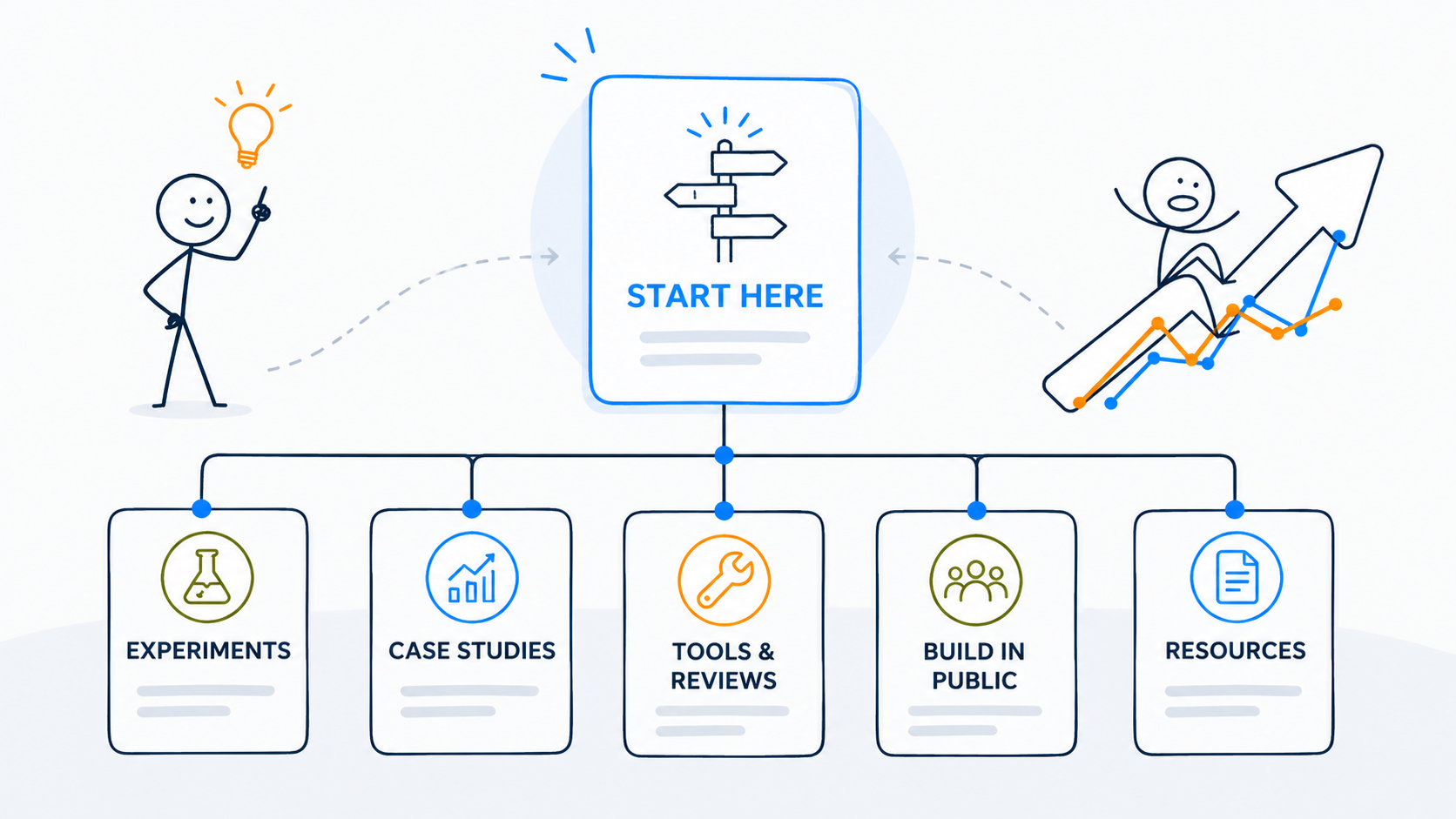
For Web Idea US – Marketing Lab, I am testing whether a Start Here hub can help clarify website structure at an early stage. Not as a decorative page. Not as a second homepage. Not as a category archive. A curated hub that helps people, search engines, and AI discovery systems understand the purpose of the site faster.
This is especially important because Marketing Lab is not a generic marketing blog. It is a public project where SEO, website traffic, visibility, analytics, AI discovery, and growth strategy are explored in real conditions. That means the structure matters almost as much as the articles themselves.
Google’s own guidance explains that links help Google discover pages and understand page relevance, and that clear anchor text helps both users and Google make sense of linked content. Google also explains that sitelinks are generated partly from a site’s link structure, which is another reminder that structure is not just a visual decision.
So the experiment is simple:
Does a Start Here hub make the site easier to understand before the content library becomes large?
My hypothesis is yes — but with conditions.
What I Wanted to Test
I wanted to test whether a Start Here hub could do three things at once.
First, help new readers understand the website faster.
Second, give the site a clearer internal structure before the content base becomes larger.
Third, create a stronger editorial center that can later connect pillar articles, experiments, case studies, tools, resources, and build-in-public updates.
This matters because early websites often grow in a messy way. One article is published because it feels urgent. Another is created because it supports a keyword. Another comes from a real observation. Then a case study appears. Then a tools article. Then a resource page.
Individually, each article may be useful.
Collectively, the site may still feel unclear.
That is where a Start Here hub becomes interesting. It gives the site a deliberate entry point. It says:
“This is what the project is. These are the main themes. These are the strongest starting materials. Here is the path you can follow.”
For Marketing Lab, that matters because the site is still in its early base-building phase. The current strategic priority is to build a strong 10–15 article foundation before moving into deeper polishing, internal linking refinement, and technical optimization.
A Start Here hub gives that early content base a frame.
Why Website Structure Becomes Confusing So Quickly
A website does not need hundreds of pages to become confusing.
Sometimes ten pages are enough.
The confusion usually starts when categories are technically correct but strategically incomplete.
For example, a user sees:
Experiments
Case Studies
Tools & Reviews
Build in Public
Resources
That menu makes sense to the site owner. It may even make sense to another marketer. But a first-time reader may still wonder:
Where should I begin?
Which article explains the core idea?
Which content is foundational?
Which content is tactical?
Which content is about this project versus general marketing strategy?
This is why I do not treat navigation and information architecture as the same thing. Navigation is what people click. Information architecture is the deeper organization behind what those clicks mean. Nielsen Norman Group makes a similar distinction, explaining that navigation, taxonomy, and information architecture are related but different models for organizing content and helping users understand complexity.
That distinction matters for SEO as well.
A menu can show the main sections of a website. But a Start Here hub can explain the editorial logic behind those sections.
That is a different job.
The Baseline Before the Start Here Hub
Before adding a stronger Start Here hub, the site already had a basic structure.
The main sections were:
- Experiments
- Case Studies
- Tools & Reviews
- Performance Dashboard
- Build in Public
- Resources
The brand positioning was also clear: Web Idea US – Marketing Lab, where marketing ideas are tested in public.
The first articles were already building the core content direction:
- Digital Marketing Analysis Before Website Launch
- Where to Get Traffic for My Website
- Why I’m Building Content Before Deep SEO Optimization
- A Business Launched a Website Without Marketing Analysis
- Free and Paid Tools for Digital Marketing Analysis
This is a good early foundation. It covers strategy, traffic, content sequencing, business mistakes, and practical tools.
But there was still a structural gap.
A new reader could land on any article and understand that article. But would they understand the whole project?
That is the difference between page-level clarity and site-level clarity.
The Start Here hub is designed to support site-level clarity.
What Changed / What Is Being Tested
The main test is not simply “add a Start Here page.”
That would be too shallow.
The real test is whether a curated Start Here hub can become a structural layer between the homepage and the full content library.
For this experiment, the Start Here hub should not behave like a blog feed. It should not show every article. It should not become a dumping ground for all new content.
Instead, it should be curated around the strongest starting points.
The hub should explain:
- what Marketing Lab is
- what is being tested here
- how the content is organized
- which articles are foundational
- where a new reader should begin
- how experiments, case studies, tools, and resources connect
That distinction is important. According to the project’s content matrix, Start Here is not a category. It is a curated entry point that should feature only foundational reads, strong introductory materials, key pillar articles, selected experiments, one strong case study, and one tools/resources entry.
That makes it different from a normal archive page.
A category page says, “Here are all posts in this section.”
A Start Here hub says, “Here is the logic of the site.”
Why a Start Here Hub Can Help Users
From a user perspective, the biggest benefit of a Start Here hub is orientation.
People do not arrive at websites in perfect order. They arrive through Google, social media, direct links, referrals, AI tools, or random browsing paths. They may land on a case study before they understand the broader framework. They may read a tools article before they understand the strategic problem the tool is supposed to solve.
A Start Here hub gives them a way to reset.
It creates a path like this:
You are here.
This is what the project is about.
These are the main topics.
These articles explain the foundation.
These categories show how the thinking develops.
That is useful because users rarely want “all content.” They want the right next step.
This is especially important for a site like Marketing Lab because the content is not only educational. It is also observational. Some articles are experiments. Some are case studies. Some are tool evaluations. Some are build-in-public updates. Without a clear entry point, the reader may not immediately understand why the mix exists.
A Start Here hub makes the editorial model visible.
It tells the reader:
This is not random. This is a structured lab.
Why a Start Here Hub Can Help SEO Site Structure
From an SEO perspective, I would not describe a Start Here hub as a ranking trick.
That would be the wrong framing.
The real SEO value is structural.
A well-built Start Here hub can help by creating cleaner internal paths to important content. It can point to the strongest foundational articles. It can use descriptive anchor text. It can reinforce the relationship between core topics.
Google’s link guidance says that links help Google find pages and that good anchor text helps users and Google understand what the linked page is about. Google’s SEO Starter Guide also emphasizes that SEO is about improving a site’s presence in search through practical improvements rather than expecting guaranteed indexing or ranking outcomes.
For a young site, that distinction matters.
The Start Here hub is not meant to force rankings. It is meant to reduce ambiguity.
It can help answer structural questions such as:
Which articles are most important?
Which topics define the site?
Which pages should receive stronger internal links?
Which categories are strategic pillars rather than random labels?
Which content should a crawler encounter early?
That is why I see the Start Here hub as part of the internal linking strategy, not just a user experience feature.
Why This Matters for AI Discovery and AIO
AI discovery adds another layer to this experiment.
Search engines are not the only systems trying to understand websites. AI tools, answer engines, and AI-powered search interfaces increasingly summarize, classify, and retrieve information from web content.
That does not mean we should write only for AI systems. I still think the first job is to be genuinely useful to humans.
But structure helps both.
A Start Here hub gives machines a clearer overview of the site’s purpose. It can describe the main themes in plain language. It can connect related articles. It can define the role of each content type.
For Marketing Lab, that matters because the site covers overlapping but distinct themes:
SEO
SEM
website traffic
digital visibility
analytics
content architecture
AI discovery
growth strategy
website launch analysis
Without structure, those topics can look like a broad marketing blog.
With structure, they start to look like a connected visibility and growth system.
That is the difference I care about.
What I Expect to Observe
At this stage, I would treat the results as directional, not final.
I would not expect a Start Here hub to create instant traffic growth. That would be an unrealistic expectation.
Instead, I would watch for smaller signals.
The first signal is whether users move from the Start Here hub into foundational articles.
The second signal is whether Google indexes the page quickly and begins showing impressions for branded or structural queries.
The third signal is whether internal links from the hub help distribute visibility to important early articles.
The fourth signal is whether the Start Here page becomes a useful page to link to from social posts, the homepage, author bio areas, and future build-in-public updates.
The fifth signal is whether the site feels easier to explain.
That last signal may sound soft, but I do not think it is minor.
If a website owner cannot explain where a new reader should start, the website structure probably needs work.
What I Think This Means
My current interpretation is that a Start Here hub is especially useful when a site has a strong concept but a growing content base.
If the site has only one or two articles, the hub may be premature.
If the site has hundreds of articles, the hub may require a larger information architecture project.
But in the middle — when a site is moving from “a few posts” into “a real content system” — the Start Here hub can become very valuable.
That is exactly where Marketing Lab is now.
The site has enough content to need structure, but not so much content that the structure is locked. This is the right moment to shape the reader journey before the archive becomes too large.
In my experience, this is where many businesses make mistakes. They wait too long to think about structure. They publish content first, then wonder why the site feels scattered. Then later they need to repair categories, rewrite navigation, rebuild internal links, and explain their own content model after the fact.
A Start Here hub is a lighter, earlier intervention.
It creates clarity before confusion becomes expensive.
What I Would Include in the Start Here Hub
For this project, I would keep the hub focused and curated.
I would not include every post. I would include a short explanation of the lab, then a guided path through the strongest materials.
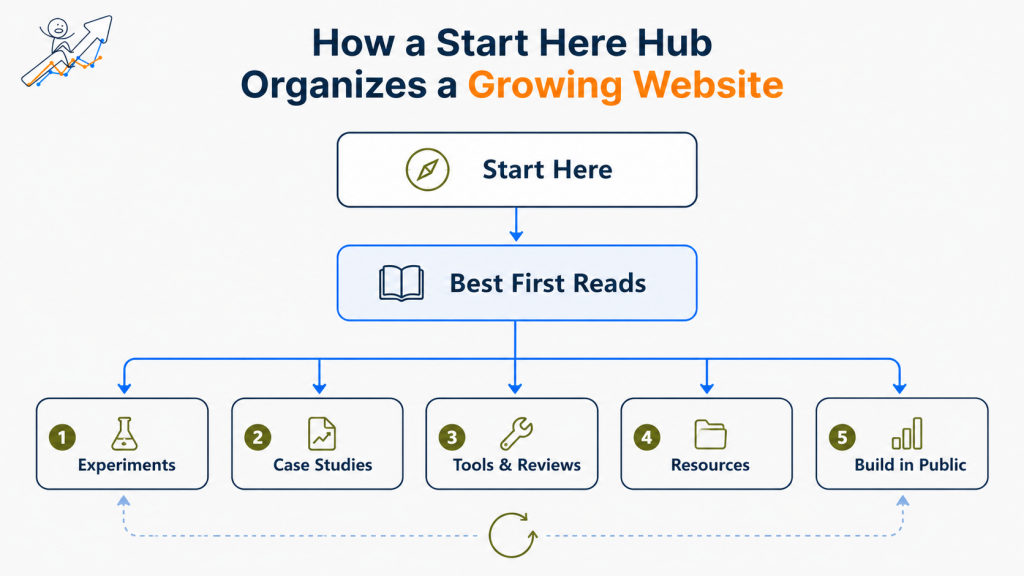
A practical structure could look like this:
1. What This Site Is
A short introduction explaining that Web Idea US – Marketing Lab is a public marketing lab focused on SEO, website traffic, digital visibility, analytics, AI discovery, and growth strategy.
2. Best First Reads
A curated set of foundational articles, such as:
- Digital Marketing Analysis Before Website Launch
- Where to Get Traffic for My Website
- Why I’m Building Content Before Deep SEO Optimization
3. If You Are Planning a Website
Links to launch analysis, traffic strategy, and future website launch checklist content.
4. If You Want to Understand Real Marketing Mistakes
A link to the case study about launching a website without marketing analysis.
5. If You Want Tools and Practical Resources
A link to the digital marketing analysis tools article and future Resources pages.
6. If You Want to Follow the Lab Itself
Links to build-in-public updates, performance dashboard notes, and future experiment recaps.
This would make the Start Here hub useful without making it bloated.
What I Would Not Put on the Start Here Hub
A Start Here hub loses value when it becomes too crowded.
I would avoid adding:
- every new article automatically
- minor technical updates
- every tool review
- every build-in-public note
- long personal explanations that belong on the About page
- generic welcome copy with no useful path
- too many competing CTAs
The hub should feel like a guide, not a storage room.
That is the main editorial discipline.
The Practical Business Lesson
This experiment is not only about Marketing Lab.
It applies to many business websites.
A service business may need a Start Here page that explains which service pages matter most and where prospects should begin.
A consultant may need a Start Here page that organizes articles by business problem instead of publish date.
A SaaS company may need a Start Here hub that connects product education, use cases, case studies, and implementation resources.
A niche content site may need a Start Here hub to clarify topical authority before the archive becomes too large.
The pattern is the same:
When content grows, structure becomes part of the product.
A website is not just a collection of pages. It is a system of meaning.
The Start Here hub helps make that system visible.
What I Would Do Next
The next step is to publish or refine the Start Here hub with a clear purpose.
Then I would watch:
- whether the page gets indexed
- whether users click into foundational articles
- whether internal links help important articles receive more visibility
- whether the hub becomes a useful destination from social and homepage areas
- whether future articles naturally connect back to it
I would also revisit the page after the next 5–10 articles are published.
That is important because a Start Here hub should not be frozen. It should evolve as the site becomes stronger.
Not every article deserves to be featured there. Only the strongest structural pieces should remain.
That is the discipline of a curated hub.
Final Takeaway
So, does a Start Here hub help clarify website structure?
My working answer is yes — when it is treated as a strategic hub, not a decorative page.
It helps readers understand where to begin. It helps the site owner define which content matters most. It supports internal linking. It gives Google and AI systems clearer paths through the site. And it forces a useful editorial question:
What is this website really about, and what should a new reader understand first?
For a growing marketing site, that question is not cosmetic.
It is structural.
And in this experiment, the Start Here hub is my way of testing whether better structure can create better clarity before the site becomes too large to organize easily.