

There is a strange pressure that appears right after a website goes live.
You publish a few articles. Google starts indexing pages. Search Console begins showing early impressions. Maybe a few clicks appear. Suddenly, everything feels urgent.
The title could be better.
The meta description could be sharper.
The internal links could be stronger.
The homepage could be cleaner.
The categories could be polished.
The featured images could be more consistent.
The CTA could be tested.
The analytics setup could track more events.
The article introductions could be rewritten.
The schema could be improved.
The sidebar could be redesigned.
The whole thing could be optimized.
And technically, all of that may be true.
But just because something can be optimized does not mean it should be optimized right now.
That is the experiment I am documenting here.
At this stage of Web Idea US – Marketing Lab, I am intentionally not optimizing everything yet. Not because optimization does not matter. It matters a lot. I have spent enough years in SEO, SEM, analytics, website strategy, and traffic acquisition to know that small structural decisions can create big long-term differences.
But I also know something else:
Early optimization without enough information can become noise.
It can make a site look more polished while doing very little to improve visibility, traffic, or strategic clarity.
So instead of trying to perfect every page too early, I am choosing a different sequence: build the content base, let the structure form, watch the first signals, and then optimize from evidence instead of anxiety.
What I’m Testing
The question behind this experiment is simple:
What should not be optimized yet on an early-stage marketing website?
More specifically, I am testing whether it is smarter to delay certain SEO, UX, internal linking, and conversion improvements until the site has enough content depth and early performance data.
This matters because many website projects get stuck in premature polishing.
A business launches a site and immediately starts adjusting small things: button labels, meta descriptions, page titles, homepage sections, header layouts, plugin settings, color details, tiny wording choices.
Some of those details matter later.
But in the early stage, the bigger question is usually not, “Is this perfectly optimized?”
The better question is:
Does the site have enough meaningful material for search engines, AI systems, and users to understand what it is about?
For Marketing Lab, the answer is still developing.
The site has a clear direction. It has a strong positioning. It already has foundational content around digital marketing analysis, website traffic, early SEO decisions, tools, and case-study logic. Google is indexing new pages quickly, which is a positive early signal.
But the site is still in the content-base-building phase.
That means I am not treating every small imperfection as a problem yet. I am treating this stage as controlled construction.
Why I’m Not Optimizing Everything Immediately
Early-stage SEO optimization can be misleading because there is not enough data yet.
When a site has only a small number of articles, every page feels important because there are not many pages to compare. One article may get impressions faster than another, but that does not always mean it is better. It may simply be easier for Google to understand. It may target a clearer query. It may sit closer to existing demand. Or it may just be getting tested earlier.
If I start optimizing too aggressively based on the first few signals, I may overreact.
That is something I have seen businesses do often.
They launch a website, check performance too early, and then start changing everything before the site has had enough time or depth to show a pattern. They rewrite titles, restructure pages, switch plugins, adjust copy, redesign sections, and sometimes even change the strategy.
But early signals are not always strategic truth. Sometimes they are just early signals.
This is especially important in SEO because visibility is not only about individual page quality. It is also about relationships between pages.
A single article can be strong, but a site becomes more understandable when related articles support each other. Search engines need context. AI systems need semantic clarity. Users need pathways. Internal links need useful destinations. Categories need enough material to feel real.
That is why I am delaying some optimization work until the site has more substance.
Not forever. Just not yet.
What I Am Not Optimizing Yet
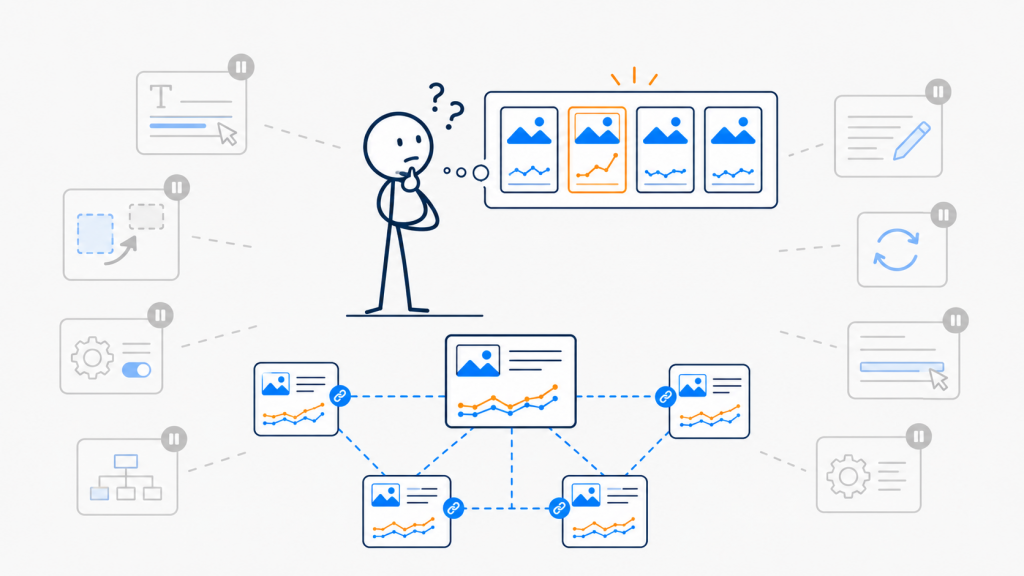
There are several things I am intentionally not prioritizing right now.
This does not mean I am ignoring them. It means I am putting them in the right order.
1. I’m Not Perfecting Every SEO Title Yet
SEO titles matter. They affect search visibility, click-through behavior, topical clarity, and how a page is framed in search results.
But at this stage, I am not treating every title as final.
Why?
Because the content cluster is still forming.
A title that looks good in isolation may need adjustment later when I understand how the full topic map develops. For example, an article about website traffic, an article about digital marketing analysis, and an article about early SEO optimization should not accidentally compete with each other. Their titles need to work together.
Right now, I care more about clear direction than perfect wording.
The title needs to be understandable. It needs to reflect the article. It needs to give Google and readers a reasonable signal. But I do not need to spend an hour testing tiny title variations on every article before the content base exists.
Later, when I can see which pages are getting impressions, which queries are appearing, and where ranking positions are forming, title optimization will be much more useful.
At that point, I can ask better questions:
- Is the title aligned with actual search queries?
- Is the page appearing for the right intent?
- Is the title too broad or too narrow?
- Is another article competing for the same topic?
- Does the title need a stronger business angle?
That is real optimization.
Right now, overworking titles would mostly be guessing.
2. I’m Not Rewriting Every Meta Description Yet
Meta descriptions are useful, but they are not where I want to spend too much energy in the earliest stage.
I still write them. I still want them to be clear. But I am not obsessing over every word yet.
Why?
Because meta descriptions are only one part of the search result experience, and Google may rewrite them depending on the query. The bigger issue right now is whether the page itself deserves to be understood, indexed, and tested.
A strong meta description cannot compensate for a weak content base.
So my current approach is practical:
Write a clean meta description. Make sure it reflects the article. Include the main concept naturally. Move on.
Later, when there are more pages and more data, I can revisit descriptions for pages that are getting impressions but not enough clicks. That is when meta description optimization becomes more strategic.
Early on, I do not want to confuse activity with progress.
3. I’m Not Building a Heavy Internal Linking System Yet
This one may sound strange because internal linking is one of the most important parts of content architecture.
But I am not doing deep internal linking yet.
I am adding obvious internal links where they make sense, but I am not building a full internal linking framework until more articles exist.
Internal links need destinations.
When a site has only a few articles, there are not enough useful paths yet. I can link between early posts, but the structure will still be thin. If I force too many links too early, the site may start to feel artificial.
Good internal linking should help readers move through related ideas naturally.
For example, an article about digital marketing analysis before website launch should link to a case study showing what happens when analysis is skipped. A tools article should link to the strategy article that explains why those tools matter. A traffic article should link to analytics, channel strategy, SEO, and paid traffic decisions.
That kind of linking becomes much stronger when the content system has enough pieces.
So for now, I am collecting future internal link opportunities as I publish.
I know which articles should eventually connect:
- concept articles to case studies
- case studies to tools
- tools to resources
- experiments to performance updates
- Build in Public notes to real tests
- Start Here to the strongest foundational pieces
But I am not forcing the full structure too early.
The internal linking system should emerge from the content architecture, not from panic.
4. I’m Not Over-Polishing Old Articles Yet
Every time I publish a new article, I see ways to improve the earlier ones.
That is normal.
The first article could be sharpened. The second could be connected better. The third might need a clearer bridge to the next topic. Some introductions could be tighter. Some sections could be more elegant.
But I am not going back to polish everything after every new post.
That would slow down the project too much.
In early content development, perfection can become a trap. You can spend weeks improving five articles instead of publishing the next five that help the site become more complete.
That does not mean quality is unimportant. The articles still need to be useful, strategic, readable, and aligned with the brand.
But there is a difference between publishing low-quality content and delaying growth because every article must feel final.
Right now, my goal is not to make every article perfect.
My goal is to build a strong enough foundation that future optimization has something to work with.
Batch polishing later will be more efficient.
Once the site has 10–15 articles, I can review the whole system more intelligently:
- Which articles should be featured on Start Here?
- Which articles deserve stronger internal links?
- Which titles overlap?
- Which topics need supporting pages?
- Which posts should become cornerstone content?
- Which pages are getting impressions but need better click appeal?
- Which articles need visuals, CTAs, or structural improvements?
That is a better moment for polishing.
5. I’m Not Optimizing for Conversions Too Aggressively Yet
This site will eventually need stronger CTAs.
There may be email signup forms, prompt products, affiliate resources, downloadable checklists, templates, dashboards, and other artifacts later.
But I am not turning every article into a conversion machine yet.
Why?
Because trust comes first.
Marketing Lab is not just a monetization project. It is also a professional asset, a public portfolio, and a place to document real strategic thinking. If I push conversion too early, before the site has enough value, the project may start to feel transactional.
That is not the tone I want.
The current priority is to prove usefulness.
I want the reader to feel: “This person understands how digital visibility works. This is not generic advice. There is real thinking here.”
Later, when the site has stronger content depth and clearer reader pathways, conversion elements will make more sense.
For example, a future article about SEO audit checklists could naturally lead to a downloadable audit template. A tools article could naturally connect to affiliate links or a Resources page. A Build in Public article about prompt workflows could lead to the Marketing Lab Prompt System.
But right now, I prefer subtle CTAs.
The project needs credibility before it needs stronger monetization mechanics.
6. I’m Not Expanding Tracking Too Deeply Yet
GTM and GA4 are already installed, and the basic tracking architecture is in place. That matters because analytics should not be an afterthought.
But I am not building a complicated event-tracking system yet.
Not because tracking is unimportant. It is very important.
But tracking should match the stage of the website.
At this point, there are not many conversion actions to measure. There may be page views, scroll behavior, outbound clicks, article engagement, and future CTA clicks. But if I create too many events before the site has clear user journeys, I may end up with data that looks impressive but does not answer useful questions.
Analytics should support decisions.
It should not become decoration.
For now, the most important questions are simpler:
- Are pages being indexed?
- Are impressions appearing?
- Which queries are starting to show?
- Which articles get early visibility?
- Which categories are being understood?
- Are readers landing on the content?
- Are there obvious technical issues?
Later, when there are more articles and clearer actions, deeper tracking will become more valuable.
That is when I will care more about scroll depth, CTA clicks, outbound tool clicks, resource downloads, email signups, and article-assisted conversion paths.
Right now, the measurement layer should stay useful, not bloated.
7. I’m Not Trying to Optimize for Every Traffic Channel Yet
This is another important decision.
The site can eventually support multiple traffic channels:
- organic search
- AI-driven discovery
- referral traffic
- direct visits
- affiliate-driven resource traffic
- maybe paid traffic later
But I am not trying to optimize deeply for every channel at once.
Early-stage marketing projects often become messy because the owner tries to make everything work immediately. The website is not mature yet, but the business is already trying SEO, social media, paid ads, email capture, lead magnets, short-form content, affiliate links, and maybe community building.
That creates too many moving parts.
For Marketing Lab, the first job is to build a search-friendly, AI-readable, strategically coherent content base.
Social sharing can support distribution. Facebook and LinkedIn can help the articles get seen. But I do not want social media to dictate the content strategy.
The website is the core asset.
The articles should build topical authority, internal logic, and long-term discoverability. Social posts can point to that work, but they should not replace the work.
8. I’m Not Redesigning the Site After Every New Idea
Design matters. Visual identity matters. Featured images matter. The site should feel consistent, strategic, and recognizable.
But I am not redesigning the site every time I notice a better layout possibility.
This is especially tempting in the early stage because every new article reveals something about the structure. Maybe a category page could look better. Maybe the sidebar could be improved. Maybe the Start Here page needs stronger article cards. Maybe the homepage should explain the project differently.
All of that may be true.
But design decisions become stronger when they respond to real content.
A website with two articles and a website with fifteen articles need different structural solutions. A Start Here page becomes more useful when there are enough strong pieces to curate. A Resources page becomes more valuable when there are real tools, checklists, and frameworks to organize.
So I am letting the content reveal the design needs.
That does not mean ignoring visual quality. The site still needs to look credible. But major design decisions should support the content system, not interrupt it every week.
What I Am Optimizing Now
This article is not an argument against optimization.
It is an argument for sequencing.
There are still things I am optimizing right now.
I’m Optimizing for Strategic Clarity
Every article needs to make the project easier to understand.
Marketing Lab is not a generic marketing blog. It is a public marketing lab where SEO, traffic, visibility, analytics, AI discovery, and growth strategy are explored in real conditions.
So each article should strengthen that identity.
If a topic does not help explain the lab, support a cluster, document an experiment, analyze a business situation, review a useful tool, or create a future resource path, it probably does not belong yet.
That is a form of optimization.
It is not page-level SEO polishing. It is positioning discipline.
I’m Optimizing for Content Architecture
Right now, I care a lot about how the content pieces fit together.
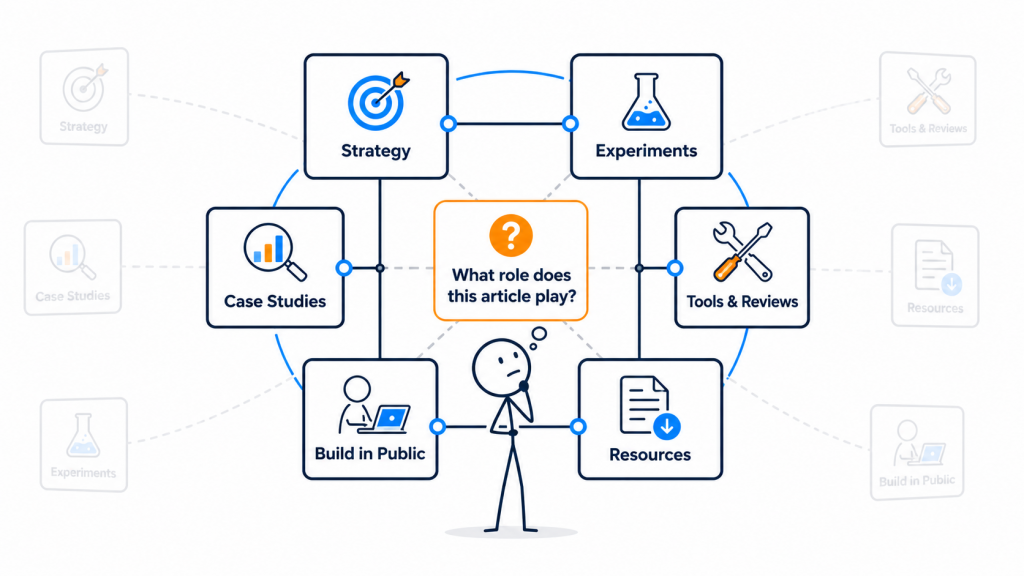
The site needs a balanced early base:
- foundational strategy articles
- experiment articles
- case studies
- tools and reviews
- build-in-public reflections
- resource pages
This matters because a site with only broad strategy articles can feel theoretical. A site with only tools articles can feel affiliate-driven. A site with only case studies can lack foundational explanation. A site with only personal updates can feel too narrow.
The strength is in the combination.
That is why I am not only asking, “Is this article good?”
I am asking:
What role does this article play in the system?
I’m Optimizing for Semantic Consistency
Even before deep SEO optimization, the site needs consistent language.
Terms like website traffic, digital visibility, SEO, SEM, analytics, growth strategy, content architecture, AI discovery, and website launch analysis should appear naturally across the site.
Not as keyword stuffing.
As conceptual consistency.
Search engines and AI systems need to understand what this site repeatedly discusses. Readers need that too. A clear vocabulary helps the project become recognizable.
So while I am not polishing every detail, I am paying close attention to whether the content stays inside the right strategic universe.
I’m Optimizing for Publishing Momentum
This is underrated.
A website does not grow from planning alone.
At some point, articles need to be published. Search systems need pages to crawl. Internal links need pages to connect. Categories need content. Analytics needs activity. The site needs enough material to become observable.
That is why publishing momentum matters in this phase.
Not reckless publishing. Not thin publishing. Not content for the sake of content.
But steady, useful, strategic publishing.
A good early-stage content base creates the conditions for smarter optimization later.
The Risk of Optimizing Too Early
The biggest risk of optimizing too early is that you optimize the wrong thing.
You may improve a title for a keyword that turns out not to matter.
You may build internal links around a structure that changes two weeks later.
You may create CTAs before readers trust the site.
You may design a Resources page before you know what resources belong there.
You may track events that do not support real decisions.
You may polish articles that should actually be supported by new content.
This is why I think early stage SEO optimization requires patience.
Not passive patience.
Strategic patience.
The kind where you keep building, observing, and making decisions in the right order.
A Simple Rule I’m Using
For this stage of Marketing Lab, I am using a simple rule:
If optimization helps the site become clearer, stronger, or more structurally useful now, I do it. If it only makes me feel more polished but does not change the strategic foundation, I delay it.
That rule helps me separate important work from nervous work.
Important work:
- publishing useful articles
- defining category roles
- clarifying the site’s positioning
- creating strong topic relationships
- watching indexing and query signals
- maintaining basic technical health
- keeping the brand consistent
Nervous work:
- rewriting titles too often
- editing old articles after every new idea
- forcing internal links before enough content exists
- obsessing over meta descriptions too early
- redesigning pages repeatedly
- adding advanced tracking before there are meaningful actions
- optimizing for channels that are not active yet
Both types of work can look productive.
Only one actually moves the project forward at this stage.
What I’ll Optimize Later
The delayed work still matters. I am not forgetting it.
After the content base is stronger, I will come back to several optimization layers.
Title and Meta Refinement
Once Search Console has more query data, I can improve titles and descriptions based on real visibility patterns.
That will include checking:
- which pages get impressions
- which queries trigger them
- where titles are too broad
- where click potential is weak
- where pages overlap
- where a stronger business angle is needed
Internal Linking
When there are enough articles, I will build a more deliberate internal linking map.
The goal will be to connect:
- foundational articles to experiments
- experiments to case studies
- case studies to tools
- tools to resources
- Build in Public notes to actual tests
- Start Here to the strongest entry points
This will make the site easier to navigate for readers and easier to understand for search systems.
Technical and UX Review
Later, I will review technical details more carefully:
- page speed
- mobile experience
- indexation patterns
- category pages
- schema opportunities
- image optimization
- navigation clarity
- article template consistency
But I want that review to happen when the site has enough content to make the review meaningful.
CTA and Monetization Layer
The monetization layer will come later through affiliate links, resources, and paid artifacts such as templates, prompts, checklists, dashboards, and frameworks.
But those offers need context.
A prompt system, for example, becomes more believable when readers can see the actual articles and workflows it helped create. A tools recommendation becomes stronger when it connects to real use cases. A checklist becomes more useful when it supports a clear problem already explained in the content.
So conversion optimization will come after trust-building, not before it.
What This Means for Business Owners and Marketers
If you are building or relaunching a website, the lesson is not “ignore optimization.”
The lesson is: optimize in the right order.
Many businesses do this backwards.
They spend too much time polishing the website before they understand the traffic strategy. They obsess over design before they understand search demand. They launch ads before tracking is ready. They rewrite copy before knowing what users are looking for. They install tools before deciding what decisions those tools should support.
A better approach is to ask:
- What does the site need to prove first?
- What content is missing?
- What does Google need to understand?
- What does the user need to understand?
- Which pages support business goals?
- Which signals are real and which are too early?
- What can wait until there is more data?
That kind of thinking saves time.
It also prevents the website from becoming a collection of polished but disconnected parts.
My Current Takeaway
Right now, I am not trying to make Marketing Lab perfect.
I am trying to make it structurally strong.
That means publishing useful articles, building topical consistency, documenting real observations, and letting early search signals appear before I start making heavier optimization decisions.
This is not a passive stage.
It is not “publish and hope.”
It is active observation.
The site is being built in public, but it is also being built in sequence.
And that sequence matters:
First, create enough meaningful content.
Then, understand what the content system is becoming.
Then, optimize based on real structure and real signals.
That is what I am testing.
Not whether optimization matters.
But whether delayed optimization, done at the right moment, can create a stronger website than premature polishing.
For now, I am choosing patience with a plan.
And in early-stage SEO, that may be one of the most useful optimizations of all.