
A new website often feels like a fresh start.
For many service businesses, it is a serious investment. The old site looked outdated. The pages were messy. The branding no longer matched the business. Maybe the site was slow, hard to update, or built years ago by someone who disappeared after launch.
So the business finally rebuilt it.
The new website looks better. The homepage is cleaner. The service pages are more polished. The contact form works. The mobile version looks professional. Everyone involved feels some relief.
And then something uncomfortable happens.
Nothing much changes.
The phone does not start ringing more often. Contact form submissions stay weak. Organic traffic barely moves. Paid ads feel expensive. The business owner checks Google and still does not see the company where they expected it to appear.
This is one of the most common post-launch frustrations I see with service businesses.
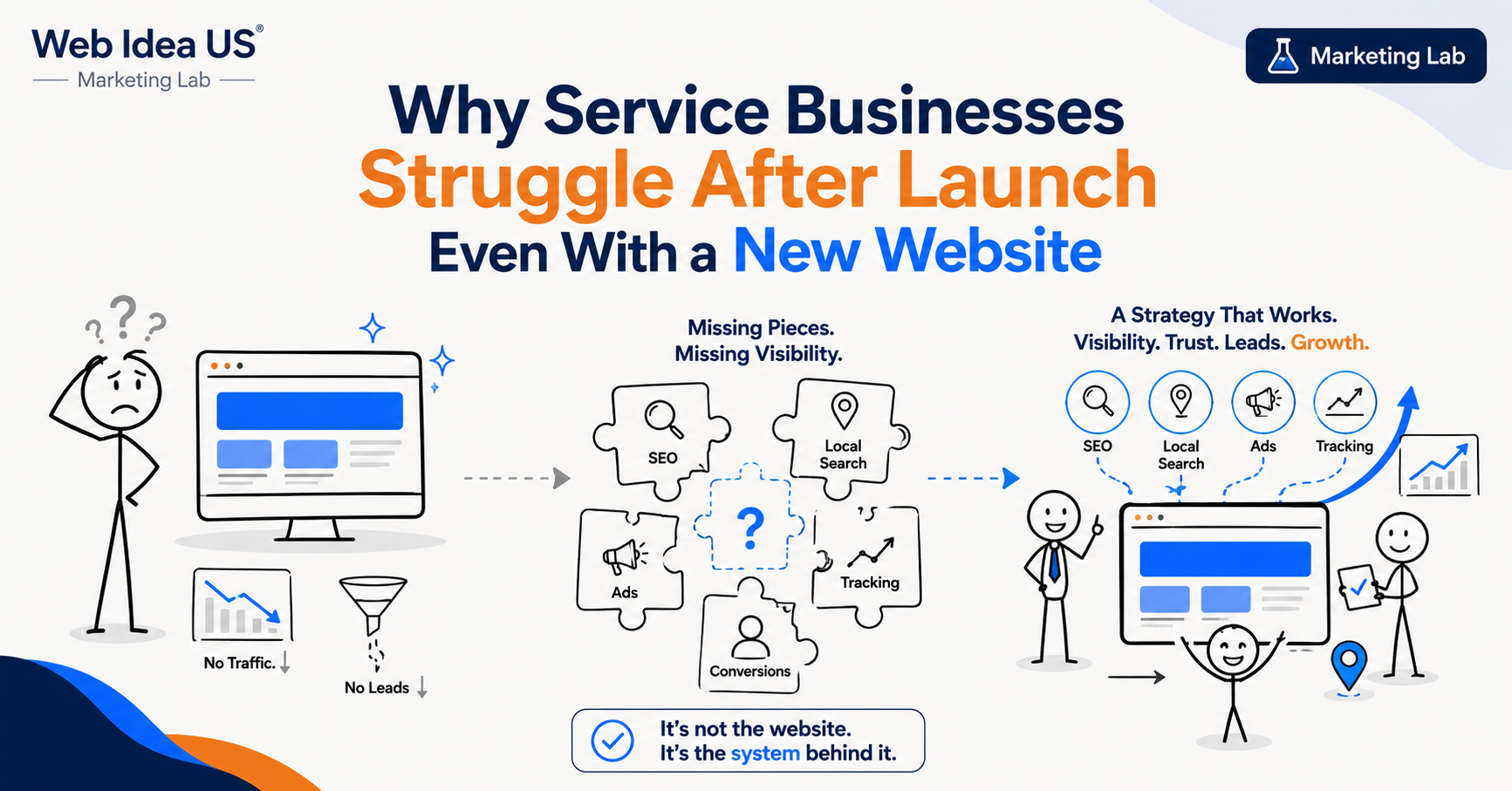
The website is new, but the growth problem is still old.
And usually, the issue is not that the website is “bad.” The deeper issue is that the business expected a website launch to solve problems that should have been addressed before, during, and after the launch.
A website can support visibility, trust, traffic, and leads. But it cannot replace strategy.
The realistic business situation
Let’s use a realistic service business example.
Imagine a local home service company. It might be a remodeling contractor, cleaning company, dental clinic, moving company, HVAC provider, home care agency, or legal service provider.
The business has been operating for several years. Most leads come from referrals, repeat customers, a few Google Business Profile actions, occasional social posts, and maybe some paid traffic.
The owner decides to invest in a new website because the old one feels outdated and does not represent the business well.
The goals sound reasonable:
The business wants more leads.
It wants a more professional online presence.
It wants to rank better in Google.
It wants visitors to trust the company.
It wants to use the site for future ads, SEO, and content.
The website launches.
On the surface, everything looks improved.
But after launch, the business still struggles to generate consistent traffic and leads.
This is where the real marketing work begins.
What looked fine on the surface
Many service business websites look acceptable at launch.
The design is modern. The homepage has a hero section, a call-to-action button, a few service blocks, testimonials, and a contact form. The website has pages for major services. The business name, phone number, and location are visible. The site is responsive on mobile.
From a design perspective, the launch may look successful.
But design quality is not the same as market readiness.
A website can look professional and still fail to answer several strategic questions:
Who is supposed to find this website?
Which search queries should bring visitors?
Which services deserve dedicated landing pages?
Which locations need visibility?
Which pages should support paid traffic?
What conversion action matters most?
How will leads be tracked?
What does success look like 30, 60, or 90 days after launch?
If those questions were not answered, the business launched a presentation asset, not a growth system.
That distinction matters.
A new website does not automatically create demand
One of the biggest misconceptions is that launching a new website automatically creates attention.
It does not.
A website does not create search demand by existing. It does not force Google to rank it. It does not make people search for your service more often. It does not guarantee clicks from social media. It does not make ads profitable by itself.
A website is a destination. But traffic needs a source.
For service businesses, those sources usually include organic search, Google Business Profile visibility, local SEO, paid search, referrals, social proof, email, partner links, direct traffic, and sometimes AI-driven discovery.
The problem is that many website projects focus heavily on the destination and lightly on the routes that lead people there.
This is why a service business can launch a better website and still have no meaningful increase in leads.
The question is not only, “Do we have a new website?”
The better question is, “Do we have a reason, path, and system for the right people to find it?”
What was actually missing
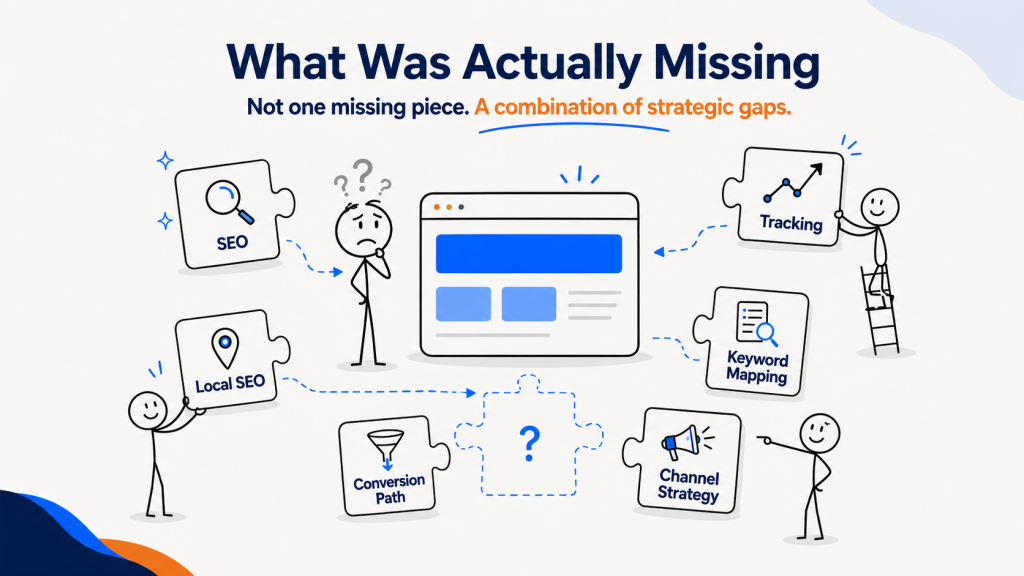
When a service business struggles after a website launch, the missing layer is usually not one single thing. It is a combination of strategic gaps.
1. No digital marketing analysis before launch
Before building or rebuilding a website, a business should understand the market around the website.
That includes search demand, competitor visibility, local intent, paid traffic economics, content gaps, review behavior, and conversion expectations.
Without this analysis, the website may be built around what the business wants to say instead of what potential customers are actually trying to find.
This matters especially for service businesses because customer language and company language are often different.
A business might describe a service as “residential relocation solutions,” while customers search for “local movers near me” or “moving company in [city].”
A clinic might use professional treatment names while patients search for symptoms, costs, insurance questions, or “dentist open Saturday near me.”
A contractor might group services into broad categories while customers search for very specific jobs.
Without pre-launch marketing analysis, the website may look organized internally but remain weak externally.
This is exactly why digital marketing analysis before website launch is one of the foundational topics in the Marketing Lab content system.
2. No keyword and page mapping
Service businesses often create pages based on their internal service list.
That sounds logical, but it is not always enough.
A strong service business website usually needs keyword-to-page mapping. That means each important service, location, and search intent has a clear page strategy.
For example, a moving company may need separate pages for:
- local moving
- long-distance moving
- commercial moving
- packing services
- apartment moving
- same-city moving
- city-specific landing pages
- storage-related moving needs
A dental clinic may need separate pages for:
- emergency dentist
- teeth cleaning
- dental implants
- cosmetic dentistry
- Invisalign
- family dentistry
- insurance-related queries
- location-specific searches
If all of those services are briefly mentioned on one general page, Google and users may not understand the relevance clearly enough.
This does not mean every tiny variation needs a separate page. That can create thin content and SEO clutter.
But high-intent services usually deserve focused pages.
When keyword mapping is skipped, the website may have content, but not enough search-aligned structure.
3. Weak local SEO structure
For many service businesses, local visibility is not optional. It is the battlefield.
People often compare local providers through Google Search, Google Maps, reviews, websites, and business profiles. BrightLocal’s 2026 Local Consumer Review Survey reported that after reading positive reviews, 54% of consumers then check the business’s website, which shows how closely reviews and websites work together in local decision-making.
That detail is important.
It means the website is often not the first touchpoint. It may be the validation layer after someone sees reviews, map results, or a business listing.
So if the website launches without coordination between local SEO, Google Business Profile, reviews, service pages, and location signals, the business may still struggle.
A polished website cannot fully compensate for weak local visibility.
Local service businesses need consistency across:
- business name, address, and phone details
- Google Business Profile
- categories and services
- review signals
- localized service pages: city or neighborhood
- relevance
- schema markup where appropriate
- clear contact and booking paths
- service-area clarity
If the new website is disconnected from this local ecosystem, it may look better but perform only slightly better.
4. No clear conversion path
Another common issue is that the website gets visitors, but does not guide them.
The business assumes that a contact form and phone number are enough.
Sometimes they are not.
Service business visitors usually need reassurance before they act. They want to know:
Do you serve my area?
Do you offer the exact service I need?
Can I trust you?
How soon can you help?
What does the process look like?
Are you licensed, certified, insured, experienced, or specialized?
What should I expect after I submit the form?
Can I call, book, request a quote, or schedule online?
If the site does not answer those questions clearly, visitors hesitate.
Conversion is not just a button. It is the path from uncertainty to action.
A strong service business website should make the next step obvious. It should also reduce friction around that step.
For example, “Contact Us” is generic.
“Request a Free Moving Estimate” is clearer.
“Schedule an Emergency Dental Appointment” is more specific.
“Get a Same-Day HVAC Repair Quote” speaks directly to intent.
The CTA should match the customer’s situation.
5. Tracking was installed too late or too lightly
Many service businesses launch a website and only later ask, “How do we know if it is working?”
That order is backward.
At minimum, a serious website launch should include clean analytics planning. Google Analytics, Google Tag Manager, conversion events, form tracking, phone click tracking, CTA tracking, and traffic source review should be considered before launch or immediately at launch.
Otherwise, the business enters the post-launch period with vague feelings instead of useful data.
It may not know:
which pages visitors are landing on
which traffic sources are working
which service pages attract interest
which buttons get clicked
whether forms are submitted
whether mobile users behave differently
whether paid traffic converts
whether organic traffic is improving
which pages need attention first
Google positions Analytics as a tool to understand website traffic, and that basic idea is still essential: if you cannot read the traffic, you cannot responsibly improve the system.
In my view, tracking is not a technical extra. It is part of the business logic.
If the website exists to generate leads, then lead actions need to be measurable.
6. Paid traffic was treated as a shortcut
After a weak launch, some businesses try to “fix” the problem with ads.
That can work, but only if the website and campaign economics are ready.
Paid traffic will not magically repair unclear positioning, weak landing pages, poor tracking, or low-intent offers. It may simply expose those problems faster and more expensively.
A service business can spend money on Google Ads or social ads and still struggle if:
- the landing page is too broad
- conversion tracking is missing
- the offer is unclear
- keywords are too general
- location targeting is loose
- the website does not build trust
- the form asks for too much too soon
- calls and form submissions are not connected to lead quality
Paid traffic is not just about buying clicks.
It is about buying the opportunity to test whether the offer, page, intent, and conversion path work together.
If they do not, the business pays for confusion.
7. The website did not reflect how people actually compare service providers
Service business buyers rarely make decisions from one signal.
They compare.
They look at reviews, location, website quality, photos, pricing language, credentials, speed of response, and perceived professionalism. They may move between search results, map listings, review platforms, social pages, and business websites before taking action.
BrightLocal’s 2025 survey found that 74% of consumers use two or more review sites when deciding to use a local business.
That does not mean reviews replace the website. It means the website is part of a broader trust environment.
A new website that ignores this comparison behavior may feel incomplete.
For example, a service page with no proof, no examples, no review integration, no location relevance, and no process explanation may struggle even if the design is attractive.
The customer is not asking, “Is this website modern?”
The customer is asking, “Can I trust this business with my problem?”
What happened after launch
In this kind of scenario, the post-launch pattern is usually predictable.
The business waits for traffic.
At first, there was excitement. The site is live. The URL is shared on social media. Maybe a few people visit. Friends, employees, or existing customers comment that it looks great.
Then the numbers flatten.
Organic traffic is low. Search Console may show some impressions, but not enough clicks. Service pages are not ranking for meaningful queries. Paid campaigns, if launched, produce traffic but not enough qualified leads. Contact form submissions are weak or inconsistent.
The business owner starts asking familiar questions:
Why is the new website not generating leads?
How long does SEO take after launch?
Should we run ads?
Do we need more blog posts?
Is something wrong with the site?
Why are competitors still ahead of us?
These are reasonable questions.
But the answer is rarely one simple fix.
The website did not fail because it was new.
It struggled because launch was treated like the finish line.
For a service business, launch is the beginning of market testing.
Why service businesses struggle after launch
The deeper reason is that many service businesses misunderstand what a website is supposed to do.
A website is not only a digital brochure.
It is also a search asset, trust asset, conversion asset, analytics asset, content hub, paid traffic destination, local SEO support layer, and brand validation point.
When only the brochure layer is built, the business gets a better-looking website but not necessarily a better-performing one.
Here is the uncomfortable truth:
A new website can improve presentation without improving acquisition.
That is the gap.
The business invested in the visible part of the system but not enough in the discovery, measurement, and conversion layers.
What should have happened earlier
Before launching the website, the business should have gone through a practical visibility and performance planning process.
Not a 100-page strategy deck. Not academic research. Not endless meetings.
Just enough structured thinking to avoid building blindly.
Demand analysis
The business should know what people search for, how often they search, and which terms show buying intent.
This includes service keywords, local modifiers, problem-based searches, emergency searches, cost-related searches, and comparison queries.
Competitor visibility review
The business should understand which competitors appear in search results, maps, ads, review platforms, and local directories.
Not just who the owner thinks the competitors are.
Digital competitors are the businesses already occupying attention.
Page architecture planning
The site should be structured around customer intent and service priority.
Important services should not be buried. High-intent pages should be clear. Supporting content should answer real questions. Internal links should guide users and search engines through the site.
Local SEO alignment
Google Business Profile, service areas, location pages, reviews, citations, and website content should work together.
For local service businesses, the website cannot be separated from the local search ecosystem.
Conversion planning
The site should define what a lead means.
Phone call? Form submission? Quote request? Appointment booking? Chat interaction? Download? Consultation request?
Then the site should make that action easy and measurable.
Tracking setup
GTM, GA4, Search Console, form tracking, phone click tracking, and conversion events should be part of the launch plan.
Without tracking, the business is guessing.
Post-launch review plan
The first 30–90 days after launch should be treated as an observation period.
What is being indexed?
Which pages get impressions?
Which queries appear?
Which pages attract traffic?
Which CTAs get clicks?
Which channels show early promise?
Where do users drop off?
That information should guide the next improvements.
How I would approach the recovery
If a service business came to me after launching a new website that was not generating leads, I would not immediately start by rewriting everything.
I would diagnose the system first.
Step 1: Separate design problems from strategy problems
A website can have design issues, but many post-launch failures are strategic.
I would look at whether the site is clear, trustworthy, and easy to navigate. But I would also check whether the site has the right pages, right intent coverage, right tracking, and right acquisition logic.
Step 2: Review search demand and page alignment
I would compare the service pages against actual search behavior.
Are the important services represented?
Are pages too broad?
Are local modifiers missing?
Are there pages for high-intent searches?
Are headings written in customer language?
Is the content specific enough to compete?
This often reveals that the website has pages, but not the right pages.
Step 3: Check local visibility signals
For a local service business, I would review Google Business Profile, review patterns, NAP consistency, service categories, location targeting, and how the website supports local relevance.
If the business depends on local customers, this layer can be decisive.
Step 4: Audit conversion paths
I would test the website like a potential customer.
Can I quickly understand what the business does?
Can I tell whether they serve my area?
Can I find the service I need?
Do I trust them?
Is the next step obvious?
Does the CTA match my intent?
Can I call easily on mobile?
Small conversion improvements often matter a lot for service businesses because traffic volume may be limited. Every qualified visitor is valuable.
Step 5: Fix tracking before scaling traffic
Before spending more on ads or producing a lot of new content, I would make sure the business can measure meaningful actions.
A service business does not need the most complicated analytics setup on day one.
But it does need enough tracking to know whether people are moving toward contact, booking, calls, or quote requests.
Step 6: Build a realistic channel strategy
Not every service business should rely on the same traffic mix.
Some need local SEO first.
Some need Google Ads while SEO matures.
Some need referral partnerships.
Some need content for long-term trust.
Some need review generation and local profile optimization.
Some need landing pages for specific service areas.
Some need better retargeting or email follow-up.
The website should support the channel strategy, not sit separately from it.
The practical lesson for service businesses
A new website is important.
I do not want to minimize that.
A poor website can damage trust, weaken conversion, create tracking problems, and make a business look less credible than it really is.
But a new website is not a complete growth strategy.
For service businesses, post-launch success usually depends on several connected layers:
- visibility
- search intent
- local presence
- trust signals
- page structure
- conversion paths
- tracking
- traffic sources
- ongoing optimization
When those layers are missing, the business may feel disappointed even though the website itself looks much better than before.
That disappointment is not random.
It is a signal that the launch was treated as a design project when it needed to be treated as a marketing system.
Final takeaway
Service businesses do not usually struggle after launch because they have a new website.
They struggle because the new website was expected to do too much alone.
A website can support growth, but it needs visibility logic, traffic strategy, local SEO, conversion planning, and analytics behind it.
The better question is not:
“Why did our new website not work?”
The better question is:
“What parts of the growth system were missing when we launched it?”
That is where the real diagnosis begins.
And once that diagnosis is clear, the website can stop being just a polished digital presence and start becoming a useful business asset.